
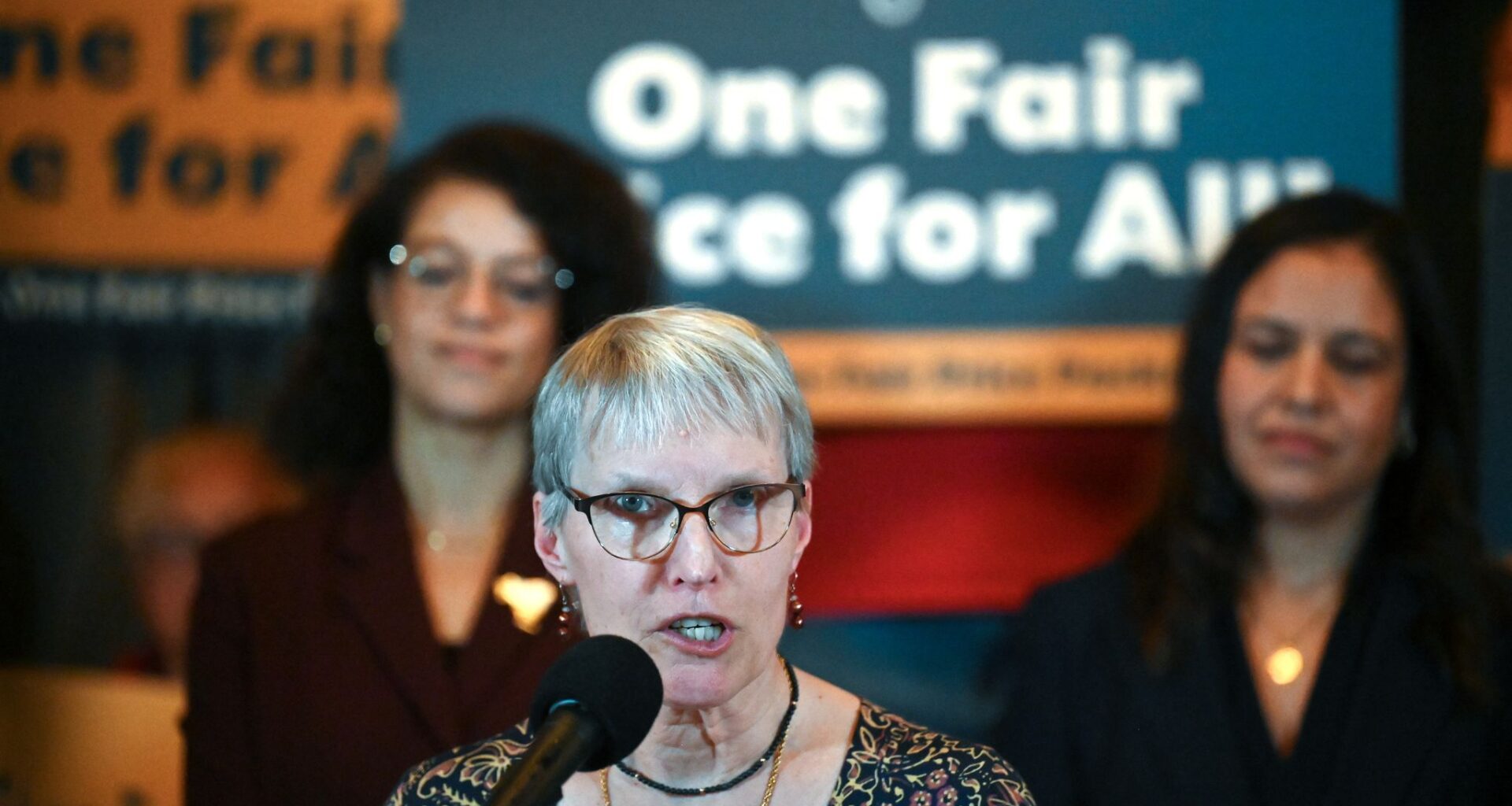
State Sen. Rachel May joined state Attorney General Letitia James at a news conference on the state’s efforts to curtail surveillance pricing retail tactics in March at the Capitol. The bill passed the Legislature overnight Thursday. (Will Waldron/Times Union)
Will Waldron/Times Union
ALBANY — Legislation that’s intended to protect consumers from unfair pricing tied to their personal data passed the state Legislature overnight Thursday, prompting outcry from some key stakeholders in the business and retail sectors who say the measures could eliminate discounts across a spectrum of goods and services.

Despite fierce backlash from a multitude of industries, New York is now in a position to become the third state to enact laws curbing personalized pricing practices. Maryland was the first state to pass that type of law, and Gov. Ned Lamont of Connecticut signed his state’s version of the legislation into law on Thursday.
Article continues below this ad
But not all governors have embraced the idea. On Wednesday, Colorado Gov. Jared Polis vetoed a “surveillance pricing” bill approved by his state legislature, saying he was “troubled by the bill’s approach to differentially lower pricing.” His veto message added: “In practice, this means that many Coloradans won’t get discounts on items they buy if I were to sign this. … I find little comfort in the state defining in statute legally acceptable consumer discounts.”
In New York, the legislation was ushered through the Senate and Assembly with a strong push from state Attorney General Letitia James, whose office had to assuage the concerns of some stakeholders, including a commission representing private colleges and universities that in the final days of the legislative session raised concerns that the proposed law could impact how scholarships, tuition assistance and financial products are offered.
But after an intervention by the attorney general’s office, the Commission on Independent Colleges & Universities in New York substituted its memorandum of opposition to the legislation with a “statement of concern,” noting that they support “protecting consumers from predatory and discriminatory surveillance pricing.”
Make the Times Union a Preferred Source on Google to see more of our journalism when you search.
Add Preferred Source
Lola W. Brabham, president of the commission, did not respond to a request for comment.
Article continues below this ad
Her statement of concern, which was among many being circulated to lawmakers at the Capitol this week, had noted “the broad language of the legislation raised concerns among our member institutions regarding whether institutional scholarships, grants, and financial aid programs could inadvertently fall within the bill’s scope.”
But she said that “it has been clarified that, under the General Business Law, these practices are not considered surveillance pricing, and that institutions of higher education are intended to fall within the bill’s existing exceptions.”
On Friday, the attorney general issued a statement saying the passage of the One Fair Price Act was “a big victory in our fight to ban surveillance pricing and help make life more affordable in New York.”
The New York Bankers Association was another organization that opposed the legislation. Banks use consumers’ personal financial data to evaluate someone’s credit standing, to verify identity and income and to detect fraud.
Article continues below this ad
In the memo outlining their concerns, the Bankers Association noted that the version of the bill that was approved in the Legislature had also removed an exemption for financial institutions, “and replaced it with a prohibition written in sweeping terms paired with single, narrow activity-based carve-out limited to creditworthiness evaluations using consumer reports under the Fair Credit Reporting Act.”
In short, they said, the exemption would leave the financial services sector “almost entirely exposed to poorly understood new standards.”
They said the legislation “would, without justification or apparent attention, make it harder for New Yorkers to obtain a mortgage, access affordable credit, and benefit from the fraud and safety protections that federal and state regulators require their banks to maintain.”
State Sen. Rachel May, a Syracuse Democrat who sponsored the surveillance pricing bill, said it will protect consumers from practices in which their purchasing history, online activity and other information can be used to set individual prices, sometimes resulting in higher costs for certain people.
Article continues below this ad
“New Yorkers shouldn’t have to wonder if the price they see is based on who they are instead of what they’re buying,” May said. “Companies are using personal data, like browsing history, device type, and even device battery level, to charge people different prices for the same product. That kind of surveillance pricing is unfair, and we can’t allow it.”
Melissa O’Connor, president and CEO of the Retail Association of New York State, joined the chorus of critics raising concerns about what the law may end up doing to consumers and businesses.
“New Yorkers in every corner of the state are concerned about affordability and our top priority during the debate on surveillance pricing was preserving access to popular discounts and loyalty programs,” O’Connor said in a statement. “The legislation, in fact, creates an incredibly confusing legal construct that specifies — and effectively limits — the ways in which retailers can lower prices for consumers.”
On Thursday, before the legislation was voted on, O’Connor had distributed an opposition memo signed by the Business Council of New York State, the National Retail Federation, Partnership for New York City and nearly two dozen other business, hotel and technology organizations.
Article continues below this ad
“We continue to argue with them that … nobody wants anybody to get higher prices, that’s for sure, that’s wrong,” said Paul Zuber, executive vice president of the Business Council of New York State. “But how are you going to tell the public, in this era of affordability, that, ‘Oh, by the way, you know that discount you used to get? We’re not giving it to you anymore. Why? Because we feel that it’s wrong that you’re getting it and not everybody.’”
Zuber said that retailers often provide discounts to consumers who are loyal customers, and many will no longer be allowed to do that.
“I don’t think anybody benefits from this,” Zuber added. “I believe the Legislature and attorney general were doing it with the right intentions, but we had simple fixes that would have continued that right intention without taking away discounts. They amended it, but it didn’t deal with everything that is problematic, and with everything that would be taken away.”
The Business Council has also taken the position that surveillance pricing shouldn’t be used to charge consumers higher prices, but they wanted to protect the ability of businesses to offer discounts using pricing technology.
Article continues below this ad
Supporters of the legislation, including the AARP, contend the measures will combat the misuse of algorithmic pricing, which can cause price increases on items based on a consumer’s personal preferences as well as demand. They say the proposed laws would also help prevent companies from taking advantage of personal data to charge higher prices on products customers are more apt to buy.
Last year, Gov. Kathy Hochul signed into law a measure that requires businesses to disclose the use of surveillance pricing.
State Assemblywoman Emérita Torres, a Bronx Democrat and the main sponsor of the One Fair Price Act in her chamber, joined the attorney general at a rally in New York City last month championing the legislation, which she said “takes a critical and necessary step toward protecting consumers from corporations that use personal data and opaque algorithms to charge people different prices for the same product.”
Article continues below this ad
“At a time when New York families are already struggling with the cost of living, we must ensure transparency and fairness in our digital marketplace,” Torres said.