
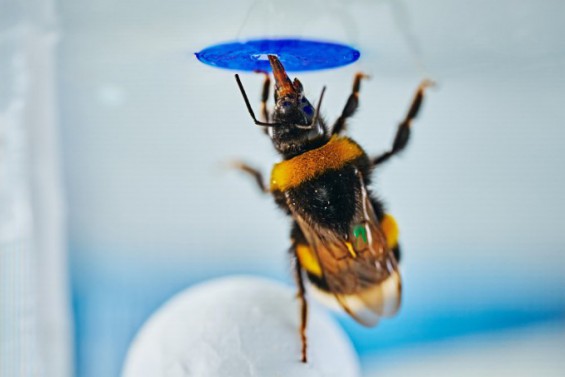
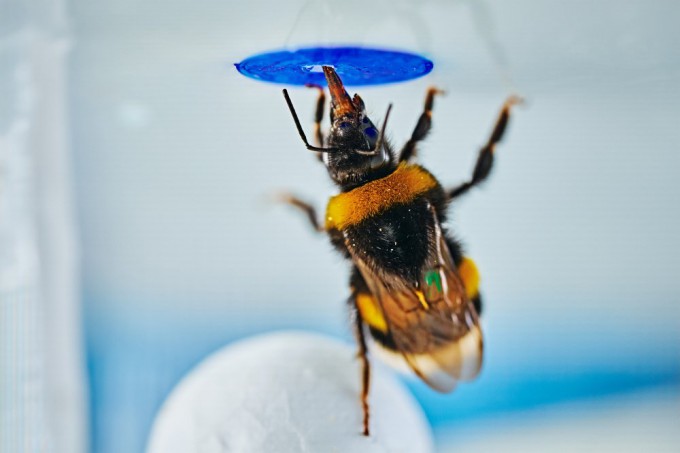
As new studies reveal bees’ problem-solving abilities and their skill in creating finely tuned environments, the idea that complex social behavior and cognitive capacity are confined to vertebrates is gaining fresh support. Image credit: Mikko Tormanen.
New research is steadily showing that bees possess far more advanced social behavior and cognitive abilities than previously expected. Honeybees build a specialized queen cell that provides a distinct environment from ordinary worker cells to raise a queen. Bumblebees have demonstrated the ability to solve entirely new problems on their own. These findings confirm that insects with small brains can perform sophisticated behaviors and make complex decisions.
Queen cells specially engineered by honeybees
A joint team from Auburn University in the United States and the Chinese Academy of Agricultural Sciences has reported in the journal ‘Nature’ on the 3rd (local time) that the honeybee queen cell is not just a simple breeding space, but a specialized microenvironment designed for queen development.
Until now, it was generally thought that whether a larva developed into a queen depended on the amount of royal jelly it consumed. Royal jelly is a substance secreted by young worker bees and provided as food for larvae. Larvae destined to become queens receive more royal jelly than ordinary larvae.
The research team found that the peanut-shaped queen cell itself, where queen larvae grow, also plays an important role in queen development. Electron microscopy analysis showed that the wax of queen cells had a looser, more flexible structure and a higher melting point than the wax of worker cells. Its chemical composition was also different. Twenty volatile compounds were identified that appeared only in queen cells.
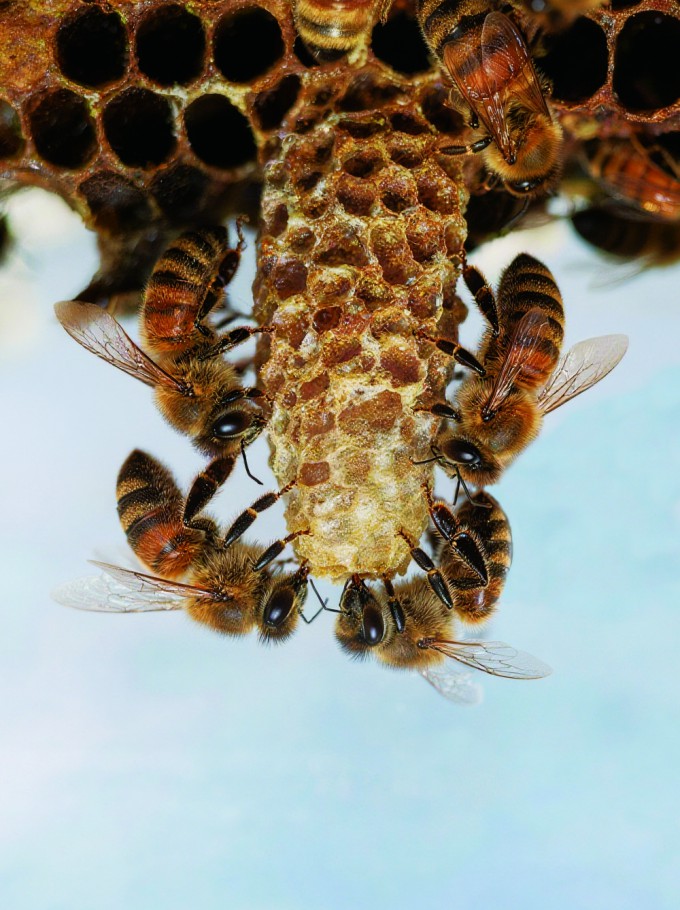
Honeybees were found to construct a specialized environment distinct from ordinary worker cells in order to raise a queen. The worker bees assigned to build queen cells also showed distinct characteristics. Image credit: Yu Fang, Chinese Academy of Agricultural Sciences.
The researchers conducted an experiment in which 172 queen larvae were reared for seven days in environments made of either queen-cell wax or worker-cell wax. Larvae kept in worker-cell wax showed a higher mortality rate and grew into smaller individuals. The team explained that this demonstrated how the unique biochemical composition of queen cells is essential for queen development.
Worker bees involved in constructing queen cells also differed from ordinary workers. They were relatively younger individuals, had higher thoracic body temperatures, and showed increased expression of genes related to wax synthesis and unsaturated fatty acid production. According to the team, this indicates that the structural differences in queen cells are not simply natural variations, but a developmental environment actively created by worker bees.
Solving new problems without training
Fresh findings on bee cognition have also been reported. A team at the University of Oulu in Finland has shown that bumblebees (often referred to as ‘bumblebees’) can solve new problems on their own without being taught a specific solution. The results were published in the journal ‘Science’ on the 4th.
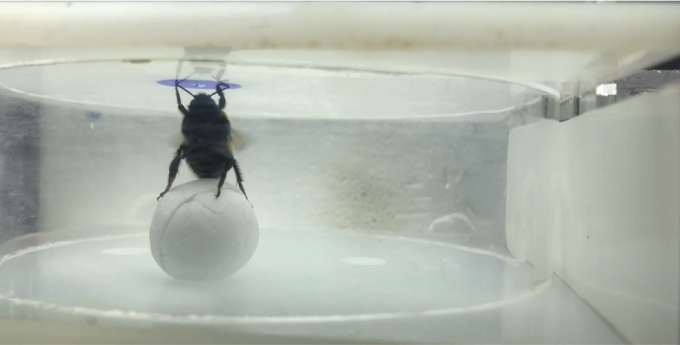
After learning that they could roll a ball and that there was a flower on the ceiling, the bees rolled the ball by themselves, climbed onto it, and drank the sugar solution from the flower. Still image captured from the experiment video. Image credit: Olli Loukola, University of Oulu.
The researchers set up an artificial flower on the ceiling of a transparent box and placed a Styrofoam ball on the floor. To reach the sugar solution in the artificial flower, the bee had to roll the ball across the floor to a position directly beneath the flower and then climb on top of it. The bees were trained only on the facts that the artificial flower contained sugar solution and that the ball was an object that could move. They were not taught that rolling the ball was the way to reach the flower.
In the experiment, bees that had learned about both the flower and the ball in advance showed a relatively higher success rate in rolling the ball to the appropriate position and reaching the flower, compared with bees that had learned only one of these pieces of information or had not been trained at all.
The team then ran additional experiments to test whether the bees could remember the target location and act accordingly even when the flower was not visible. After first showing the bees where the flower was, the researchers blocked it from view with a partition, yet the bees still moved the ball in the correct direction. The team interpreted this as evidence that bees engage in goal-directed problem-solving behavior without relying solely on visual cues.
Spontaneous problem-solving abilities have long been regarded as a capacity limited to vertebrates such as primates and birds. These new studies are being seen as evidence that bees do not simply act on basic instinct, but are animals with sophisticated social behaviors and advanced cognitive abilities.
doi.org/10.1038/s41586-026-10534-3
doi.org/10.1126/science.ady1618
Even when the flower is hidden behind a partition, the bees can still roll the ball in the correct direction and reach the flower. Image credit: Olli Loukola, University of Oulu.
Copyright ⓒ DongA Science. All rights reserved.