
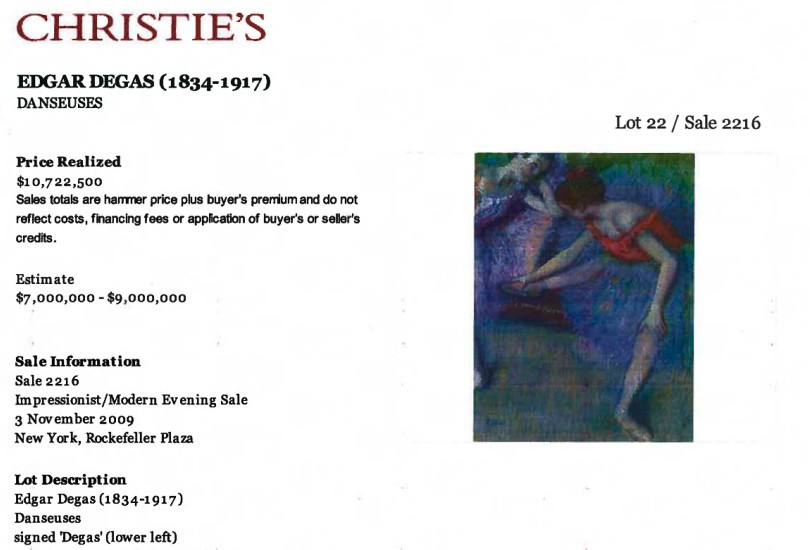
A Manhattan appellate court changed course on a lawsuit by a family who says that Christie’s auction house sold a Nazi-looted Edgar Degas painting without consulting or benefiting the living heirs of the victim.
The descendants of holocaust survivor Margaret Kainer brought the case in 2013, only to hit a roadblock for more than nine years as New York’s court system waited for the Swiss court system to reach a decision on whether they are legitimate heirs.
The appellate court ruled on June 4 that the long-dormant case “seeking justice for a plunder that occurred in the ‘unique and horrific circumstances of World War II and the Holocaust’ should move forward.”
Manhattan Supreme Court originally issued a pause on the case in 2017, and New York’s Appellate Division, First Department, and the Court of Appeals upheld that decision in 2019 and 2021, respectively. The Manhattan-based appellate court reconsidered that decision after the heirs renewed the claim last year, ruling that any further delay threatens their ability to ever get justice or piece together historical facts.
“We do not want the responsibility of prosecuting this action to fall to the next generation of Margaret’s heirs,” wrote Associate Justice John Higgitt in a unanimous decision by the appellate court.
Notably, the court emphasized in the decision that the question over whether the plaintiffs are in fact the lawful heirs to Kainer’s art collection remains open,” but that the case should proceed into discovery so that the parties can seek to shed some light on that issue. In the initial complaint, the heirs wrote that they had formally applied to the Manhattan Surrogate’s Court to represent the estate.
In their complaint, the heirs claimed that the Swiss bank UBS falsely took control over a foundation in charge of overseeing Margarte Kainer’s assets — including the painting in question — after she died without children in France in 1968. The foundation allegedly told European authorities that Kainer had no heirs and claimed ownership of the painting by virtue of a 1972 “certificate of partial inheritance” issued by German authorities, according to the court papers.
The sale of the pastel artwork “Danseuses” by the French Impressionist painter took place in 2009, after the foundation struck a deal with Christie’s in exchange for a portion of the sale proceeds.
Christie’s sold the piece first to a private buyer and then arranged an auction a few days later, where it went for $10.7 million.
The heirs originally sought to recover the assets they claimed were “looted” by UBS and Christie’s as part of the deal. The Supreme Court’s 2017 decision dismissed the claims against UBS and the foundation, arguing that New York was not the proper venue to pursue litigation against these foreign entities, but only paused the case against Christie’s while the international litigation continued.
“The plaintiffs argue the settlement agreement did not include the correct heirs—a question that is the subject of a foreign court proceeding to which Christie’s is not a party,” wrote a spokesperson for Christie’s in response to the court decision. “As here, Christie’s Restitution team remains deeply committed to resolving provenance issues before offering objects for sale through fair and just resolutions.”
Nine and a half years later, nothing is close to being resolved in the Swiss case, according to the court papers.
Justice John Higgitt wrote that the heirs will need to seek discovery in their claims against Christie’s around the 2009 sale of the painting, and further delays could risk making it “more difficult if not impossible” for the heirs to reconstruct the facts necessary to prove their case.
He also wrote that with respect to Nazi-looted art, state and federal policy dictate that cases be resolved expeditiously.
“We simply conclude that at this point in time, the interests of justice are best served by vacating the stay,” Higgitt wrote.