
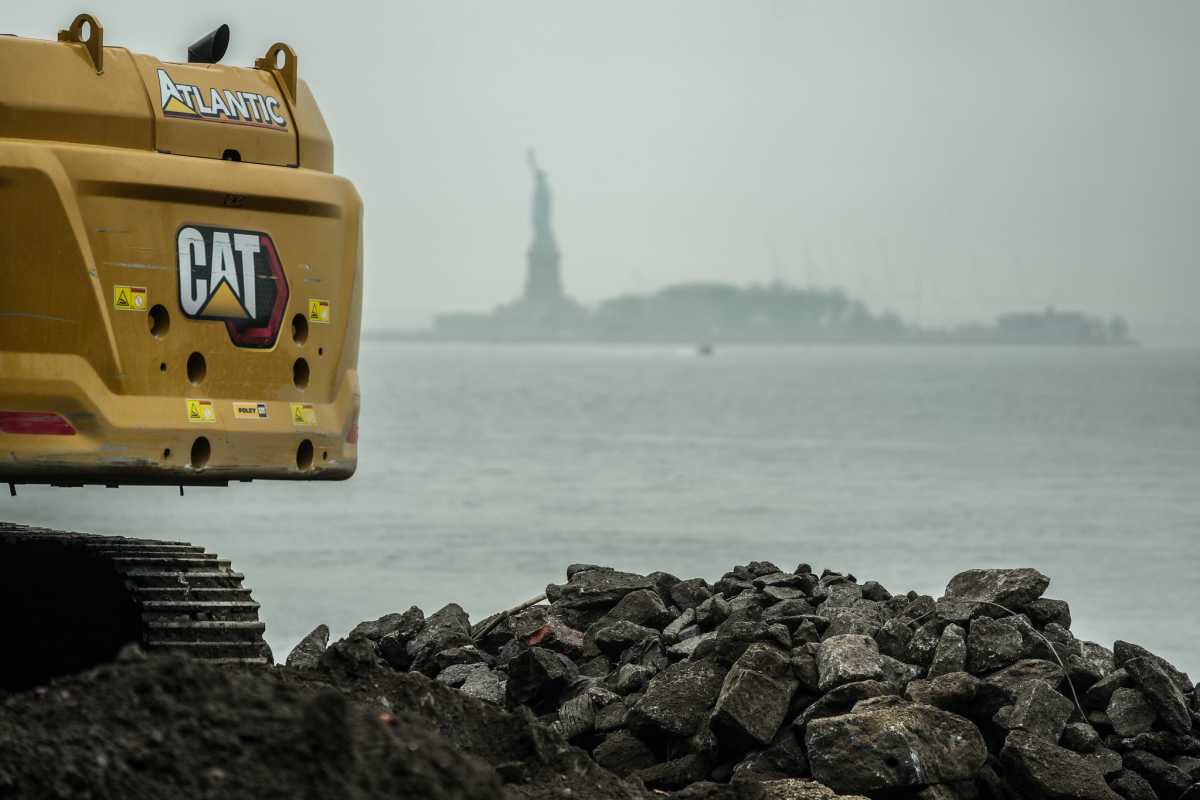
NYC finally completed the first phase of a 2024 climate resilience project that raised the waterfront in Battery Park to protect it from sea level rise, Mayor Zohran Mamdani announced on Monday.
Phase one of the Battery Coastal Resilience project rebuilds and elevates a portion of the wharf promenade in The Battery, helping protect one of New York City’s most iconic public parks from projected sea-level rise through 2100, officials said.
Former Mayor Eric Adams announced the groundbreaking of the $200 million component of the overall Lower Manhattan Coastal Resilience (LMCR) strategy in May 2024. The completed phase, announced on June 8, 2026, along with the broader LMCR plan, will protect thousands of residents, jobs and businesses, Mamdani said.
“The Battery is one of the most treasured public spaces in New York City, but it is also on the front lines of the climate crisis,” Mamdani said. “We cannot treat climate resilience as something we can put off until tomorrow.”
Led by the NYC Economic Development Corporation (NYCEDC), the NYC Department of Parks and Recreation (NYC Parks) and the Mayor’s Office of Climate & Environmental Justice, the project is “a reminder that protecting New Yorkers requires action today,” Mamdani said.
“With phase one now complete, we are taking a major step toward safeguarding Lower Manhattan’s residents, workers, small businesses and public spaces from rising seas and stronger storms,” the mayor added.
The completion of phase one comes just in time for a busy season of events for Battery Park City, including the ever-popular Swedish Midsummer Festival on June 20 and River & Blues, an outdoor summer concert series in July.
The Battery is also home to a rich biodiversity, as it is prominently located in New York Harbor.
“The Battery sits at one of New York’s most symbolic and heavily visited waterfronts,” Paula Recart, president of The Battery Conservancy, said. “This project strengthens the park’s ability to withstand future climate impacts while preserving what matters most: access to the harbor, extraordinary public space, biodiversity and connection to the city and to one another.”
Officials explained that the project is a double win, not only for protecting the waterfront, which was damaged during Hurricane Sandy in 2012, but also for how the work was completed. By using low-carbon and reclaimed materials, like granite, wood, and bronze, and transporting supplies by barge instead of truck, the Battery Coastal Resilience project cuts embodied carbon by more than 50%, eliminates over 2,000 truck trips, and reduces transportation emissions by more than 90%, a city press release stated.
“By rebuilding and elevating this historic waterfront, we are strengthening critical infrastructure, improving public access to the shoreline and ensuring that The Battery can continue serving New Yorkers and visitors well into the future,” NYC Parks Commissioner Tricia Shimamura said.
Jeanny Pak, interim president and CEO of the NYCEDC, said the agency is looking forward to “continuing this all-important work as additional climate resilience projects advance and come online after years of planning, design, and construction.”
The second and final phase of the project is expected to be completed in 2027 and will reconstruct and elevate the remaining portion of the wharf, officials said.