
Two of New York City’s top fiscal watchdogs are set to warn the City Council Tuesday that Mayor Zohran Mamdani’s first budget relies so heavily on one-time measures and accounting maneuvers that the city’s structural deficit is only getting worse — even as the Council’s own economists project nearly $2 billion more in tax revenue than the mayor’s office.
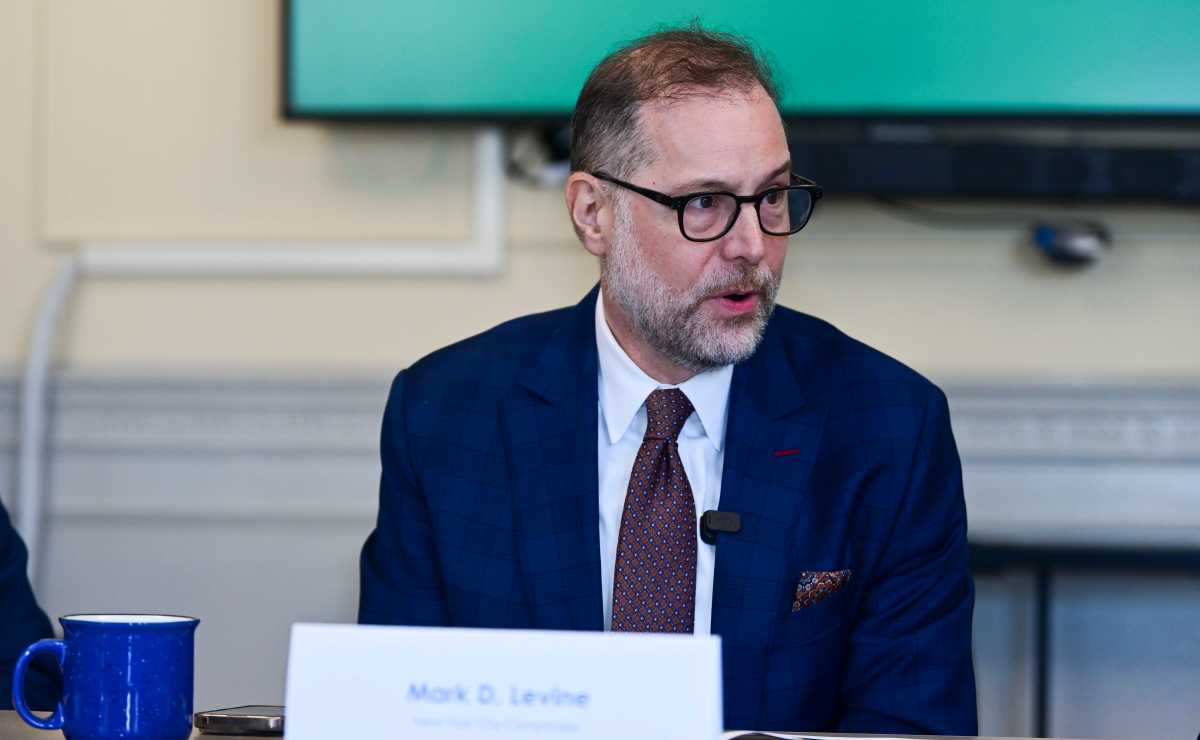
City Comptroller Mark Levine is scheduled to testify before the Council Finance Committee that the city faces an $8.8 billion budget gap in fiscal year 2028, exceeding the $7.1 billion shortfall projected in the mayor’s own executive budget.
The Citizens Budget Commission, an independent fiscal watchdog releasing its own report Tuesday, projects the gap grows to $9.8 billion by fiscal year 2030 — before accounting for the full cost of upcoming labor contracts or new programs Mamdani campaigned on.
“When we plug in our tax forecast and our estimates of underbudgeted costs and unmet program needs, including overtime and childcare vouchers, the FY 2028 gap widens to a daunting $8.8 billion,” Levine says in prepared remarks provided to amNewYork ahead of the hearing. “We will face that gap without the option of the many one-shot measures that we used up this year.”
Mamdani budget full of ‘gimmicks,’ fiscal hawks warn
The CBC finds that 61% of the budget’s $12.7 billion in gap-closing actions “do nothing to stabilize the budget long term,” with $5 billion in one-time measures and $2.8 billion in delays and stretch-outs. Only 39% of actions yield recurring savings.
The report singles out the pension re-amortization as “a gimmick that delays payment of actuarially calculated pension obligations.”
The maneuver reduces city contributions by $10.7 billion through fiscal year 2032 but requires $15.6 billion in higher contributions from 2033 through 2037. “Simply put,” the report states, “the City will spend more later.”
The budget also draws down prepayment of future expenses by 72% year over year — the largest single-year decline since the aftermath of the Sept. 11, 2001, terrorist attacks, according to Levine — and leaves the General Reserve at its statutory minimum of $100 million, giving the city “virtually no budget cushion to deal with a revenue shortfall or unanticipated costs,” according to the CBC.
Levine notes the city is spending $4.4 billion more than it is bringing in this fiscal year.
The class-size reduction mandate, meanwhile, was delayed by 2 years but not eliminated. The CBC notes the city will still ultimately be required to spend more than $1.4 billion annually to comply — a cost that has been deferred, not erased.
The Mamdani administration pushed back on the pension characterization. Mayor Mamdani, speaking at his budget presentation last month, defended the move as fiscally prudent. “It is fiscally prudent to have predictable payments,” Mamdani said. “What we are proposing is extending that cycle by five years, and that is an extension that would ensure that we would pay the same amount every single year as opposed to what is currently a variable amount increasing year after year.”
The mayor added that the city’s pension systems are currently funded at 86% across all five systems. “There is not a question of if we will get to 100. It is simply when,” he said.
City officials also pointed to an independent analysis describing the prior pension payment schedule as “not reasonable fiscal policymaking” and “poorly designed,” and noted that Council Speaker Menin proposed a similar pension schedule adjustment in her own preliminary budget response in April. The restructuring, city officials emphasized, has no impact on retirees’ benefits or current employees’ future benefits.
Contradiction in city economy
The watchdogs’ warnings come amid a city economy sending contradictory signals. Wall Street profits in calendar 2026 are projected at $54 billion, well below last year’s record $65 billion but still strong by historical standards, Levine says in his prepared remarks, and tax collections through April are running 6.5% above last year.
But gas prices are up 34%, food up 5% and electricity up 12%, driving citywide inflation to 4.6% in April — the highest in three years.
The private sector shed roughly 6,000 jobs so far in 2026, and real wages declined for two-thirds of private-sector workers, even as workers in the highest-paying industries saw wages grow 5.7%.
Levine also warns of longer-term risks the budget does not address, including the potential impact of artificial intelligence on the city’s economy. A recent analysis from his office found that an AI-driven labor dislocation or the collapse of an AI investment bubble could reduce revenues relative to baseline by between $9 billion and $14 billion over the financial plan period, according to Levine.
Both the comptroller and the CBC credit Mamdani for eliminating a proposed property tax increase and correcting years of underbudgeting.
The CBC acknowledges the mayor “reversed underbudgeting that had grown to nearly $8 billion annually” and presented “a significantly more realistic picture of the City’s expenses — a welcome change from the prior administration’s obfuscation.” The largest areas corrected include $1.6 billion for city-funded housing vouchers, $989 million for homeless shelters, and $550 million for special education due process cases.
The budget also includes $3.5 billion in new spending, with $1.3 billion directed toward Mamdani administration priorities, including housing and homeless services, childcare, immigration and legal services, and worker protection programs. A significant portion of the gap-closing plan was also aided by $2.4 billion in state funding, including restored support for juvenile justice programs, public health reimbursements, and September 11th line-of-duty benefits.
The CBC finds that the mayor’s signature savings initiative, Executive Order 12, has fallen short of its ambitions. The order directed agency chief savings officers to identify recurring reductions through delivering services more efficiently, consolidating programs, insourcing functions performed by outside vendors, and eliminating or sunsetting programs.
Despite that guidance, only 26% of EO12 savings represent true efficiency gains, the report finds. The vacancy-elimination program cut 2,268 positions but was more than offset by 3,137 new positions added elsewhere, yielding a net headcount increase of 869 jobs. The commission concludes that “realism and this limited level of savings alone will not create fiscal sustainability.”
The City Council’s Finance Division is separately releasing its own June economic and tax revenue forecast on Tuesday, projecting $451 million more than the mayor’s office in fiscal year 2026 and $1.5 billion more in fiscal year 2027, driven by stronger-than-expected personal income and business tax collections, with an additional one-time boost expected from FIFA World Cup sales and hotel tax revenue in fiscal year 2027.
The Council projects average annual tax revenue growth of 4.3 percent through fiscal year 2030, above OMB’s projections, and notes its forecasts have historically come closest to actual collections among the city’s major fiscal monitors.
“This updated forecast confirms the overall resilience of the city’s economy and provides an opportunity to more fully fund priorities that address the affordability crisis, improve quality of life, and support working families,” Council Speaker Julie Menin said. “We can invest in New Yorkers today while planning responsibly for tomorrow.”
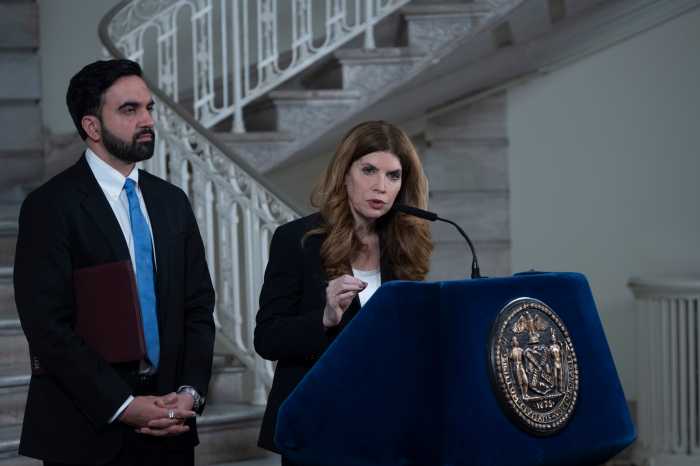 FILE: Council Speaker Julie Menin and Mayor Zohran Mamdani. Menin said Tuesday’s updated Council forecast confirms “the overall resilience of the city’s economy” and creates an opportunity to fund priorities for New YorkersPhoto by Lloyd Mitchell
Both watchdogs flag the city’s reserve levels as inadequate regardless of the revenue outlook. The Rainy Day Fund stands at $2 billion — far short of what the CBC estimates would be needed to weather a typical recession, which could produce a $15 billion revenue shortfall over two years.
Among the ten largest U.S. cities, New York ranks ninth in reserves relative to annual revenue, ahead of only Chicago, according to Levine. Credit rating agencies Moody’s, Fitch and Kroll have all shifted the city’s credit outlook from stable to negative, a risk Levine says is compounded by “the structural gap, the low level of reserves, and the repeated reliance on one-shot measures.”
To address the imbalance, Levine plans to propose a charter amendment establishing formal rules for the Rainy Day Fund, including a target balance of 16 percent of tax revenues, a 10 percent floor, a deposit formula triggered when revenues exceed trend and narrow criteria for withdrawals.
Under his proposed formula, the city would be adding $854 million to the fund this year rather than leaving it flat, Levine says. The CBC is urging the city to double Executive Order 12 savings to $2 billion in fiscal year 2027 and increase them by $1 billion annually thereafter — pushing agencies to consolidate programs, improve efficiency and eliminate ineffective services — while also raising the General Reserve to $500 million to protect against unexpected costs or revenue shortfalls.
A City Hall spokesperson said Mamdani “inherited a historic fiscal deficit — brought about by irresponsible under-budgeting and chronic mismanagement by the last administration,” and that through savings, state partnership and new taxes on the wealthy, the mayor “closed the budget gap and put forth a balanced executive budget proposal that makes historic investments in New York City’s working people.”
The city council and mayor must adopt a final budget by June 30.