
Dreamshook
Irish Pavilion
May 9–November 22, 2026
Venice Biennale 2026
“We know by what we share in, not just by what we analyse,” reads the lower right of On Imagination (with Petrarchinos) (all works 2026), a drawing on view as part of Isabel Nolan’s Dreamshook, representing Ireland in this year’s Venice Biennale. The evolution of imagination into idea and representation into reality is a longtime theme of the Dublin-based Nolan, whose work spans tapestries, painting, photography, sculpture, installation, and, incessantly, drawing. Dreamshook includes fourteen sculptures, drawings, and tufted tapestries, all of which poetically explore the life and work of the Venetian printer and publisher Aldo Manuzio (ca. 1450–1515) in a distillation of how knowledge is a process of shared experience when an individual’s dream becomes a communal reality.
Nolan, born in 1974, grew up in an Ireland in transition from a country isolated at Europe’s edge to a global nexus during the Celtic Tiger’s 1990s rise. As a child, Nolan always drew with graphite or colored pencils, and eventually studied at the National College of Art & Design. Seeing the Irish time-based installation artist James Coleman (b. 1941) introduced the idea that artists were living and not just historical. Perhaps Nolan’s sense and interest in time—often implied in her work through repeated motifs such as suns or sunsets—could owe to Coleman, but certainly her ambitious scale and sense of material relationship found examples in Irish women artists working in sculpture and installation in the 1980s and 1990s, such as Alice Maher (b. 1956), whose narrative textiles and figurative sculpture are included in In Minor Keys. Unlike Coleman or Maher, however, Nolan is less specific in her references and more sharply absurd in her abstraction, as if channeling the modernist writers the island is so known for.
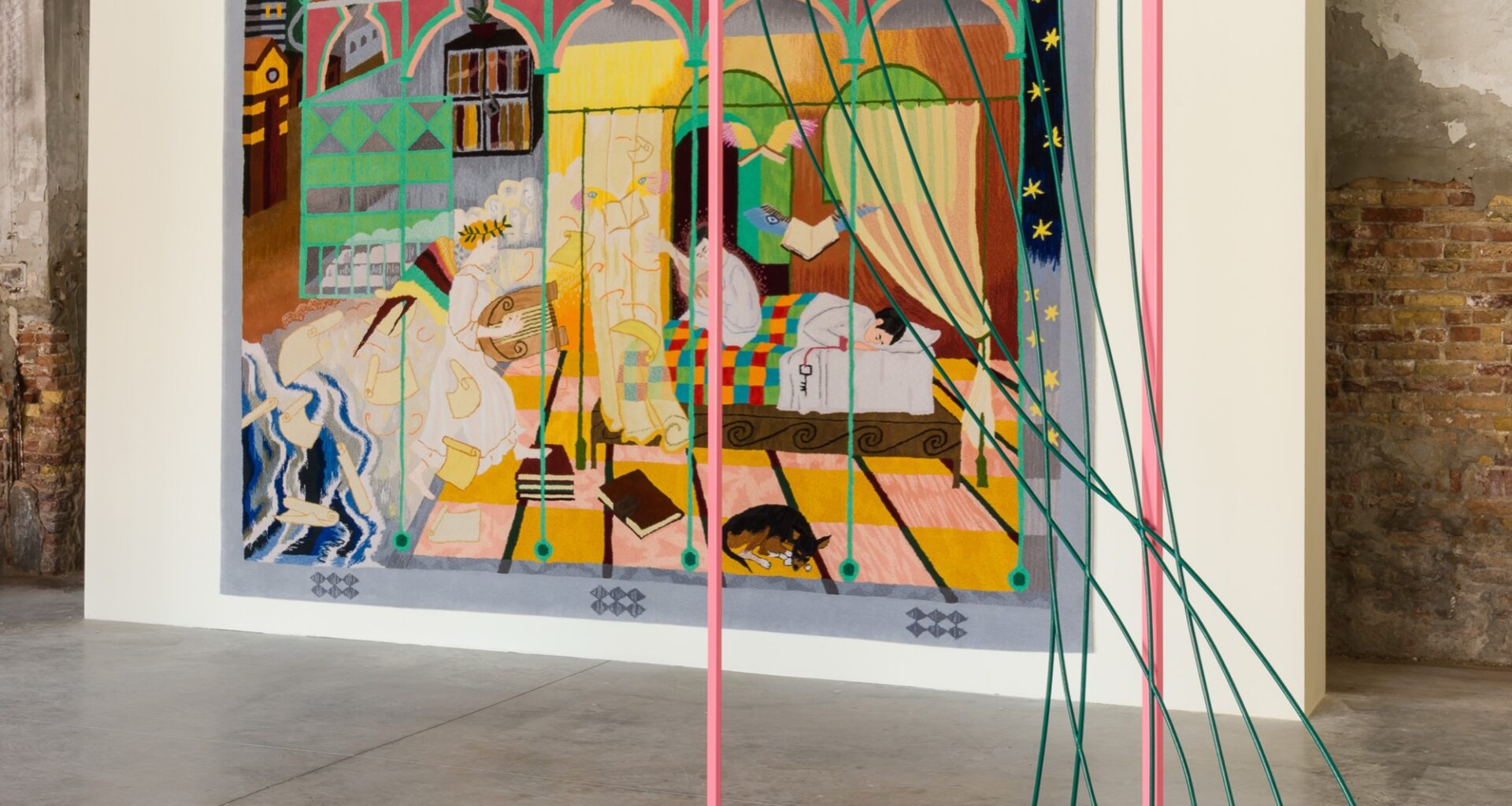
For instance, in Dreamshook’s arched centerpiece, the vibrantly colored, hand-tufted Aldus Dreams of a Plentiful Supply of Good Books tells the story, in one compact tableau, of Manuzio’s efforts to clarify the written word (he is credited with introducing the semicolon and italics, as well as innovating portable, pocket-sized books). In it, Manuzio figures as both asleep under a checked duvet—a church key dangling from his wrist on a red string—and awake and reading at the bed’s edge. A swirl of open books is at his fingertips, but behind a translucent yellow curtain, while a winged, harp-playing angel steps on a pile of books on the left. This scene takes place in a Venetian dwelling presided over by a bucolic farmhouse under a starry night. The composition, with its juxtaposition of fantasy and history in a palette of 1950s Technicolor, is more cartoon than history or altar painting. Nolan’s figuration here feels innocent and guileless, akin to a child’s illustration of a legend, and the shaggy surface of the weave implies an animated, fictive quality, as if the composition could completely change if a hand ran over the wool that composes it. This central tapestry is flanked by Hilma af Klint-reminiscent The Dreams of Reason Produce Monsters (the Seraphim of the Canon) and the Boschian Make Haste Slowly. While both are figurative, including references to books, the sun, trees, and water, they are more lyrical than the centerpiece, meditating on the power of reading and knowledge (Enlightenment) and its perils (colonialism and its attendant evils).