
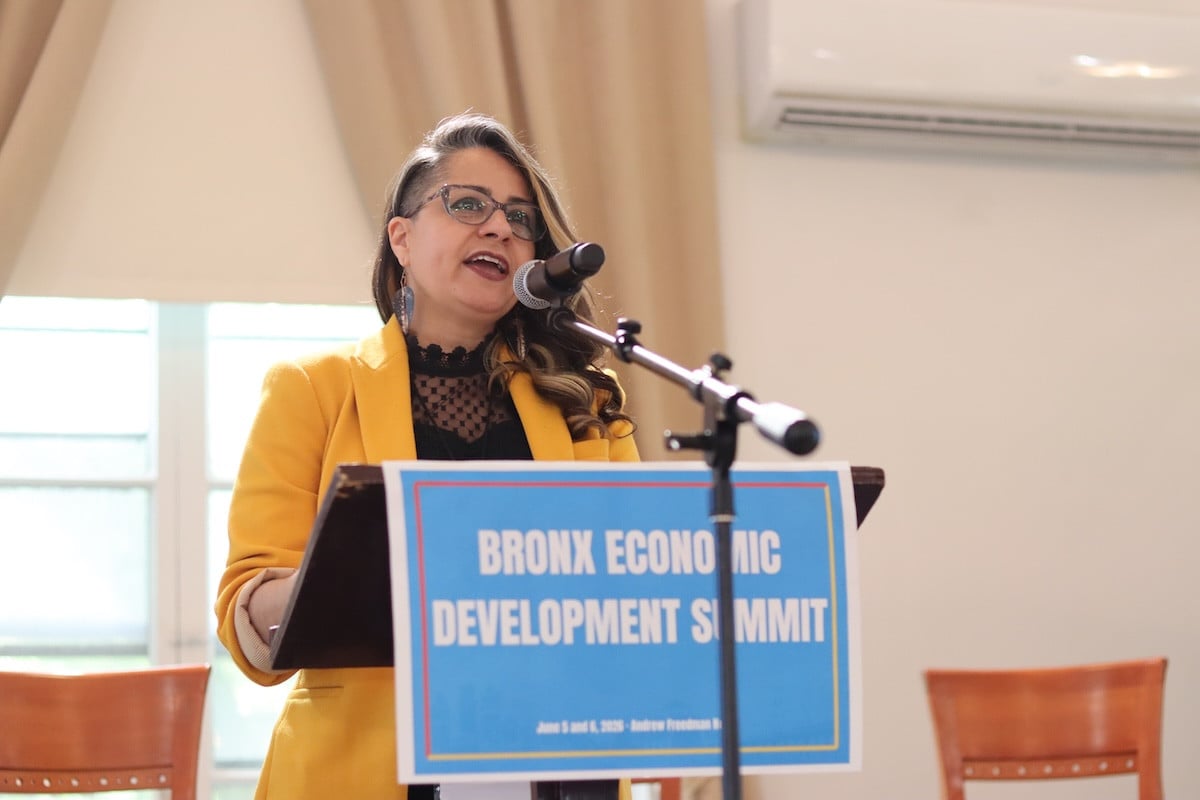
At the first Bronx Economic Development Summit, organizers make the case that community control isn’t fringe – it’s the future of urban economic development.
The Bronx gave the world salsa. It gave the world hip-hop. Now the Bronx is staking its claim as the birthplace of a new economic development paradigm.
It’s a paradigm rooted in decades of organizing around projects like the Kingsbridge Armory and the former Lincoln Recovery Center, both of which will soon be transformed under hard-fought community ownership. It builds on what Bronx residents love about their borough — parks, culture, food — more often seen in headlines as the city’s poorest or sickest. It brings a renewed emphasis on local — in terms of ownership, hiring, and even financing.
Last weekend at the Andrew Freedman Home, steps from Yankee Stadium in the South Bronx, leaders from around the borough convened with counterparts from around the country to discuss that paradigm at the inaugural Bronx Economic Development Summit.
The gathering was part of a process to draft the Bronx’s first-ever Comprehensive Economic Development Strategy, or CEDS. Once finalized, the document will be submitted for acceptance to the U.S. Department of Commerce’s Economic Development Administration in order to unlock new federal funding streams.
CEDS drafting processes are usually led by local governments, economic development authorities, chambers of commerce and other more traditional economic development bodies — entities who often find themselves at odds with grassroots groups like the 5,000-member Our Bronx, who is co-leading the Bronx CEDS process along with the Bronx Economic Development Corporation.
The event’s organizers have come to see the CEDS as a way to bring broader legitimacy and hopefully some new funding sources in support of the economic development vision they’ve been shepherding for decades.
“One of the biggest challenges in this work is what can feel like at times, a divide between community-centered priorities and traditional economic development practice,” said Sandra Lobo, executive director at Our Bronx. “For many residents, the economy is rent, bills, job quality, safety, health, all the things that determine whether life is stable and affordable. For many professionals, the economy is growth, investment, development indicators. Our work…is to connect those realities into one cohesive set of strategies.”
The new Bronx CEDS appears to have buy-in from its local government, too. Bronx Borough President Vanessa Gibson provided welcoming remarks to open the proceedings. Mayor Zohran Mamdani showed up along with a bevy of local officials on the summit’s second day to pledge support for the plan and its priorities. Mamdani cited Our Bronx’s role in the Kingsbridge Armory redevelopment as “a model for how to keep the people of the Bronx in the driver’s seat.”
Working toward EDA funding
With the passage of the 1965 Public Works and Economic Development Act, Congress created the Economic Development Administration as a successor to the earlier Area Redevelopment Administration. Initially, the new agency focused on three types of regions: industrial areas that were behind in the adoption of new technology, degraded agricultural areas, and depleted mining areas.
The EDA started making grants, largely to local governments or their economic development arms, to support economic development planning as well as infrastructure to support new industry. Everything from new roads to expanding water and sewer systems, fiber-optic cable for broadband, harbor or port expansions, even business incubator facilities.
The EDA also makes grants for local governments to create revolving loan funds that provide access to capital for small businesses. According to the Urban Institute, the EDA makes an average of six revolving loan fund awards annually, with award amounts generally ranging from $800,000 to $1.4 million. There are currently more than 500 EDA-funded revolving loan funds across the country, holding more than $1.5 billion in assets.
The total amount of EDA funding has varied wildly since the agency’s inception. Over its first decade, it mostly hovered around $2 billion, peaking at more than $4 billion in 1976. From 1982 to 2019, its funding never cracked $1 billion.
Comprehensive regional economic plans have been a standard prerequisite for EDA funding from the agency’s very beginnings. In 1969, the EDA created its Economic Development Districts program to bring local governments together, sometimes across state lines, into regional planning bodies that made sense from an economic development perspective. There are over 400 designated districts across the country, including many across New York state, each with its own CEDS.
Just north of New York City, the Hudson Valley Regional Council manages an EDA Economic Development District covering seven counties. Next door in Connecticut, the Western Connecticut Council of Governments manages the Western Connecticut Economic Development District. New York City itself is not currently part of an EDA Economic Development District.
In some cases, CEDS get submitted to EDA for the purpose of opening the door to the agency’s other programs without the need for an Economic Development District designation when there aren’t multiple local governments to coordinate between. Brooklyn has submitted a CEDS to EDA going as far back as 1984 and as recently as 2017. Staten Island also submitted a CEDS to EDA back in 2005 and as recently as 2020. (In NYC, each of the five boroughs is its own county, which the EDA recognizes as a local jurisdiction for CEDS purposes.)
Over recent years, the EDA has provided $1.3 million for a small business recovery program in Brooklyn, $1.1 million to build out space in a city-owned building in Brooklyn for two biotech companies working on products related to Covid-19 treatment, and $2.4 million for a revolving loan fund managed by a Brooklyn-based nonprofit supporting small businesses in Brooklyn, Queens, Manhattan, the Bronx, the Hudson Valley and New Jersey.
In the wake of Covid-19, the Bronx Economic Development Corporation, a nonprofit not affiliated with local government, sought EDA funding to help recover from the pandemic’s lingering economic impacts as well as dealing with the instability of other federal funding streams for community development. But EDA officials explained they couldn’t access it without first submitting a CEDS.
That’s when the nonprofit turned to Our Bronx, a grassroots organization which had already spent years laying the groundwork for the community engagement plan that the CEDS process required.
A comprehensive plan for the Bronx
Back in 2019, the Northwest Bronx Community and Clergy Coalition — today known as Our Bronx — helped form the Bronx-wide Coalition, a group of community, faith, and labor organizations from across the Bronx. Over the next four years, the coalition led a series of conversations with Bronx residents and business owners across the borough to generate ideas and priorities for community and economic development.
The result was the Bronx-Wide Plan, a first-of-its-kind comprehensive planning document for the Bronx.
Though the Bronx has a population of 1.4 million, there had been no official or unofficial comprehensive plan for the borough — nor is there for any of New York City’s other five boroughs, nor the city as a whole. New York is unusual in this regard; most states require local governments within their jurisdictions to have a periodically updated comprehensive or general plan as a guide for long-term infrastructure, housing and economic development. Cities of comparable population to the Bronx alone — including Philadelphia, San Antonio, Dallas, Phoenix, and San Diego — all have comprehensive or general plans.
The coalition’s idea was for the Bronx-Wide Plan to influence spending and investment priorities at every level of government and the private sector. Budget bills at all levels of government would start supporting projects cited in the plan. Banks of all sizes would start funding some of the plan’s sundry proposals or initiatives, demonstrating their compliance with the Community Reinvestment Act. Philanthropic foundations of all sizes will begin making grants and other investments directly in alignment with the plan, and they won’t be shy about seeking credit for doing so.
Some of the projects outlined in the Bronx-Wide Plan are now a reality, or on the way. There’s a new credit union branch in the South Bronx, operated by the Lower East Side People’s Federal Credit Union. The long-vacant Kingsbridge Armory has a new redevelopment plan approved by City Council that includes a historic community-ownership component as well as space for Our Bronx to incubate worker-owned cooperatives.
When the Bronx Economic Development Corporation turned to Our Bronx about forming a partnership in 2025, it all made perfect sense as a way to broaden the conversation and add legitimacy as a result of all the ideas they’d spent years hashing out gaining federal certification as a CEDS.
“We already had the civic infrastructure across all those sectors,” Lobo tells Next City. “I think people were excited about what it meant to expand the work that they were doing. The Bronx-Wide Coalition already had faith, community, and labor at the table, and now we had anchor institutions, we had educational institutions, finance. We had banks coming in and wanting to learn more and understand how they could partner.”
The new best practices
If last week’s summit was your introduction to economic development, you would be forgiven for thinking community control of land or worker-ownership of businesses were mainstream economic development across the country.
The conveners invited speakers from Boston, Philadelphia, Chicago, St. Louis, and even as far as Oakland, California, to share their stories and exchange notes about the work they are doing in their communities. The parallels were endless; the conveners’ intent was to take a page out of the conventional advocacy playbook by showing that the community-controlled or worker-ownership approaches they’re championing in their CEDS also have champions elsewhere.
“We wanted to make sure that folks understood we weren’t inventing something, that we actually had really incredible models that were successful at scale in all different kinds of places across the country,” Lobo says.
“They are not fringe strategies. They’re actually sound, financially sustainable, and really important strategies to affordability and stability in the long run.”
In an opening keynote, Nneka Onwuzurike spoke about her time working at the City of Chicago, where she started out working for its Office of Equity & Racial Justice and eventually ended up as first deputy mayor for business and neighborhood development. During her tenure, Chicago made a $15 million commitment to “community wealth building,” providing grants to an array of community-controlled real estate projects, housing cooperatives, and worker-owned cooperatives.
To keep that work moving forward, Onwuzurike told attendees, the most important thing isn’t having the best data, developing the proper legal structure, or securing more funds. The most important thing is, still, relationships.
“What I’ve come to learn over time is that the most important infrastructure we are building isn’t a financial infrastructure or legal infrastructure, it is a people infrastructure,” Onwuzurike said. “Who are the entrepreneurs, who are the visionaries, who are the weavers and connectors, the storytellers and archives, the facilitators and mediators who are already in relationship with? And importantly, who have you not yet recruited into this work?”
In a breakout session on community-controlled real estate, Adriana Abizadeh-Barbour of Philadelphia’s Kensington Corridor Trust reflected on seeing real estate as more than just financial or commercial assets. As her organization continues to build on its already 32-property portfolio, its real mission starts to become clear.
“A lot of folks see us as real estate development, but we’re really a power organization,” Abizadeh-Barbour said. “Real estate is a tool, a commodity, and we want to decommodify land as a base for power. Those who have amassed land have amassed wealth, those who have amassed wealth have amassed power. We are building power to redesign systems that have been intentionally designed to cause harm.”
It’s a message that was also reflected by her co-panelist Noni Session of Oakland’s East Bay Permanent Real Estate Cooperative, whose project to revitalize the historic Esther’s Orbit Room as an anchor for a broader cultural corridor revival recently commenced gut renovations.
“Once we acquired Esther’s we started to feel the symbolic, economic, historical place it held in everyone’s imaginations,” Session said. “It’s become a vehicle for organizing.” While it’s at a far different scale, the Kingsbridge Armory has played a similar role as a tent-pole for organizing around community-control of real estate and economic development in the Bronx.
In another breakout panel, Onwuzurike went deeper into her experience supporting a nascent community wealth ecosystem in Chicago. She first credited the co-ops and community land trusts in that ecosystem, many of whom have organizing histories that go back long before her time in city government. Inviting them in to help shape the city’s community wealth building approach required getting used to discomfort as a public official.
“You have to come with a blank slate,” Onwuzurike said. “For me, I get a little anxious that I need to come with something for folks to react to, but in doing that it replicates the same harmful system. One of the most important things we did together was come up with a shared definition of community wealth building, what is it, and more importantly what it isn’t.”
Now, the definition they created collaboratively — “local democratic and shared ownership and control of community assets” — is being used by city agencies as well as foundations in announcing opportunities for funding or real estate development.
Oscar Perry Abello is Next City’s senior economic justice correspondent and author of The Banks We Deserve: Reclaiming Community Banking for a Just Economy (Island Press). He also writes Next City’s free economic justice newsletter, The Bottom Line.
Since 2011, Oscar has covered community development finance, impact investing, economic development, housing and more for media outlets such as Shelterforce, Impact Alpha, Yes! Magazine, City & State New York, The Philadelphia Inquirer, B Magazine and Fast Company. Oscar is a child of immigrants descended from the former colonial subjects of the Spanish and U.S. imperial regimes in the Philippines. He was born in New York City and raised in the inner-ring suburbs of Philadelphia. Reach Oscar anytime at oscar@nextcity.org or follow him on your favorite social media platform at @oscarthinks.
Follow Oscar .(JavaScript must be enabled to view this email address)