
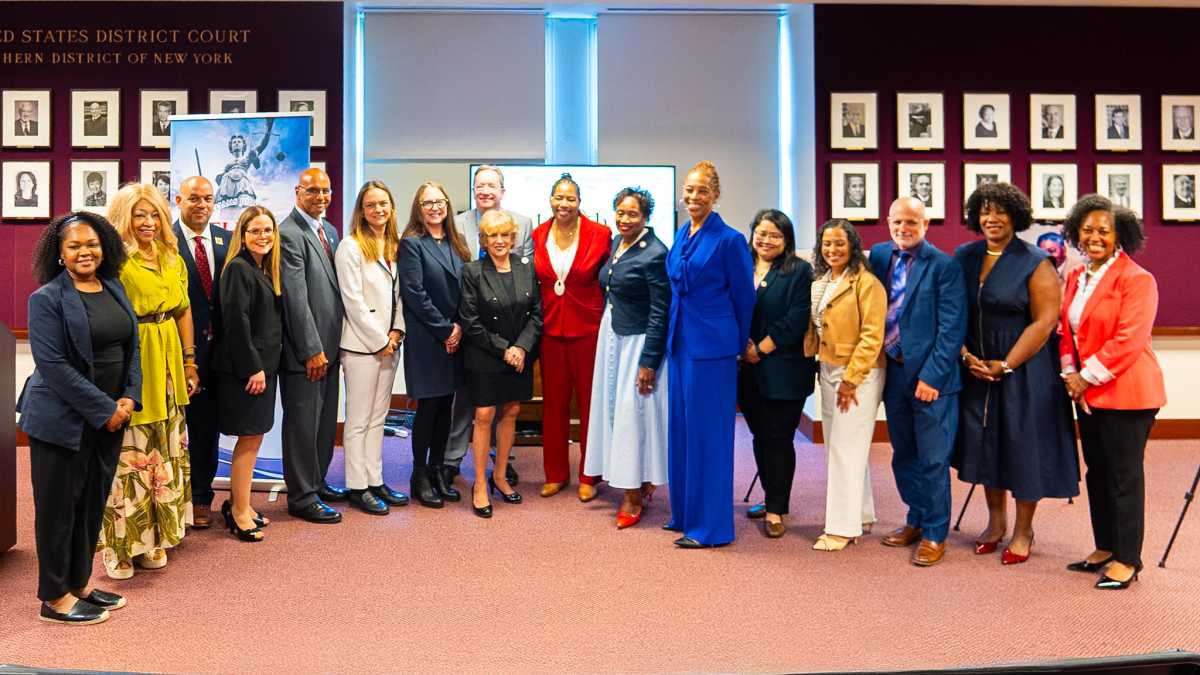
In celebration of Juneteenth, the Franklin H. Williams Judicial Commission delivered a sweeping message about racial equality at its annual Juneteenth Symposium, titled “Reviving Reconstruction: America’s Unfulfilled Promise” on June 11.
The full-day program, held at the Daniel Patrick Moynihan Federal Courthouse in Lower Manhattan, included experts in law, academia, and public service who discussed modern forms of racial inequity in the American court system.
“Juneteenth must not be celebrated simply as a day off,” Associate Judge of the New York State Court of Appeals Shirley Troutman said. “It is instead an opportunity to reflect upon the past and to ensure that all Americans are ever mindful that freedom is not only something that must be valued, it must be protected.”
The commission, named after its founder and civil rights lawyer, diplomat and co-organizer of the Peace Corps Franklin H. Williams, was formed as the nation’s first committee dedicated to improving racial equality in the courts. It was formalized in 1991 when it released a detailed report that found a severe lack of racial diversity on the bench and a perception among some New Yorkers that minorities are not fairly treated in the courts.
The Juneteenth program examined the Reconstruction Amendments, Supreme Court jurisprudence, and modern challenges to racial equity initiatives. The program highlights the unfinished work of Reconstruction and its enduring relevance today.
“The fierce urgency of now is what Martin Luther King talked about,” said the symposium’s keynote speaker Anthony Paul Farley, a professor of Jurisprudence at Albany Law School. “Let’s make now something in our lives, not later, not dreams that may one day come true somewhere over a rainbow or on a mountaintop or in some promised land that votes against the current, borne back ceaselessly into the past.”
Farley gave a provocative speech in which he compared the ideology of MAGA Republicans to the 1896 Plessy vs. Ferguson segregationist legal doctrine, which he pointed out was never about equality.
“Remember when this [decision] came up in law school is that dissents are important and dissents grow and they’re seeds for the future,” Farley said. “I want you to forget all that. Let’s win all of our cases now, not on appeal to history.”
One panel discussion, moderated by Associate Justice of the Appellate Division, First Department Troy K. Webber featured a conversation on historical challenges to racial equity within the courts.
Another moderated by Director of the Center for Health Equity at Evergreen Lenora FooteBeavers, discussed pathways to advance racial equity after the U.S. Supreme Court’s Students for Fair Admissions v. Harvard decision, which mandated race-neutral college admissions.
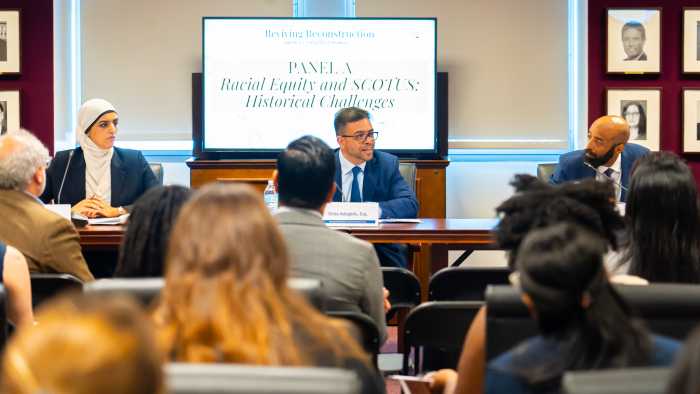 From left, a panel of Tahanie Aboushi, Debo Adegbile and Vincent Southerland discuss the Suprem Court of the United States record on racial equity.Photo by Gregory Alexander
 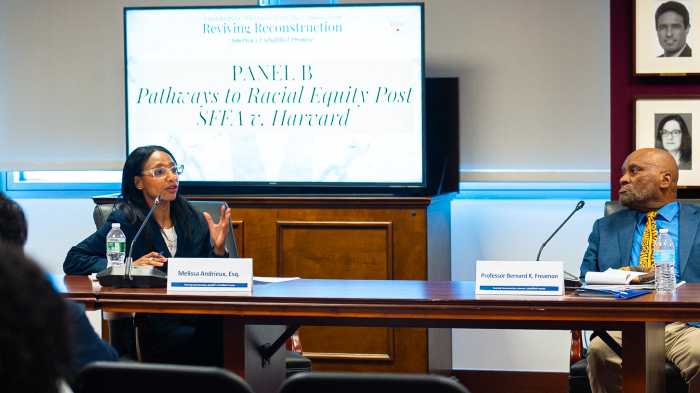 From left. Melissa Andrieux,
partner at Dorf Nelson & Zauderer, and Professor Bernard K. Freamon discuss the 2023 supreme court decision that blocked race as a college admissions criteria.Photo by Gregory Alexander 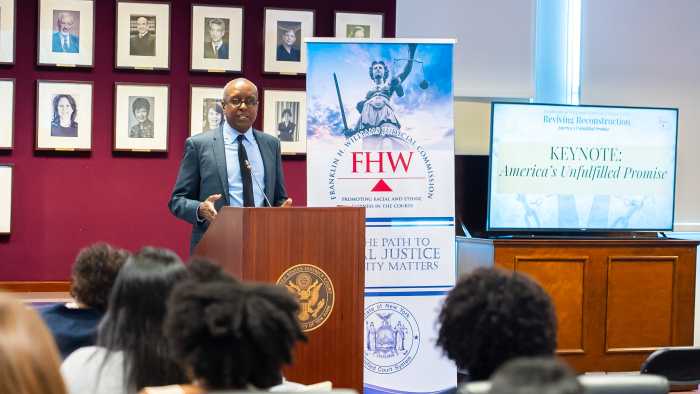 Photo by Gregory Alexander
 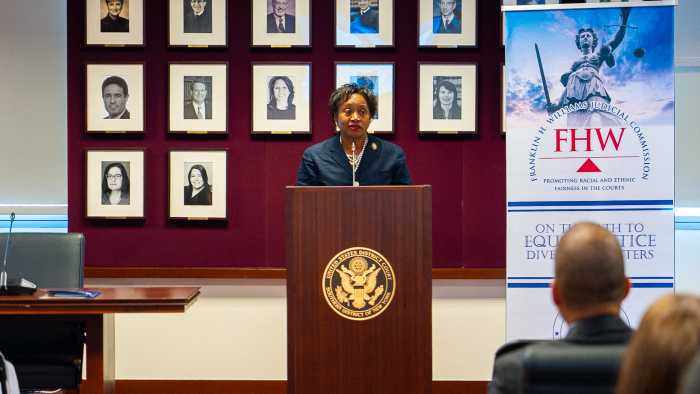 Associate Judge of the New York State Court of Appeals Shirley Troutman speaks at the Franklin H. Wiliams Judicial Commission’s symposium.Photo by Gregory Alexander
 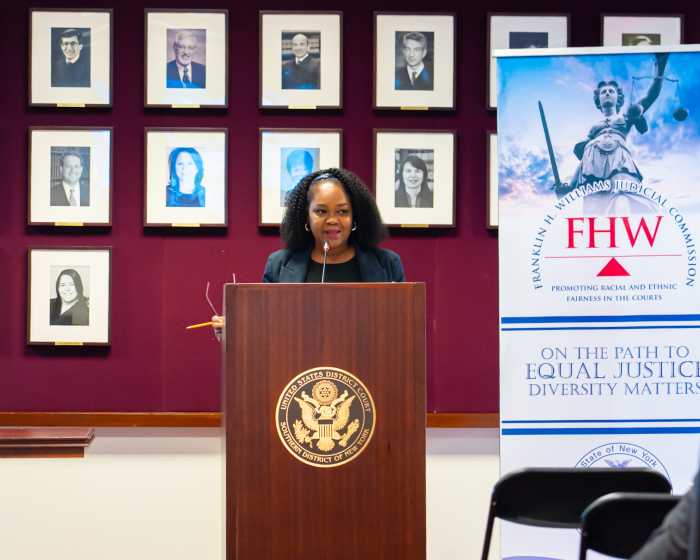 Executive Director of Franklin H. Williams Judicial Commission gives closing remarks at the commission’s symposium.Photo by Gregory Alexander