
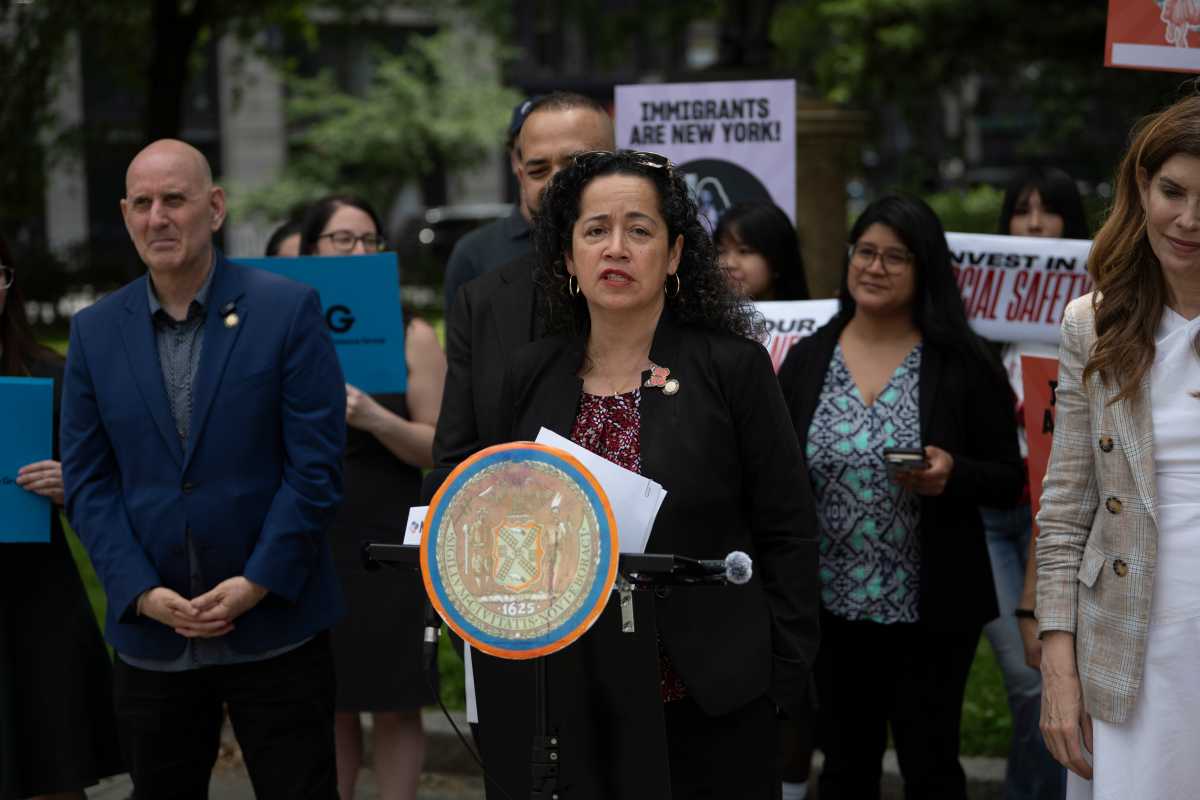
New York City agencies would have to post multilingual signs explaining the rules governing immigration enforcement at municipal properties and clearly identify nonpublic areas where nonlocal law enforcement may not enter unless access is permitted under city law, under legislation the City Council is expected to approve Thursday.
Introduction 55-A, sponsored by Council Member Alexa Avilés (D-Brooklyn), would require the Mayor’s Office of Immigrant Affairs to produce plain-language notices describing existing city laws governing access to city property and restrictions on city participation in immigration enforcement.
Covered agencies — defined in city law as agencies that provide direct public or emergency services — would have to display the information prominently at all city property under their jurisdiction. They would also have to identify nonpublic areas and post notices stating that federal and other nonlocal law enforcement officers may not enter those spaces unless access is permitted under the city’s property-access law.
The Department of Education would separately have to make age-appropriate versions of the information available in the main or central office of every public school, on individual school websites where available, on the DOE website and through online portals used by students and parents.
NYC immigration enforcement rules bill aims to clarify public’s rights
The measure would not establish a blanket ban on Immigration and Customs Enforcement entering city buildings or create a new citywide judicial warrant requirement. Instead, it would require agencies to explain and visibly implement access rules and restrictions on city participation in immigration enforcement that are already contained in city law.
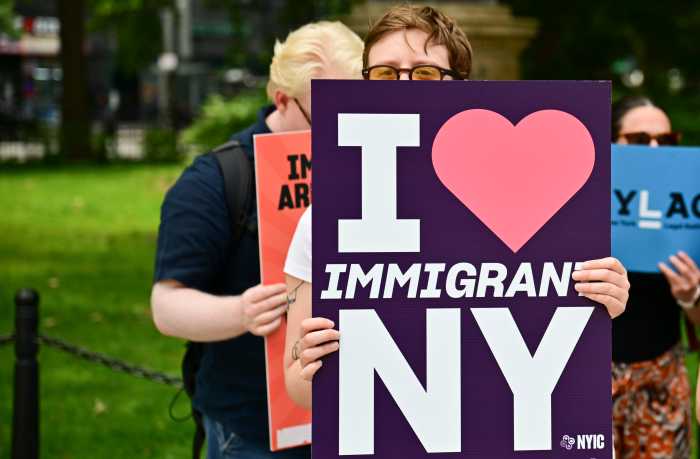 Photo by Lloyd Mitchell
At a rally outside City Hall on Wednesday, Avilés said protections written into law have limited value when residents do not know about them or understand how to exercise their rights.
Avilés said the signage requirement was only one part of the response the city needed as federal immigration enforcement escalates in New York City. She also pressed the Council and mayor to fully fund legal services for immigrants, arguing that nonprofit providers were already overwhelmed.
“We cannot allow that money to be caught up in a budget dance while our people are literally being attacked and detained,” she said.
Council Member Carl Wilson (D-Manhattan) said fear of immigration enforcement was shaping ordinary decisions for families in his West Side district.
Families were afraid to send their children to school, go to work, visit the grocery store or otherwise live normally because they feared being detained, he said.
“Access to legal representation can be the difference between a family staying together or being torn apart,” Wilson said.
He also described language access as a civil right, arguing that residents must be able to obtain health care, education, housing and public benefits regardless of the language they speak.
“We cannot balance the budget on the backs of immigrant communities,” Wilson said.
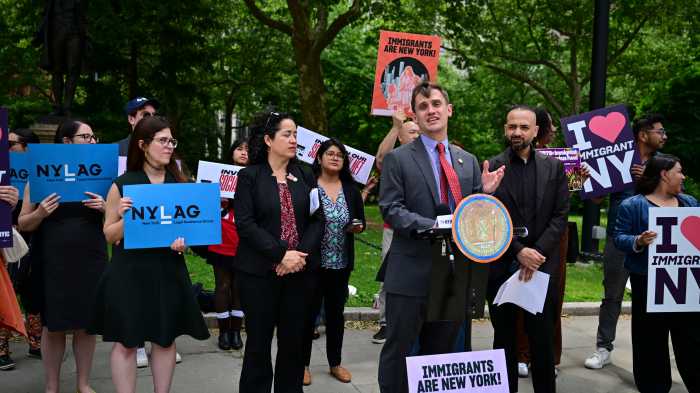 Council Member Carl Wilson speaks outside City Hall on Wednesday, calling for increased funding for immigration legal services and language access.Photo by Lloyd Mitchell
Council Member Harvey Epstein (D-Manhattan), who previously ran a legal-services office, said New York’s own immigrant history should shape its response.
“Whether you came here two weeks ago, two years ago, or 200 years ago, your family came here for a reason,” Epstein said.
Lisa Rivera, president and CEO of the New York Legal Assistance Group, said city funding had allowed attorneys to maintain a near-daily presence at the immigration courts at 26 Federal Plaza and file federal petitions challenging detention.
Rivera also described a recent case involving agents detaining a father who was accompanied by his baby. She said the presence of an attorney and other witnesses allowed advocates to respond immediately and assist the family, and that the father was released several days later.
ICE surge threats
The rally came amid an escalating confrontation between New York officials and the Trump administration over immigration enforcement.
Gov. Kathy Hochul last month signed a broader state package restricting the use of public resources for civil immigration enforcement, barring local governments from entering into agreements that deputize police and correction officers to perform federal immigration work and limiting immigration authorities’ access to nonpublic areas of schools, hospitals, houses of worship and other sensitive locations without a judicial warrant or court order.
The package also bans most law enforcement officers, including federal agents, from wearing masks while interacting with the public and creates a state-law mechanism allowing New Yorkers to sue government officials over alleged constitutional violations.
Federal officials immediately rejected key provisions. The Department of Homeland Security said it would not comply with the mask ban, arguing that the state cannot control federal law enforcement, while Hochul acknowledged that the package would likely face litigation.
The threat intensified Monday when Trump border czar Tom Homan said he had reviewed plans for what he described as the largest ICE deployment New York City has experienced.
“You are going to see more ICE agents than you have ever seen in New York City,” Homan said. “And it’s coming.”
Homan framed the proposed surge as a direct response to Hochul’s legislation, arguing that limits on cooperation inside jails would force federal agents to deploy larger teams into residential neighborhoods.
He has threatened increased enforcement in New York before without carrying out an operation on the scale seen in other Democratic-led cities. But the latest warning came with Homan’s claim that an operational plan had already been reviewed, as Congress considered legislation that would substantially expand ICE’s funding and enforcement capacity.
Hochul said President Trump had previously assured her that he would not send a federal deployment into New York unless she requested one.
“I’m not asking,” she said Monday. “That will never happen.”
Under Avilés’ bill, MOIA would have until Aug. 31 to develop the signs and until Sept. 25 to distribute them to covered agencies. Agencies would have to post the notices and identify their nonpublic areas by Sept. 30.
The office would also have to conduct multilingual outreach through community organizations, IDNYC registration sites, homeless shelters, public parks, and LinkNYC kiosks.
Agencies would have until Oct. 31 to report where the signs were installed. MOIA would then submit a citywide compliance report to the Council speaker by Nov. 30 and every three years thereafter.
– With reporting from Lloyd Mitchell