
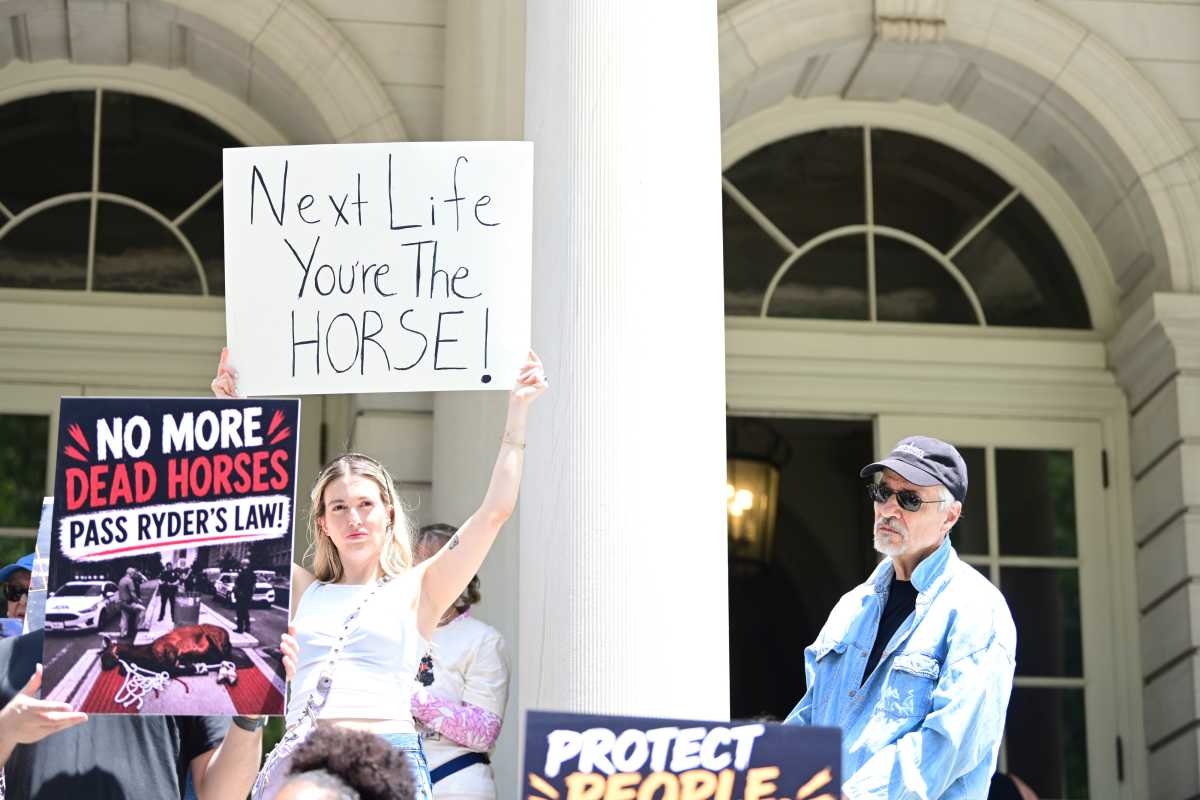
City Council Member James Gennaro (D-Queens) on Thursday introduced a bill, Intro. 937, focused on carriage horse welfare, with the goal of improving conditions for the animals without eliminating the industry.
Gennaro introduced the bill, which is backed by TWU Local 100, the union that represents carriage horse drivers, during the same June 11 council meeting where his colleague Christopher Marte (D-Manhattan) reintroduced a measure that seeks to phase out horse carriages in the city — known as Ryder’s Law. TWU fiercely opposes Ryder’s Law because it would leave its members out of work.
Both bills were unveiled two days after the death of a carriage horse named Deniz inside Central Park. Deniz died shortly after collapsing while taking two passengers through the park. His cause of death has yet to be determined.
Gennaro said his bill builds upon Local Law 10 of 2010, a measure he passed when he was first in the council to add several health and safety regulations to the horse carriage industry.
The council member said it would require the city to conduct a decennial study on ways to improve horse safety along approved routes between their Hell’s Kitchen stables and Central Park, allow horse carriage drivers to begin working at 7 a.m., when it is cooler out, and mandate a study on the installation of hitching posts, to make it harder for horses to bolt.
He said it would also require the appointment of a new five-member rental horse advisory board, including one member representing the saddle horse industry, another representing the carriage horse industry, one veterinarian, and two members from the general public.
In remarks during the council meeting where he introduced the bill, Gennaro accused anti-horse carriage advocates of “exploiting” Deniz’s death, citing the horse being deemed fit by the NYPD veterinarian in March.
“Advocates will seize upon the specious argument that Deniz was worked so hard that he was worked to death, which is simply not a possibility in New York’s carriage industry,” he said.
Alexander Kemp, TWU Local 100’s administrative vice president, said in a statement that the bill would both safeguard horses’ health and safety, while keeping carriage drivers employed.
“This is common-sense legislation with measures to further improve the health and welfare of the iconic Central Park carriage horses and protect the livelihoods of the overwhelmingly immigrant workforce of carriage drivers,” Kemp said. “We believe Council members should stand with blue-collar workers and support increased safety protocols for their beloved horses.”
City Council Speaker Julie Menin, during an unrelated Thursday press conference, said the dangerous incidents involving carriage horses are “obviously not acceptable,” but did not explicitly back either bill.
“I’m gonna let both bills go through their standard legislative process,” Menin said.
Ryder’s Law is designed to wind down the horse carriage industry by ending the issuance of new licenses and banning the operation of carriages in Central Park. It also includes language calling for the establishment of a job retraining program for out-of-work carriage drivers.
Its proponents say it is necessary to end an industry that is inhumane and outdated.
They have pitched it as the best way to protect carriage horses themselves, their drivers, and pedestrians in and around Central Park. It comes in response to years of incidents of horses dying and running loose on the job.
“Time and time again, the horses, their drivers, and the public are put at risk; this needs to end,” said Marte, during the council meeting where he introduced the bill.
“Ryder’s Law will do what our constituents are telling us to do,” he continued. “It will ban carriage horses while requiring DCWP (Department of Consumer and Worker Protection) to work with carriage drivers to transition them into other jobs. This bill is not anti-worker, it’s anti-cruelty.”