
ROCHESTER, N.Y. — What was a rite of passage for more than 160 years will now become optional starting in 2027.
“It’s an ever-changing landscape,” Opportunity Network College Access and Success Senior Director Emmanuel Moses said.” I think a lot of more conversations are trying to move towards like what fully encapsulates a young person’s not just potential, but what they’ve done.”
New York state students will no longer be required to pass five Regents exams in order to graduate, leaving only six states that still mandate high-stakes exit exams.
“It’ll just be a shift in mindset, being able to kind of work through, evaluating some of the other things that they have,” Nazareth University dean of admissions Amanda Brady said.
What You Need To Know
New York state students will no longer be required to pass Regents exams to earn a diploma beginning in the 2027-28 school year
New York State Department of education is adopting a new idea of a ‘Portrait of a Graduate,’ reflecting on intellectual and interpersonal skills needed in an inclusive learning community
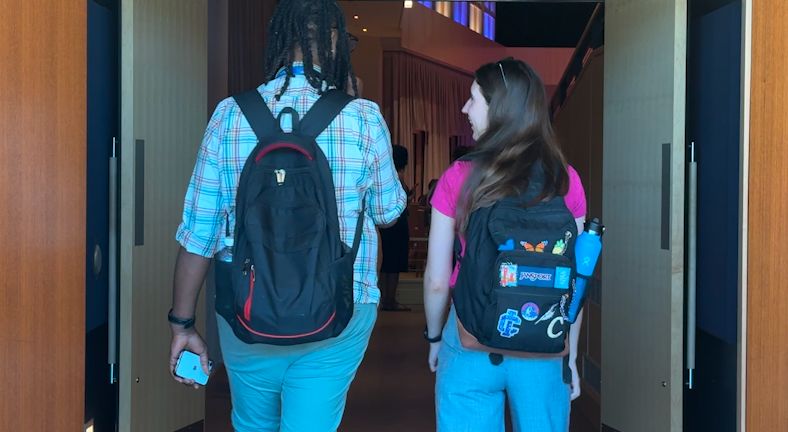
College and high school admissions counselors and advisors prepare to help students transition into post-secondary education, engaging in conversations at the the New York State Association for College Admission Counseling annual 2026 conference at Nazareth University
As college and high school counselors prepare to help students transition into post-secondary education, they are also considering the “Portrait of a Graduate,” introduced by the New York State Department of Education.
According to NYSED, the portrait of a graduate will encapsulate a student who is academically prepared, a creative innovator, critical thinker, effective communicator, global citizen, reflective and future-focused and culturally responsive in a learning environment.
“A transcript is the most significant and reliable indicator of a student’s potential,” Moses said. “But also, you have all of the other things that are either non-cognitive or, of course, that’s why we have letters of recommendation. That’s why we have extracurriculars. We have our personal essays. So I do think there’s a lot of conversations happening. How are we taking the full picture of not just the student, but also the resources that are offered to the schools? Not all schools are able to support all students equitably with apps or anything else. So I do think personally, for me, I know my colleagues at institution are working really hard to ensure that they are changing the landscape, but also looking at every student as a student rather than just this one aspect of their application.”
The New York State Association for College Admission Counseling recently gathered for its annual 2026 conference at Nazareth University. With more than 500 admissions professionals in attendance, the networking event sparks conversations to help better support the thousands of students preparing for opportunities after high school.
And with Regents changes, educators are finding new ways to measure success for both the students and their district.
“We are familiar in New York state with the different institutions that we work with,” Brady said. “So looking at all of their day-to-day scores, you know, we look at a lot of state students as well. And they don’t have Regents scores. So we’ve already evaluated transcripts without that piece. I think this conference helps, too, because we’re able to connect with colleagues. And if you have a question about a student, you might be able to go right to them and say, ‘hey, I know that so-and-so applied here.’”
Monroe University Admissions Advisor Candace Myers finds herself new to the space, trying to navigate both personally and for her students who are making future decisions within their educational careers.
“I want to make sure I do my job properly and assist students properly, and just helping them, make the right decisions for their lives,” Myers said. “That’s so crazy to hear that regions are fizzling out and students are going to be, you know, basically looked at in a bigger picture. Sometimes the region score does not really explain, or it’s how the picture pool of a student is taken that exam, students get tested, anxiety, students change answers, they start to double-guess themselves, and things like that. The schools are now going to have to really be accountable for that, because they no longer have this percentage, just testing rate that they can use to say, ‘hey, this is our school, they really need to make sure they’re good in all areas with all classes, professionals, teachers and just across the board overall.’”
Although testing is still an important part of learning, several educators at the conference say graduation should reflect readiness and not just a number.
“How do we continue to bring our students, our communities, where the first gen, whether legacy, whether BIPOC, whatever that looks like, the goal of all of us is to make sure that they not only have access to post-secondary opportunities, but are also supported to their full selves in an ever-changing space,” Moses said.
“So I meet with students who are bright students all the time as I’m going over transcripts to help them with the process. And, I look at their written scores, I’m like, ‘well, what happened here?’ ” Myers said. “I think allowing students to not be judged based on a score gives them just more of an opportunity. It really allows them to really express who they are and tell the story academically of who they are.”