
by Michelle Mullen
Walking through the halls of RiverSpring Living, residents don’t simply pass by the generic prints often associated with nursing homes. Instead, they are greeted with vivid Armenian landscapes, Soviet-era still-life lithographs, delicate Jewish etchings and original works by Pablo Picasso and Marc Chagall.
Spread throughout the Riverdale campus is a collection of more than 4,500 works of art, many tied to Russian, Jewish and Eastern European history, among other styles and cultures. The collection, partially housed in the on-site Derfner Judaica Museum, stretches across hallways, residential floors and public gathering spaces, transforming the senior living facility into something closer to a museum.
Senior curator Emily O’Leary said the collection was built around the idea that residents should live among meaningful artwork rather than in a sterile environment, bringing museum-quality art directly into the building.
Much of the Russian and Soviet-era art traces back to Eric Estorick, a London art dealer whose family fled antisemitism in Eastern Europe. O’Leary said Estorick formed a connection with the Hebrew Home at Riverdale, RiverSpring’s predecessor, after his father’s stay at the facility.
In the 1960s, Estorick organized exhibitions featuring artists from the Soviet Union and Eastern Europe, introducing many Americans to artwork rarely seen outside the region during the Cold War. O’Leary said Estorick was struck by the extraordinary technical skill of the artists despite the barriers separating Soviet and Western art communities at the time.
One of Estorick’s earliest exhibitions, explained curator Susan Chevlow, centered on the Leningrad Experimental Graphics Workshop, a group of officially approved Soviet artists known for masterful printmaking.
“They had a lithography workshop,”Chevlow said. “And I think he showed in that exhibition a little over 15 artists, and they were all master lithographers.”
The works themselves range widely in style and subject matter. Along one hallway hangs a series of etchings by Soviet Jewish artist Anatoli Kaplan, who illustrated scenes from Jewish life and stories by Sholem Aleichem. The black-and-white prints show crowded holiday tables, musicians and village figures drawn with rough, expressive lines.
O’Leary explained that Kaplan managed to continue producing Jewish-themed work while remaining an officially recognized Soviet artist, carefully navigating the restrictions placed on artists during that era.
Nearby are colorful Armenian paintings filled with saturated reds, blues and golds. One of O’Leary’s favorites is a portrait by Armenian artist Mariam Aslamazyan showing women in traditional clothing gathered around overflowing baskets of fruit and vegetables.
“She has been referred to as the Armenian Frida Kahlo,” O’Leary said.
The painting, titled “Collective Farm Abundance,” reflects the balancing act many Soviet artists faced. While the rich colors and patterned textiles celebrated Armenian culture, the title itself carried socialist themes approved by the Soviet government.
“That happened a lot,” O’Leary said. “Naming things like that is also how you can get away with certain things.”
Elsewhere in the halls are quiet snow-covered landscapes, abstract Czech paintings and still lifes featuring seeds, bread and blank canvases meant to symbolize self-sufficiency and artistic labor.
One large painting by Soviet artist Pyotr Ossovsky depicts a bleak railway crossing beneath a gray winter sky. Unlike the highly idealized Soviet propaganda art common during Joseph Stalin’s rule, the work feels cold, heavy and realistic.
“It was supposed to show life as it was,” O’Leary said of the post-Stalin movement known as Severe Style. “Because of all of the artifice of when Stalin was in power.”
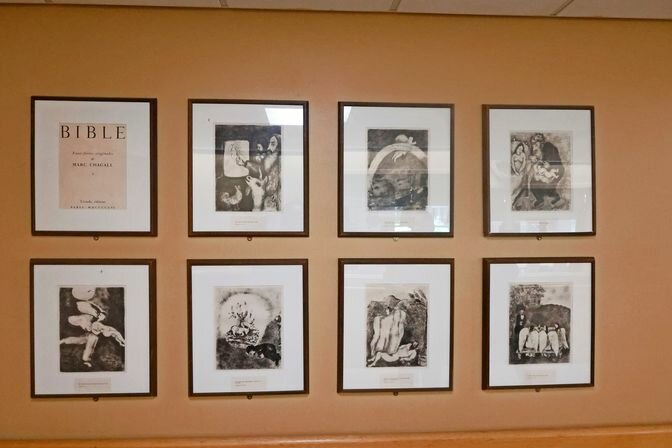
The collection also includes famed artist Marc Chagall’s Bible etchings stretching across an entire hallway. The prints, filled with floating figures, angels and biblical scenes, were created over a decade interrupted by World War II.
Today, the collection continues to grow through donations from artists, estates and collectors. O’Leary said the variety of artwork reflects decades of collecting from many different donors and artistic traditions.
For residents, the artwork has become part of everyday life, Chevlow explained — a daily encounter with histories and cultures that stretch far beyond the walls of the nursing home.
Eighty-five-year-old Hebrew Home resident Eileen Nagle said the artwork offers a welcome conversation starter.
“At any point in time and anywhere on campus you can see art,” she said. “It keeps us attached to the arts scene and what’s happening and it’s really nice to know it’s all around us.”
Icilda Mitchell, 91, shared Nagle’s sentiment, noting the collection adds a touch of cheer to the environment.
“I look forward to having the art here so I can share it with visitors who come to campus and show them around,” Mitchell said.
Keywords
RiverSpring Living,
Riverdale,
Derfner Judaica Museum,
art collection,
Pablo Picasso,
Marc Chagall,
Soviet art,
Eastern European art,
Jewish art,
Armenian art