
by Olivia Young
Spuyten Duyvil Shorefront Park is finally open to the public after five years of grueling volunteer work to restore trails eroded by rainfall and overgrown with invasive species.
Jodie Colón, founder of the Friends of Spuyten Duyvil — a group of volunteers, called stewards, trained by the New York City Department of Parks and Recreation to maintain green spaces — said hundreds of people poured their time and energy into the park. Not only stewards, but local high school students and involved residents too, she said.
“I’m so excited,” Colón said, noting in past years, volunteers have put in 500 hours annually. “It’s so much work that it’s hard to grasp the magnitude of what we’ve done.”
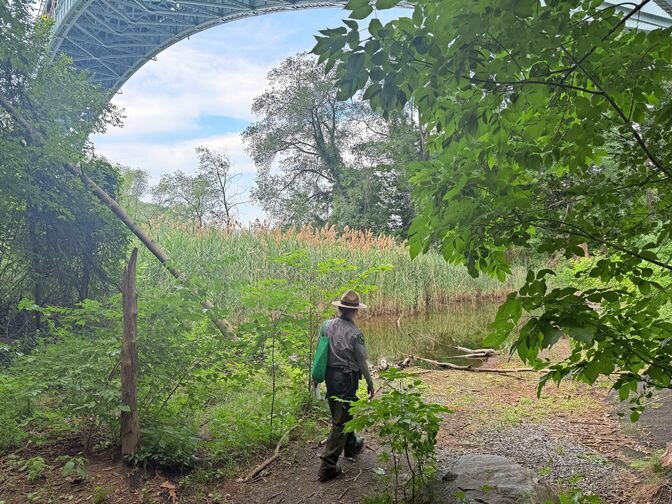
The 6.6 acre park sits beneath the Henry Hudson Bridge, and is home to several native New York species, wildlife that leaves behind small footprints in the mud, and a pond fed by stormwater. Sections of it are also at the base of a steep edge, where rainfall rushes down and washes out the trails, creating ruts in the soil and exposing rocks, roots and other tripping hazards.
Over the years, volunteers cleared weeds and fast-growing vines, and also dragged buckets of soil, hauled in rocks and reshaped logs to prevent runoff along the trail, a process that largely consisted of trial and error, Colón explained. She added it required constant maintenance to upkeep. They are now trying out a soil that is a mix of sand, silt and clay known for improving drainage. They won’t be sure it’s effective until the next rainfall, Colón said.
The park was finally deemed safe to visitors after environmental protection organization Natural Areas Conservancy, who has also been helping with restoration efforts over the past month, officially designated the trails, Colón said.
Barricades and caution tape blocked off much of the park’s trails until June 6 — also known as National Trails Day — when more than 30 residents joined Colón and Urban Park Ranger Lenora Todaro for a walkthrough of the park’s now smoothed-over trails, pointing out various plant types and their histories.
Todaro gestured to a patch of snakeroot, and explained when colonial people first arrived in America, they used to feed the native New York plant to their cows. But, snakeroot contained a toxic alcohol called tremetol, and when people drank the cows’ milk they fell ill with “milk sickness” and died.
Spuyten Duyvil Shorefront Park is also scattered with large, gray rocks that have pronounced horizontal layers. Todaro said they could have been put there by humans, or they could’ve been picked up and brought there by the Wisconsin Ice Sheet — the glacier that formed the Bronx — during the Ice Age.
Opening up the trails is an opportunity for residents to engage with green spaces, but it will also help maintain the park, Colón said. As people walk on the trails, their feet will grind down leaves that Colón and volunteers would typically rake, and crush weeds that would have to be pulled. Those visitors could also become volunteers as they build a connection to the park, she added.
A section of the trail is still blocked off, and there are parts of it that may be too steep to be accessible, but part of the goal of reopening is to see how the public adjusts to the park and work from there. The goal was to make the trails walkable, not to repair them in full, Colón said.
Terri Levine, a longtime resident who has been walking the park for years, said while she’s always enjoyed the trails, they are much easier to navigate now. The number of people like Colón who are committed to maintaining it is a comfort, Levine added.
“It’s also a feeling that it would stay this way,” she said. “And that things will get even better and better.”
One volunteer, 76-year-old Annette Sambolin, is also a pathkeeper, or someone who is trained under the parks department’s Super Steward Urban People Advancing Trails and Habitat, or PATH, program. She’s worked since the Covid-19 pandemic to clear invasive plants, adding she was happy to make the area one that other people would enjoy.
Colón cited a similar motivation behind her efforts.
“We’re doing this for the rest of the community,” Colón said. “We want them to experience what we know is so special about having places like this in such an overbuilt, urban environment.”
Todaro, who grew up in Riverdale, said she appreciated the serenity of the park in a place like New York City. She admired the look of the Henry Hudson Bridge against vibrant forestry, and the way a visitor could glance from the branches down to the pond and the racoon footprints surrounding it.
“Everybody needs a place to get some peace and rest,” she said. “Every time there’s another park and another trail, that’s another opportunity for that.”
Keywords
Spuyten Duyvil Shorefront Park,
Riverdale,
Bronx parks,
trail restoration,
park reopening,
Friends of Spuyten Duyvil,
Jodie Colón,
volunteer conservation