
GENEVA — President Trump and Vice President JD Vance secretly signed the Iran peace deal Sunday — with officials describing plans to give Tehran “small antes” of money as nuclear talks continue.
The electronic deal-signing was a surprise because a formal ceremony had been booked for Friday in Geneva — and also because the text of the deal is not yet public and may not be released for days.
The memorandum of understanding will reopen the Strait of Hormuz and sent oil prices crashing to near-prewar levels — bringing hope for lower gasoline prices — with parallel stock gains. The Dow Jones Industrial Average notched a new all-time high.
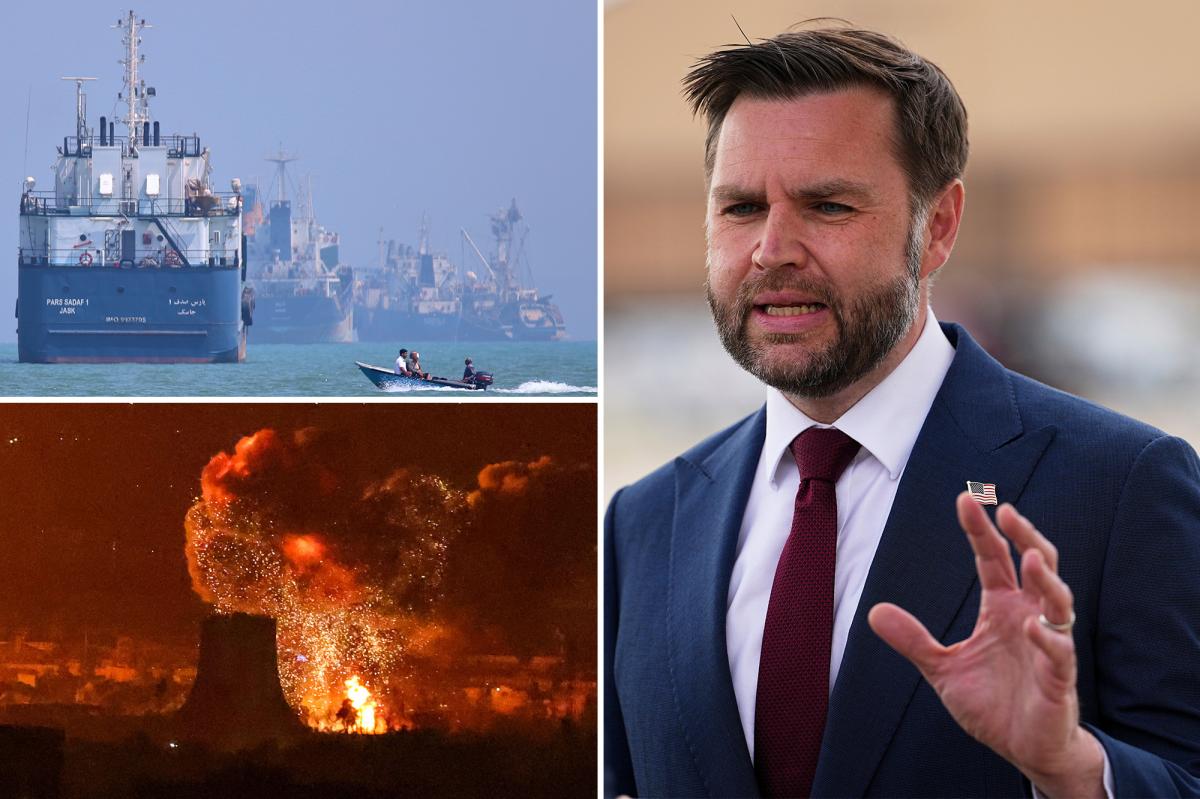
Vice President JD Vance said the US-Iran peace deal was signed digitally. Matt Rourke/Pool AP via AP
An explosion erupts following strikes near the Azadi Tower in Tehran. AFP via Getty Images
But the mystery over the MOU is causing suspicion and propaganda on both sides.
Officials confirmed the document will reopen the strait with no tolls this week, but the status of the waterway and Iran’s specific nuclear commitments remain unclear — stirring concern among foreign policy hawks and Israel advocates.
“I would describe it as an agreement to continue to argue about the important issues in the region,” retired Gen. Wesley Clark scoffed in an interview on CNN. “But I do think if we get the strait open and there’s no toll, that would be positive.”
Aside from nuclear concessions that comprise Trump’s major war aim, the post-conflict status of the Strait of Hormuz was described differently by the parties.
Iran claimed a last-minute change in the deal meant Iran and Oman will be recognized as the sole authorities over the crucial waterway, Iran’s Fars news agency reported.
“For the next 60 days Tehran will guarantee free passage through the strait, but after that period vessels will be required to pay tolls to cover security, navigation, environmental and insurance services,” the propaganda organ reported.
However, a senior US official said that the 60-day window is interpreted differently by American negotiators.
A small motorboat passes anchored vessels in the Strait of Hormuz. AP Photo/Amirhosein Khorgooi
“On the toll question, we’re quite explicit in this MOU. The straits will be open toll-free for 60 days, and we expect that to become part of the final agreement as well,” the official said.
The follow-up talks are expected to focus heavily on Iran’s nuclear program, with progress expected within 30 days, a different senior US official said.
Trump recently has given in-principle support for the down-blending of Iran’s near-weapons-grade 60% enriched uranium, which could then be left in Iran.
How exactly the material would be excavated remains unclear.
Follow The Post’s coverage on the latest in the war with Iran:
US officials on Monday openly acknowledged plans for sanctions relief and the unfreezing of assets, along with a $300 billion Arab-led infrastructure fund for Iran.
But those officials said it all would be tied to certain benchmarks, with the progress ceasing if funds flow to regional proxies such as Hezbollah in Lebanon or the Houthi movement in Yemen.
“You’ll see in the MOU, we discuss the possibility of releasing frozen funds, sanctions relief, a big $300 billion fund to rebuild their country, and all of these things are going to be tied to performance,” a Trump administration official told reporters.
“We’re still at the early phases where we’re building trust, and I think what you’ll see is that we are prepared to release frozen funds and we are prepared to relieve sanctions, and we’ll do some small gestures of that in the beginning if they make some small gestures to us that show that they’re willing to meet their commitments as well,” the official said.
A number of vessels in the Strait of Hormuz on June 15, 2026. REUTERS
“Those will be kind of small antes to kind of see the cards, but that’ll be based on performance, and we’re going to get together this week and talk about what we want to do, and when we do it.”
“We’re being very open,” the official added, “about the fact that we are going to be willing to release some of the frozen funds in phases, but it’s all going to be tied to verifiable milestones.
“Again, there’s not a lot of trust.”
Two senior US officials insisted that “zero” dollars of frozen funds had been released — countering weekend news reports that regional US allies had started to dispense cash.
Trump and Vance electronically signed the order, with Iranian parliament speaker Mohammad-Bagher Ghalibaf signing for his nation, the officials said.
It’s unclear why the signing occurred without a public event — or when precisely it happened on Sunday.
Vessels seens in the Strait of Hormuz on June 14, 2026. REUTERS
Finalization of the MOU was announced at 5:15 p.m. Eastern Time Sunday by Pakistani Prime Minister Shehbaz Sharif, shortly before Trump had an 80th birthday dinner with family and then hosted a UFC cage match that ended well after midnight.
“We have done a great job,” Trump said Monday while greeting French President Emmanuel Macron at the site of the G7 outside Geneva.
“Hopefully it is going to be a good relationship and we are going to get along. If we don’t, we go back to where we started, but I don’t think that is necessary.”
Trump said that “the Iran deal will bring a lot of success to the world. Because the oil was really clogged up there for a while.”
Trump called the MOU “a really powerful document” that was “not like the Obama documents.”
He said, however, that the text might not be released until “sometime after Friday” — longer than a 24-48-hour window cited by one US official.
Sen. Lindsey Graham (R-SC), a leading war hawk, called on Trump and Vance to treat the agreement like a treaty and submit it for congressional approval.
“I look forward to reviewing the final product and I believe it is imperative that the architect of the deal, Vice President Vance and his negotiating partners, be part of the process in presenting the final deal to Congress,” Graham said.
“Congratulations to all in getting us to this point. Time will tell.”