
The Moment and the Distance
Gagosian
April 30–July 2, 2026
New York
Standing among the soaring paintings by Helen Frankenthaler on view at Gagosian puts one in the position of a Lilliputian among titans. Aside from two works made in the early 1960s that provide an originating reference point, Frankenthaler made the other paintings in this imposing and impressive show between 1968 and ’92, a quarter century that saw the artist at the height of her powers. From the outset of her career in 1950, Frankenthaler knew innately that her painterly skill was deft, innovative, and irrefutable. She also knew she’d need moxie, perspicacity, and fortitude to gain traction in the renegade New York scene of the fifties and sixties, an accretion of self-assurance gained through the tough trial-and-error of making her way through what was indisputably a man’s world. At Gagosian, we witness an artist with full command of, and confidence in her practice.
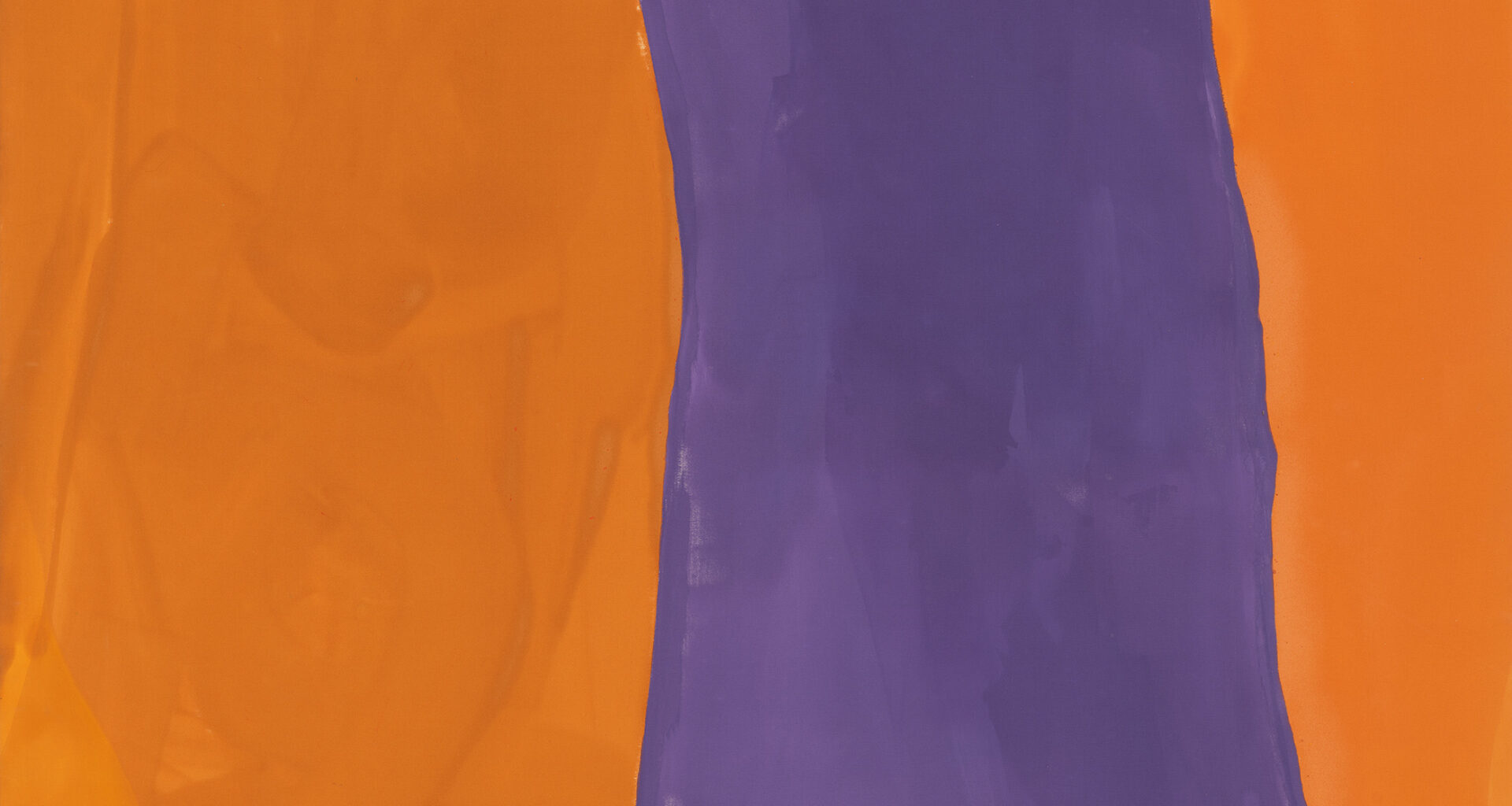
Alassio (1960) and Provincetown I (1961) open the exhibition by grounding the viewer in Frankenthaler’s initial innovation, her soak-stain method of applying paint. She applied oil paints thinned by turpentine directly to unprimed surfaces so that the paint absorbed into the weave of her canvas, diluting lines and forms to dreamy, sometimes hallucinatory, effect. This pair hangs alongside Moontide and Gamut, works from the later end of the decade (both 1968), establishing a relationship that reveals how radically Frankenthaler’s work morphed in just a few years. Though Alassio and Provincetown I are by no means modest canvases, the later two are manifestly oversized in scale, and Gamut is a painting whose immensity you feel in your body. They are rendered in acrylic rather than oil (as are the rest of the exhibition’s offerings), which intrinsically alters the character of the work. The strata of color across the horizontally situated Moontide bleeds from a hazy blue into layers of pink-based hues—salmon, puce, and terra cotta—that put one in mind of a seascape, though there are no marks that ever define it as such. In Gamut, Frankenthaler restricted herself to a palette of saturated plum and disco gold, which cascade from the heights of the eleven-foot vertical in swashbuckling bands. Not only do these bold works make the case for Frankenthaler as an artist emergent from the Color Field painters, but a pioneer among them.