


The Queens Gazette interviewed filmmaker Rowan Haber about their delightful documentary We Are Pat, a hilarious and endearing documentary with Julia Sweeney’s iconic pop culture SNL character “Pat” in the 90’s (“Pat” became a phenomenon on SNL) linking the exploration of identity through the lens of the world of comedy. The producing team is really a who’s who of game changing creatives in the film industry. Following a critically acclaimed debut at the Tribeca Film Festival in 2025, Rowan Haber’s delightful documentary We Are Pat began with an Academy Award-qualifying theatrical run on May 29 at DCTV in New York, with screenings in Los Angeles, Chicago, Portland, Philadelphia, and much more and nationwide this summer. Tribeca Films, the distribution label from Tribeca Enterprises and Giant Pictures, will release We Are Pat digitally on June 23rd, which times perfectly with Pride month in June and the film’s insightful trans and non-binary themes.
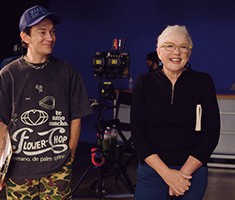
Created by Julia Sweeney in the 90s, “Pat” became a phenomenon on SNL before facing cultural backlash as conversations around transness and non-binary identity politics evolved. What starts as a pop culture excavation becomes something deeper: a reflection on gender identity, the elasticity of comedy, the ethics of authorship, and what happens when a joke outlives the era it was born in.
NB: Why is Pat such an icon?
RH: Ooh, wow, this is such a good question. I think Pat is an icon because they are, they were, very precious in certain ways. The fact that we were gonna sort of be discussing gender nonconformity in such a big way. Obviously, gender nonconforming and trans people have existed for forever, but I think questions around how to function within society and people’s gender panic is really forecasted in the past sketches in a way that is for me so relatable, but is so specific and so in a lot of what we’re talking about now in terms of gender nonconformity.
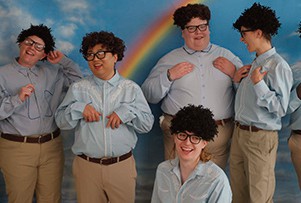
I also think Pat is kind of iconic because they just own who they are in any circumstance. They’re supremely confident. They let everything roll off their back.
It’s very unlike a real person in the way that I think real people would actually be very affected by people constantly questioning what gender they are. I think that’s something that actually weighs down on you, but I think that for Pat, it’s kind of one of Pat’s… their obliviousness is sort of like a superpower, which I think is really special. And of course, their outfit is iconic. So those are some good reasons.
NB: If you could have done anything differently while filming, what would you have done?
RH: Oh, such a good question. I think I would have allowed the writers a little bit more time to work on their sketches. Because we have this writer’s room where they’re recreating the Pat sketches and, if you think about SNL, like SNL as a machine, and all these folks do is pitch ideas, write sketches. They’re just so used to that.
So I think maybe I would have provided a little bit more time with the writers. And in our film, I was like, okay, you have like 45 minutes to create a sketch, and then we were just building the sets and making them. So maybe I would do a little bit more time to refine those.
NB: What advice do you have for aspiring filmmakers and documentarians or any advice about getting producers or funding?
RH: Pick a topic that you are completely obsessed with because you’re going to be working on it for five to ten years. You have to be really in love with the thing that you’re interested in and also pick something that you want to spend time with. I’ve made a lot of queer historical docs that felt really important and were really special to make, but were more serious, and it was so nice making this film because it was comedic, and so I got to spend a ton of time around comedians and around the trans community. And so the process was really special for me as a filmmaker to do that.
You have to know that you’re running a marathon. You just have to keep going. And shamelessly, stomp for your own film, which is really how we got it made.
NB: Did you say stomp? S-T-O-M-P? I’m not familiar with that word.
RH: Just like go hard for your own film.
NB: Do you have any positive memories of Queens from your time at NYU Tisch?
RH: Oh, my god. Well, I mean, such amazing food in Queens. Like a lot of their, I have a lot of food, amazing food memories. Actually, my cinematographer from the film, Christine Ng, lives in Queens, and does these stunning backyard barbecues. I have like a lot of, for whatever reason, maybe I’m just hungry because we’re approaching lunch, but I have a lot. I have a lot of really good food memories, just like highly positive food memories. It’s such an iconic borough. Like, do you know what I mean? There’s nothing like it. I’m from the West Coast, so we don’t have places like Queens, obviously, in Portland, Oregon, or in Los Angeles where I normally live.
NB: Could you describe Queens in three words?
RH: Oh my gosh, okay. What do you think about this? Delightful. Large. Delicious.
For the full interview, visit qgazette.com.