
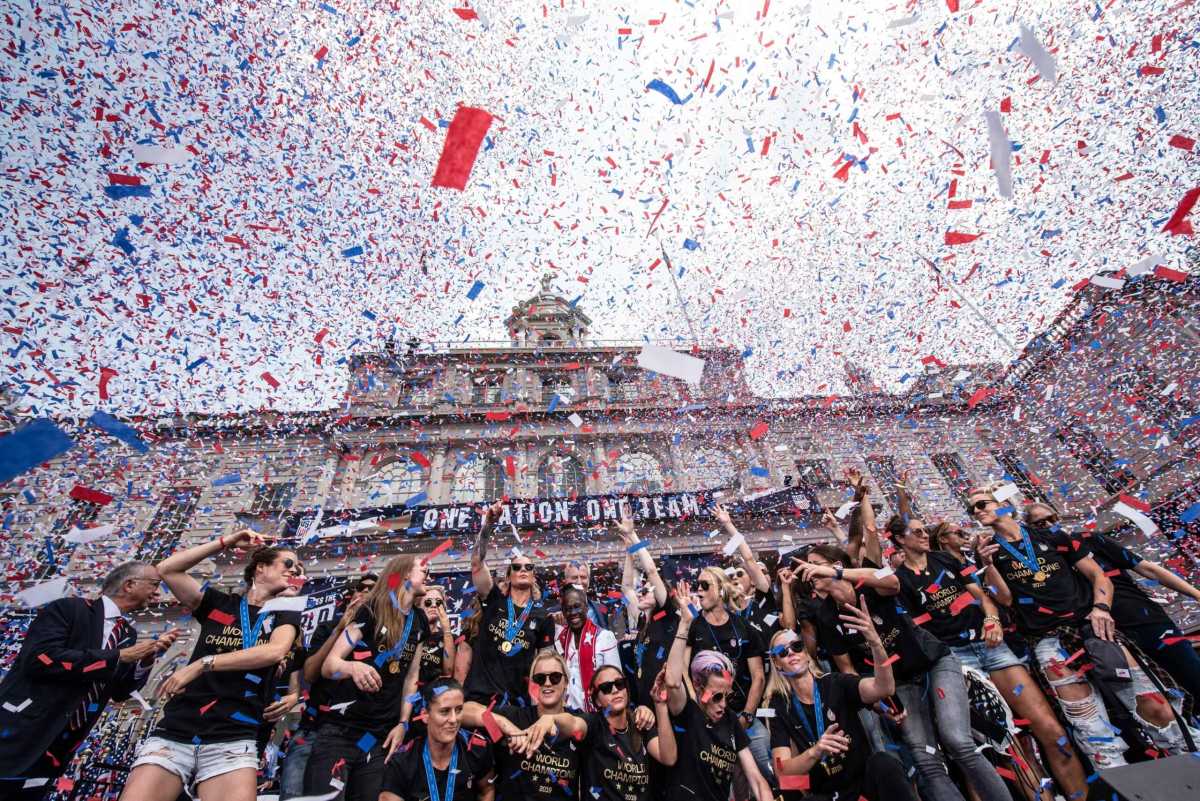
Hours after the Knicks won the 2026 NBA World Championship on Saturday, Mayor Zohran Mamdani shared a simple, three-word post on X.
“Parade. Thursday. Manhattan.”
The brief message carries almost 140 years of New York City history, with ticker-tape parades celebrating the accomplishments of U.S. heroes, welcoming international leaders, and signifying the end of global disputes.
But what is a ticker-tape parade? And what is ticker tape?
The first unofficial celebration took place on Oct. 28, 1886, when Wall Street workers spontaneously tossed ticker tape scraps, pieces of paper once used to transmit stock market data through telegraphs, out of their office windows as the Statue of Liberty was unveiled in New York Harbor.
Ticker-tape parades throughout the end of the 19th century to early 20th century celebrated the centennial of George Washington’s presidential inauguration, the victory in the Battle of Manila Bay during the Spanish-American War, and the return of President Theodore Roosevelt from an African safari in 1910, which marked the first officially authorized ticker-tape parade.
Lilly Tuttle, a curator at the Museum of the City of New York, told amNewYork that the significance of people and events honored with ticker-tape parades marked New York as “the headquarters of national celebration.”
“If you look at ticker-tape parades historically, a lot of the people who were honored, or a lot of the events that were honored, were actually of national significance,” Tuttle said. “Sports teams are somewhat the minority of the entities that were recognized over the years.”
The first athletes honored with a ticker-tape parade were U.S. Olympians who competed in the 1924 Summer Olympics in Paris. Other athletic honorees include Bobby Jones, an American golf legend who scored two ticker-tape parades for winning the British Open in 1926 and again in 1930, track and field star Jesse Owen and the 1936 U.S. Olympic team, and tennis-player Althea Gibson, the first black woman to receive a ticker-tape parade after her 1957 victory at Wimbledon.
New York’s professional sports teams have been honored with ticker-tape parades for national victories, including the installation of the New York Mets in 1962 and their World Series championships in 1969 and 1986, the New York Yankees’ World Series victories in 1977, 1978, 1996, 1998, 1999, 2000, and 2009, the New York Rangers’ Stanley Cup championship in 1994, and the New York Giants for their 2008 and 2012 Super Bowl wins. The last ticker-tape parade was held in 2024 for the New York Liberty after they won the WNBA championships—New York’s first basketball championship since the Knicks’ 1973 NBA victory.
The Knicks: A part of NYC’s ticker-tape parade tradition
While this is not the Knicks’ first championship, it will be their first ticker-tape parade.
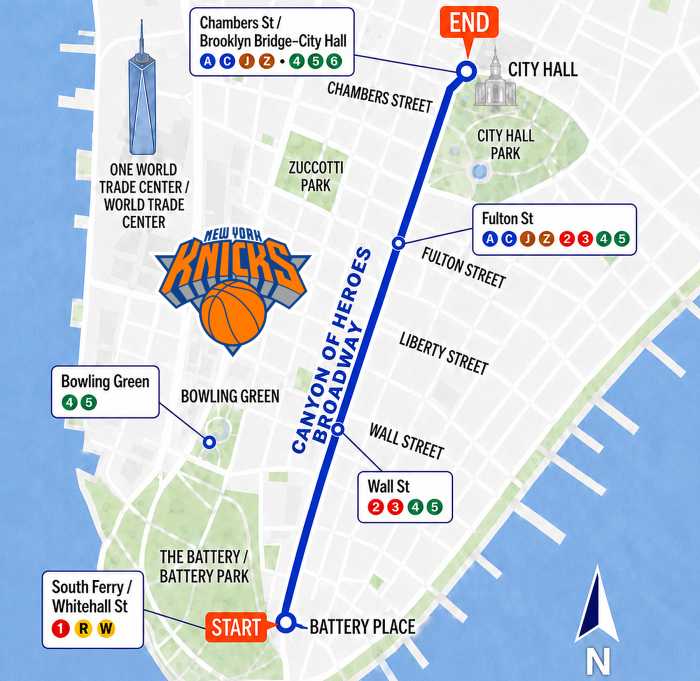 A map of the Knicks ticker-tape parade route through the Canyon of Heroes in Lower Manhattan on Broadway, which is being temporarily rechristened as “Champions Way” this week.Illustration by Luis Matos
Tuttle explained that New York was undergoing a “period of austerity” amid the Knicks’ 1973 victory and that the cost of parade security and cleanup was more “prohibitive” than in the early 20th century, when it was common to hold multiple parades in a single year.
Today, organizations like the Downtown Alliance work to supply and distribute approximately 2500 pounds of confetti for the celebrations and secure garbage cans for efficient cleanup.
Jessica Lappin, the organization’s president, told amNewYork that the distinct New York celebration is “a way for the city to come together and to celebrate either these historic moments or these big wins.”
“It is a magical time. These Knicks have brought the city together in a way I’ve never seen, and I’m a born and bred lifelong New Yorker,” Lappin said. “We just hope that those who come to celebrate are kind, are safe and continue that spirit of being good neighbors.”
Controversial ticker-tape parades
In addition to assisting with parade setup and cleaning, the Downtown Alliance began an initiative in 2003 to “honor the history” of all 209 ticker-tape parades with a granite plaque, starting in lower Broadway heading north, and worked with the Museum of the City of New York to compile records on every ticker-tape parade since the impromptu 1886 celebration.
“There have been some wonderful moments we would still celebrate today, but some complicated historical figures as well, so we wanted to tell the full story,” Lappin said.
Controversial examples of past ticker-tape parades include the celebration of Charles Lindbergh in 1927 after he completed the first solo nonstop transatlantic flight. Lindbergh accepted a medal from the Nazis in 1938 and led the “America First” movement throughout the 1940s, grounded in antisemitism and a fear that U.S. entry into World War II would “destroy the treasures of the white race.”
Tuttle noted that the ticker-tape parade could be seen as a “tool of propaganda” during the height of the Cold War in the 50s and 60s.
“It would seem that any time a foreign dignitary came to New York, and some of them with relationships to our country or relationships to their own country that today we would consider very problematic, they were honored with a ticker-tape parade,” Tuttle said.
Localizing the parade
While ticker-tape parades throughout the 20th century often featured foreign leaders and World War II admirals, the unique tradition has become more localized, with six of the eight parades held since the turn of the century honoring New York City sports teams and essential city workers, who were celebrated with a “Hometown Heroes” parade in 2021 after the Covid-19 pandemic.
“The idea that it’s a local hero, that it really speaks to the people of New York, it’s not some sort of, somewhat potentially, nationalistic, propagandistic tool, but actually something that’s by and for New Yorkers, I think has incredible potential to bring people together and really celebrate the team that we are all feeling so incredibly proud of, and a team that is overdue is overdue for this level of celebration,” Tuttle said.
Thursday’s parade will start at 10 a.m. near Battery Park, taking the Knicks through the “Canyon of Heroes” to City Hall, where Mamdani will present the champions with Keys to the City.