
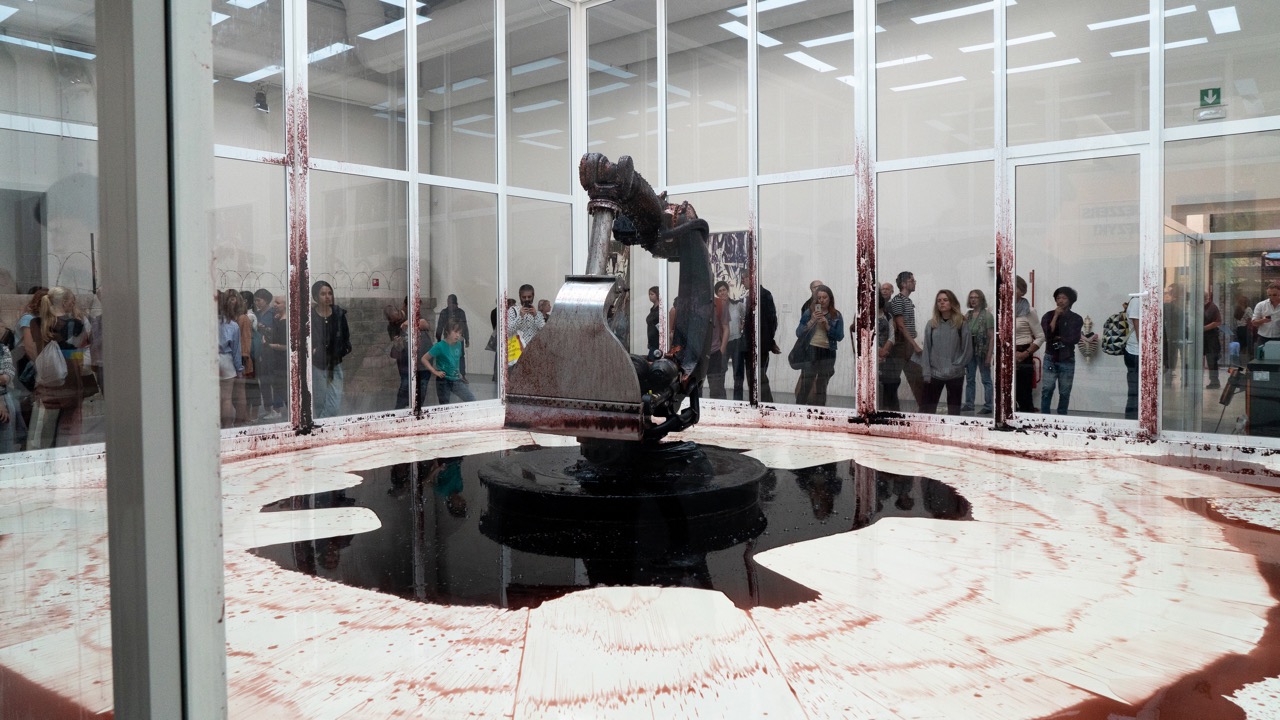
By stripping the machine of its functionality and transforming it into a medium of aesthetic contemplation, the work hypnotically lays bare the machine’s style of movement, cultivating a visual language of recognition and articulation. This KUKA arm is the same industrial robot that screws bolts, solders metal, paints, and undertakes a whole host of other actions in our factories and warehouses. But, in the past decades, they have also become a source of entertainment, precisely because of the kinesthetic experiences they offer. For instance, the same technology produces the magic of flight in Universal Studio’s amusement park ride for Harry Potter and the Forbidden Journey (opened in 2010).
Other applications in the art world have sought to generate a sense of sympathy for these anthropomorphized machines. In Sun Yuan and Peng Yu’s Can’t Help Myself (2016) at the Guggenheim Museum, the same manufacturing arm swept up a red, blood-like fluid issuing from its core amidst dance-like movements. The human-like, life-likeness of this latter work generated a sense of compassion for the Sisyphean labor of the machine, drawing a deep empathic parallel to the monotonous and repetitive movements of humans working under automated systems. There are limits to the efficacy of empathy, but if these works have any true political action, it comes from the aesthetic contemplation of machines that are purposely concealed from our gaze in factories and behind the scenes of amusement parks.
Removed from the domain of the machine alone, artists have recognized the dance-like poetics of automated movement. In Revital Cohen and Tuur Van Balen’s 75 Watt (2013), workers at the White Horse Electric Factory in Zhongshan, China engage in a choreographed mimicry of the assembly line, inspired by the indication that humans can sustain a seventy-five watt output over the course of an eight-hour workday. As stated by the artists, “In 75 Watt, a product is designed to be made in China. The object’s only function is to choreograph a dance performed by the labourers manufacturing it.” At once, the piece translates human labor into dance, while also alluding to the dance-like choreographies of machines, robotic arms, and materials. In Cao Fei’s Whose Utopia (2006), these ideas are inverted whereby dancers in a Chinese factory interrupt their mechanized labor through dance breaks that capture their individualism against the monotony of the factory.
Transforming automation’s movements to embodied choreographies confronts us with how our privileged world is built on the graces of workers who must dance as machines. Through the anthropomorphizing of industrial machinery, artists embrace ideas like choreography and dance as monikers to articulate what is most vividly present in automation: the stylized movement.
Now, having meandered through factories, labs, exhibition spaces, and such, let us try a little thought experiment:
Imagine you are a robot.
Go ahead, do it. What’s it like?
Imagine you are a robot.
Did your spine straighten, did your shoulders go back, did your arms lock at ninety degrees? Now, move, like a robot. Did your head cock to the side as you stiffly turned, trying not to move your neck while your arms moved angularly?
Now, imagine that you are a slightly more advanced animatronic, like the ones you might see at the Hall of Presidents at Walt Disney World. Better than Rosie from The Jetsons, but not as good as the Terminator.
Did your arms move in and out in graceful gesticulations, repeating in various pre-determined loops? Your movements were probably somewhat stiff but desperately trying to show off their natural eloquence.
Finally, imagine that you are the latest, most advanced animatronic on the market. (Think: the Na’vi River Journey animatronic at Disney’s Animal Kingdom or one of those Boston Dynamics dancing robots)
What changed? Perhaps your arms moved grandiosely in hyper-fluid gestures. You probably are moving a little too much, and in ways that feel somewhat unnatural as you try to show-off how real you seem.
In each of these cases, you performed a certain style of movement. In none of these cases were you ever inclined to just move like yourself, no matter how advanced that machine might become. There’s an aesthetics of movement that automation has taught us across the past century.
No matter how new, how high-tech, or how advanced of a robot you might try to be, there is still something distinctly mechanical in one’s gait. These movements are so distinct that one TikToker has a whole account dedicated to acting like different animatronics across various theme parks. The popularity of his posts is not because they are ridiculous, but because these characters are instantly recognizable by how they move. In each case, the machine has a particular aesthetic.
This little thought experiment performed some of the major transitions in animatronics across the twentieth century: starting from a simple cam-and-level system, where a rotating disc with incision cued up a series of predetermined actions and movement. Then, we moved on to the era of pneumatic and hydraulic animatronics, which used electrical impulses recorded as sound on magnetic tape to synchronize a series of dedicated actions. This brought about greater complexity, while still limited by a certain number and forms of movement. And, finally, we come to the present where electrical actuators of an increasingly small size allow for fluid and precise movements that can sinuously curve and undulate a body. It is the most hyperreal form of movement—one that exceeds the rather motionless stances and twitches of ordinary people that lack this level of finesse.