
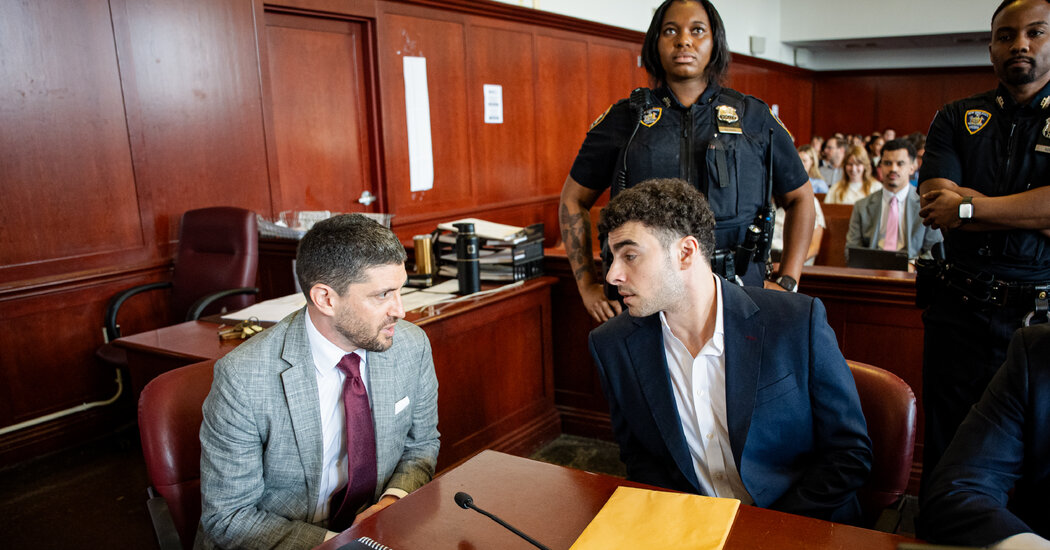
Luigi Mangione’s lawyers plan to argue that he was experiencing “extreme emotional disturbance” when he killed a UnitedHealthcare executive in Midtown Manhattan in 2024, a state judge said on Wednesday.
The disclosure in the State Supreme Court hearing amounts to a tacit admission by his lawyers that he killed the executive — the first time his lawyers have done so.
In New York, if defense lawyers can convince a jury that strong emotions resulted in a “profound loss of self-control,” leading to a homicide, the highest charge their clients can be convicted of is manslaughter.
Mr. Mangione has pleaded not guilty.
Justice Gregory Carro, who is overseeing Mr. Mangione’s case, said at the pretrial hearing that he would unseal documents and a transcript of a hearing earlier this month related to Mr. Mangione’s mental health defense.
The disclosure comes less than three months before the scheduled start of Mr. Mangione’s trial in September. He faces multiple charges, including second-degree murder. He is also facing federal charges in a separate trial.
Mr. Mangione, 28, is accused of killing the executive, Brian Thompson, on the morning of Dec. 4, 2024. Surveillance footage showed a man in a hoodie emerge from between parked cars, point a handgun affixed with a silencer and fire at Mr. Thompson as he walked toward the hotel’s entrance.
“He’s saying that he did it, which is a big concession,” said Gary Galperin, a former state prosecutor in Manhattan who now teaches at Cardozo School of Law. Mr. Mangione’s legal team has the burden of proof to convince the jurors that his action was an understandable response to his grievance against health care insurers, Mr. Galperin said.
“While it’s a viable defense, based on these facts, he will have a high hurdle to convince a jury,” he said.
While Mr. Thompson’s killing shocked some Americans, others viewed it as a manifestation of long-running frustrations with rising health care costs.
The state’s case also narrowed on Wednesday, when Justice Carro granted the defense’s move to dismiss a charge related to an ammunition magazine that he ruled last month could not be used as evidence at a trial.
In his decision last month, Justice Carro said a gun and notebook found inside of Mr. Mangione’s backpack at the time of his arrest could be used as evidence during his murder trial, while other items would be omitted.
Mr. Mangione still faces other charges in state court, including second-degree murder which could lead to a possible sentence of 25 years to life.
Last year, Mr. Mangione’s legal team asked Justice Carro for more time to give notice of their intent to offer psychiatric evidence in the case.
At the time, Mr. Mangione faced the federal charge of using a firearm to commit murder, which made him eligible for the death penalty. In January, a Manhattan federal judge ruled that prosecutors would not be able to seek the death penalty against Mr. Mangione, dismissing two counts and leaving intact two stalking charges.
Extreme emotional distress is a defense that is typically connected to a triggering event that defendants argue created an overwhelming feeling of stress that led them to lose control, said Barry Kamins, a former New York judge who is now a defense lawyer. Some states call similar strategies the “heat-of-passion” defense, he added.
Where the defense has been successful, Mr. Kamins said, lawyers have argued the crime was an immediate reaction to an event during which the emotional disturbance remains active, “rather than over a period of time.”
Prosecutors in state and federal court have argued that Mr. Mangione’s actions were planned. They have pointed to notebook entries dated months before the killing in which they say Mr. Mangione wrote “the target is insurance” and described his “intent to ‘wack’ the C.E.O. of one of the insurance companies at its investor conference.”
On Wednesday, Joel Seidemann, a prosecutor with the Manhattan district attorney’s office, said the defense team had “stonewalled” them by not disclosing who they planned to call as an expert witness to establish emotional distress.
Justice Carro ordered Mr. Mangione’s team to hand over that information by Thursday, saying that prosecutors need to know “what malady it is that this defendant suffers from.”
“I’m not going to let you surprise the People on the eve of trial so get it done,” he said.