
Cottage Industry
A.D. NYC
May 25–June 28, 2026
Queens
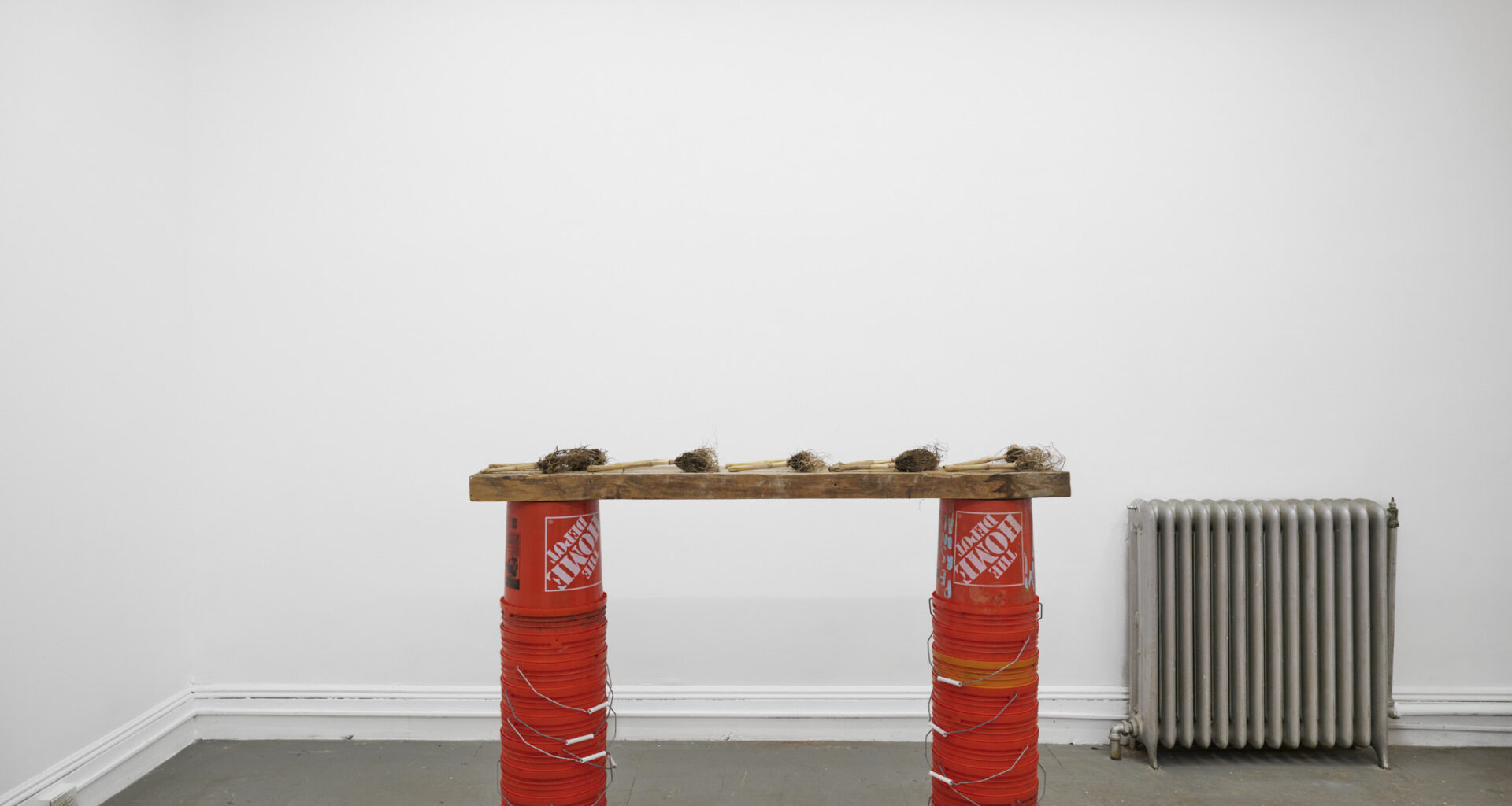
Cottage Industry, A.D.’s first show since leaving Two Bridges for Ridgewood, showcases three artists whose work evokes the small, craft-based operations of the show’s namesake. Each artist fashions one-of-a-kind works in studios and backyards, and sources their materials from their immediate surroundings. Bright orange Home Depot buckets, raw slabs of wood, paper towels, old sweaters, and stuffed animals bring the unassuming white room to life.
Liz Magor’s sculpture Pembina (2017) at first appears cute and surreal, but upon inspection, the work becomes disturbing. A hollow, polymerized gypsum cast of a cardboard box retains the relief of tape marks, and the indentations left from the flaws in the box seem like scars. The stuffed animal is actually a seamlessly stitched Frankenstein’s monster, with a pig’s face replacing a monkey’s. The pig’s eyes, the color of eggplant, slant downward in a morose expression. It is a chimera, whose soft little feet are barely latched to the gypsum pedestal with hidden magnets. The creature carefully cradles an upside-down sweater from the waist. The garment hangs like a condemned criminal. A sheer single layer of tulle netting encases the sweater, though the tulle has been cut to foreground a “Pembina Pipe Liner” patch logo. Pembina, a natural-gas infrastructure company, which has been accused of greenwashing and encroaching on Indigenous lands, operates in Western Canada, near Vancouver, where Magor lives and works. The sweater is a Cowichan sweater, a name which honors one of the tribes that popularized the warm, nearly waterproof garment. Hand-knit from wool, these sweaters usually feature an impressive collar and are known for their patterns of Canadian flora and fauna. Indigenous peoples invented the style, which blends European and native garment-making techniques, during the forced Westernization campaigns by the Canadian government. The sweater is also colloquially referred to as a “Siwash sweater.” Siwash is likely a slang term for “savage.” The sweater would eventually become associated with Canadian identity more broadly, and be featured in Olympic celebrations. Like the homunculus pig-monkey, the combination of gypsum and cardboard, and the sweater with a sewn-on patch, two entities that were artificially smashed together must now co-exist as one whole.
Brooklyn-based painter Joseph Brock also blends surprising materials in his physically dense paintings. Kear and Noel (C.4) (2025–26) encases paper towels beneath layers of acrylic medium, a kind of paint without pigment. This makes the perfectly rectangular objects appear foregrounded, evoking the precision of buildings. Dotted patterns on the paper towel suggest constellations, a stitching pattern, a logo, or a child’s first attempt at tracing letters. The dotted shapes are in the process of becoming communicative but stop short. The dots do not even appear on the same layer of the canvas, suggesting an editing process, where additions to the communication have been made at distinct times. Viewers at the opening craned their necks to inspect the mysterious painting more closely. The points of interest in Brock’s other painting Kemble’s Eyelets (C.4) (2026) are the edges of the canvas. The two simple crayon lines draw the viewer’s eyes down to the bottom of the frame, where one can ruminate on the build-up of scrap cloth, acrylics, and gesso.