
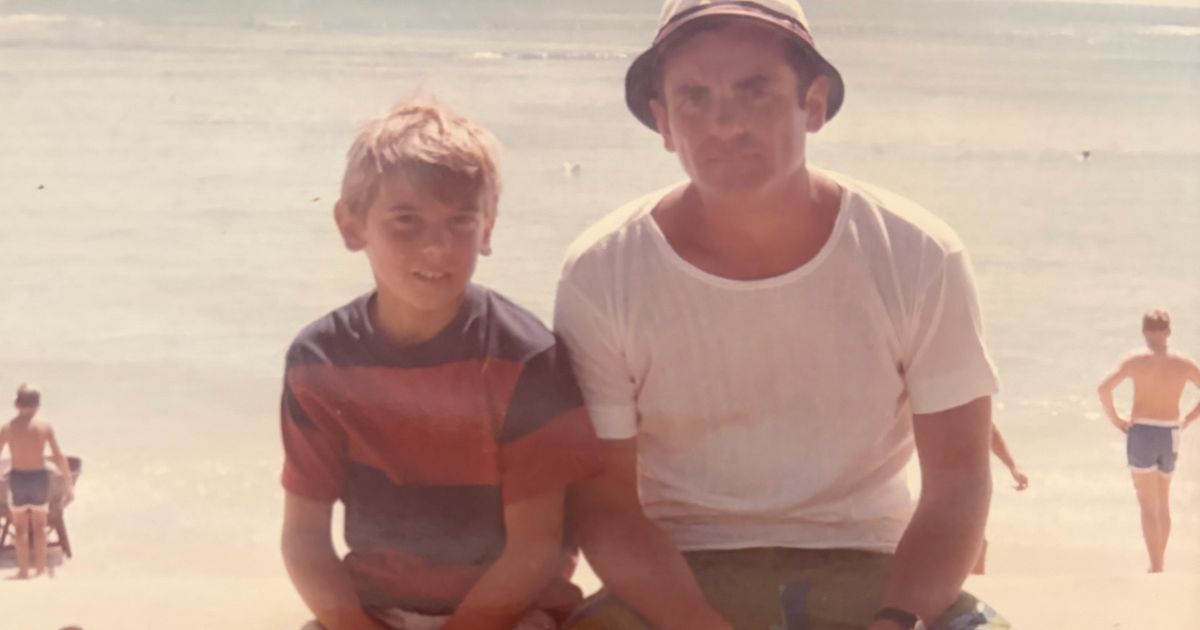
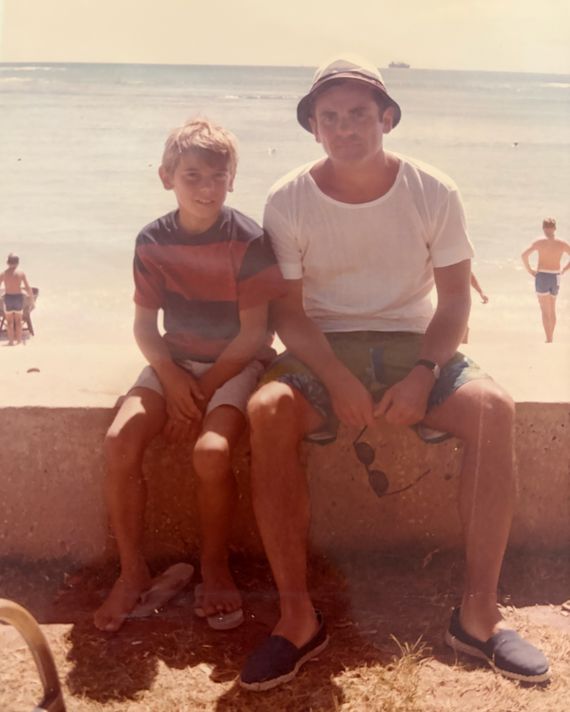
Griffin and Dominick Dunne.
Photo: Courtesy of the writer
This article was featured in New York’s One Great Story newsletter. Sign up here.
Hey Lenny, David Selznick’s obit got on the front page of the Times,” Dad called to my mother when he returned home with the paper. “One, two, three,” he muttered, running his finger over the newsprint, “five columns!”
In the early 1960s, it took a lot of moving parts to ship the New York Times to Los Angeles. First the editors would put the paper to bed at midnight, leaving room for a late-breaking story. When the text was finalized, the “bulldog,” as they called the early edition, was fed onto conveyors and then twined, bundled, and loaded on trucks headed for the recently named John F. Kennedy International Airport. Depending on cargo space and on-time departures, the paper would arrive at L.A. newsstands bearing word of current events that were by then 24 to 48 hours old. By the time Dad had bought the paper that day, David Selznick, the producer of Gone With the Wind, had been dead for two days.
“Selznick’s lucky he cooled on a slow news day,” Dad said, half to me and half to the picture of the dead guy, who didn’t strike me as lucky at all, “or he never would have gotten on the front page.” (“Cooling” was my father’s favorite word for dying.)
It might have startled an outsider to overhear such morbid pragmatism from a father speaking to a 10-year-old, but Dad was Irish Catholic, raised to fight the fear of eternal darkness with the darkest of humor, a trait I’d eventually inherit like a whoopee cushion in a coffin.
“You know who really got fucked,” he continued, “C.S. Lewis. The guy who wrote The Chronicles of Narnia that Mom keeps trying to get you to read.”
“I hate witches,” I said quickly, sullen, knowing his remark was a dig at my failing grades.
“Well, your mother loved him.” He said Lewis had died the same day as the Kennedy assassination. “Lenny was as upset that no one would notice his death as much as she was about the president getting shot.”
My mother, Ellen, had left behind her dream of being an actress in New York the day I was born. She seemed to find her solace in the novels and biographies she burned through two or three at a time; the low strings of Mahler’s Fifth always made her cry.
Dad fixed himself a drink from the bar in our den and sat next to me, returning to the two-day-old paper. My mother was in the kitchen and out of earshot when he fired up another of his unfiltered Camels.
My father, Dominick, was a young man then, in perfect health, a television executive early in his career. But he read the obits most days — sighing over the loss of Clara Bow, gloating about a dead NBC honcho who’d treated him poorly — and my earliest misguided insight was that unless the New York Times announced your death, you hadn’t really lived.
Dad didn’t seem to give much thought to his own death, except on the rare occasions when the obits carried news of a deceased classmate from Williams College. He knew that if he were to die soon, he wouldn’t be Times worthy — maybe he’d get a passing mention in Variety. But he felt certain that if he lived long enough to fulfill his ambitions — doing exactly what, he wasn’t yet sure — he would make the paper of note. His dreams for who he might become radiated off him in those days. I remember my anxious concern, should those dreams not come true.
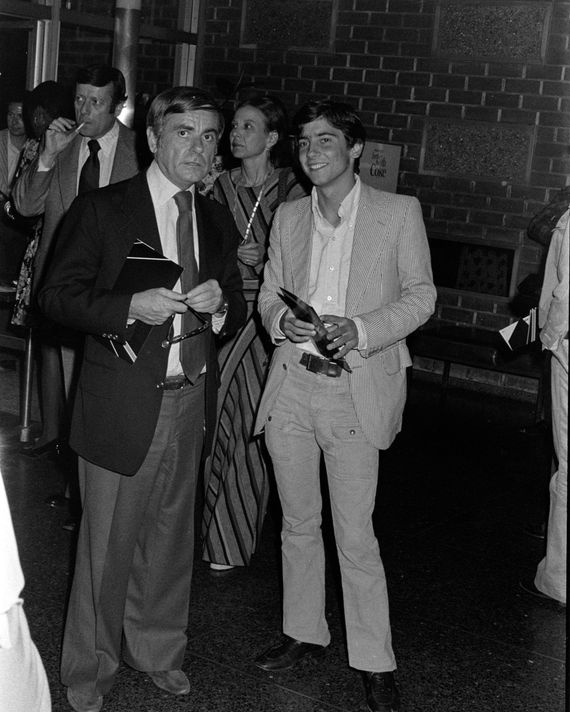
Photo: Fairchild Archive/WWD/Penske Media via Getty Images
When I moved to New York at the age of 19 in 1974 to be in the theater, an older actor who’d once been on Broadway told me that obits were a great source for finding an apartment. Despite my father’s interests, I’d always skipped over the business stories and obituaries, but I’d overstayed my welcome on friend’s couches.
The first morning I looked, a headline blared in the D-section of the paper: “Doris Vinton, 81, Dies; Was a ‘Follies’ Dancer.”
The “follies” were the Ziegfeld Follies, a series of extravagant theatrical revues that ran from the turn of the century to the mid-’30s. If anybody had a rent-controlled apartment, it would be an old hoofer who’d probably held onto it since before the Depression. Reading on, it felt as though she were tap-dancing toward me, out of the grave. I learned she’d starred opposite W.C. Fields at the age of 13; I imagined the loneliness of a child in the company of women a decade older and the stage-door Johnnys who assumed every Ziegfeld girl would put out for a box of chocolates. There were no protections for minors on Broadway back then, and when she retired, Doris became their advocate. She later spent her august years helping former Ziegfeld gals make rent. By the last paragraph I admired her so much that I would no more ask her landlord about vacancies than steal nickels from a parish votive. Doris got me hooked on the obits, and I began to read them daily. Just like my father.
It was around this time that I began to learn to read like a writer. I’d been a dyslexic high-school dropout from a family of high achievers, all with degrees from Ivy League colleges. But on arrival to the city, I’d recast myself as an ambitious autodidact. During my downtime between shifts waiting tables, I’d sit in the Map Room at the New York Public Library and devour the books that once intimidated me. I began to take notice of novels’ structures, of the careful weft of character and exposition, especially admiring when it could all be done concisely. I finally appreciated the powerful brevity of my aunt Joan Didion, who famously honed her craft by studying the terse sentences of Hemingway. I realized the masters of this discipline — the most attuned to my attention deficit — were in fact the authors of well-told obituaries, who laid bare the life of a mistress to a monarch; the travails of the last doughboy, the final surviving veteran of the First World War, who departed at 110; the passing of an assassin’s widow.
I became familiar with the Times’ lineup of obit writers and looked forward to reading the latest copy from Penelope Green, Alden Whitman, and the legendary Robert “McG” Thomas the way I would years later look out for a Zadie Smith or George Saunders story in The New Yorker. I couldn’t wait for the next crime boss to get clipped so Selwyn Raab, who grew up around wiseguys on the Lower East Side, would flay him as artfully as he had Carmine “the Snake” Persico, 85, a Colombo-crime-family boss whom he’d described as possessing a “keen intelligence, street-bred guile, an appetite for violence and a willingness to betray.”
Decades later, Penelope Green would call me out of the blue to ask if I wanted to give a quote on the passing of the first dear friend I’d made in New York, the journalist Jesse Kornbluth. I was astonished to be speaking with her, as if I’d spotted a white tiger or been introduced to Mike Nichols, and told her I was a “huge fan.” Catching myself, and trying to tone it down a bit, I said, “I got a thing about obits.”
My thing about obits wasn’t limited to the Times. By then, I could be as moved by a three-inch announcement in a small-town paper, purchased by a recent widower. Not long ago, the daughter of a very close friend died suddenly. Overcome with grief, he collapsed into silence, unable to speak to those who cared for him or even respond to our emails. I loved this man for his laughter and his bear hugs and worried this unexpected loss would forever mar his joy. When he sent me a link, and nothing more, to his daughter’s obituary in the Times, written by Alex Williams, I took it as a sign that he might survive after all.
Williams captured the ferocity of his daughter’s paintings, noting her influences as Egon Schiele and Alice Neel and describing her enormous canvas of January 6-ers storming the Capitol as “a brutal tour de force.”
To her father, the piece was a tether to the child he raised — she was alive within its lines — and proof of how much she’d accomplished in her brief time on earth. It cheered me somewhat that my pal, himself an accomplished novelist, would see that she’d garnered a remembrance written with such respect.
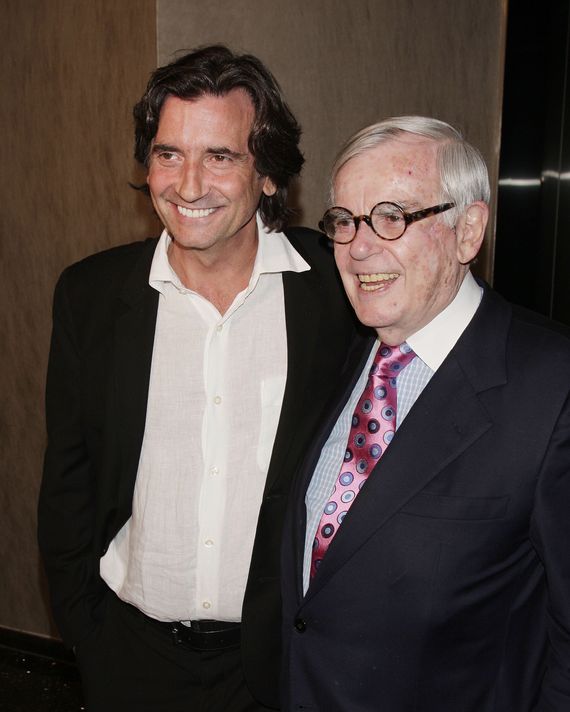
Photo: Kevin Winter/Getty Images
By the first decade of 2000s, the last decade of my father’s life, he was a renowned journalist, known for his longform stories in Vanity Fair. Now and then, he’d get a call from a copy editor at the Times’ obit desk to update his file for their “advance,” the in-process story of his life, prepped to be ready when his time came. Dad found this hilarious and would keep the conversation going far longer than the editor expected. He’d always ask, “Do you know something I don’t?,” providing some relief from the caller’s awkward task.
When the desk called again as my father neared 83, he brought the editor up to speed about everything but the cancer that had spread from his prostate to his bladder. He’d almost finished his final novel, he said, but failed to mention that he’d refused an operation that surely would have extended his life. The long and painful rehab would have interfered with his writing; the dread of leaving behind an incomplete manuscript outweighed the benefit of a few extra months. I was hopeless to convince him otherwise.
Time moves quickly, and with less than a year to finish the novel, being under “deadline” took on new meaning. Dad’s advancing cancer left him in constant discomfort that made working on the book more difficult than he’d expected. He shifted his focus instead to meticulously planning for his funeral, entering preproduction for a pageant he wouldn’t live to see.
Dad had become a movie producer after his days in television, and the memos he emailed me, arriving in bursts, with David Selznick’s Benzedrine-driven sense of urgency, reminded me how good he’d been, before his last two movies flopped in the ’70s and he never got to make one again. He had a great eye for how things should look, and I remember him on the set of Play It As It Lays, adapted by Joan and my uncle John Gregory Dunne from her novel, driving the production designer crazy. He was constantly adjusting the set for the Hollywood home of the main character, Maria Wyeth — a neurotic, out-of-work actress — moving around candles, trade papers, and framed photographs the art director had carefully placed.
Now, planning his grand exit, Dad dictated that I use Frank E. Campbell, the century-old funeral home on Madison Avenue, for the basic arrangements; nail down the location at Saint Vincent Ferrer; notify the cast of eulogists and pallbearers; and earmark the budget to cover hors d’oeuvre and liquor for an after-party with 300 guests at the Union Club. The church was very strict about the music, allowing only Ave Maria and The Battle Hymn of the Republic. Dad went with Battle Hymn for his coffin’s exit but insisted that when my daughter Hannah, then 19, got up to speak, she should sing My Funny Valentine, the last beat of an inside joke between them. From the time she turned 4, he’d sent her roses every Valentine’s Day with the note, “From your secret admirer.”
“She should get up to the altar as if she’s going to speak and then burst into song,” he wrote, “The Monsignor’s going to shit himself but fuck’em, I’ll be dead anyway.”
Far into the last year of his life, Dad still traveled on Vanity Fair’s dime — to cover a costume ball in Tangier or a murder trial in L.A. — and he’d never board a plane without dashing off last-minute instructions that began: “In case of another flight United 93–9/11 or some such thing, here are my latest instructions for my leave-taking.” One such missive asked me to pass on directing tips to Father Daniel Morrissey, who he wanted to officiate his “low mass not high mass”:
“Tell him I like drama, and he should dress for the part in Jesuit attire. Ask him to speak about me briefly. He knows me. He knows my Hollywood friends. I met him at Rocky Cooper’s funeral” — the wife of Gary — “where he read a prayer written by Rosalind Russell,” another actress of the Golden Age. “I thought,” Dad said, “That’s my kind of priest.’”
Until the last month of his life, when he required round-the-clock care in his apartment on East 49th, Dad was still full of vim and vinegar, greeting well-wishers at his table at the ‘21’ Club or Swifty’s. He loved getting in the mud with whoever crossed him on any given day. I remember the very mention of Bobby Kennedy Jr. could set him off enough to withdraw a Smythson’s pad from his breast pocket and jot down a barb to toss the next time he badmouthed Kennedy on Larry King. (Their loathing for each other had begun after Dad accused Kennedy’s cousin Michael Skakel of murder and Kennedy said on air Dunne “is not a journalist; he’s a gossip columnist.”) Everyone who has lost a parent has wished they could tell them about a current event from the world they left behind. My wish is to see my father’s face when I tell him Bobby has a worm in his brain, collects racoon penises, and is a vaccine skeptic whom President Trump appointed to be secretary of Health and Human Services. “No, wait. Back up,” he’d most definitely say. “He was appointed by President who?”
Dad had a mercurial temper that could become obsessive, but in that final year I knew that’s what was keeping him alive. When planning his funeral, an unintended slight could ignite the reordering of eulogists or the dropping and replacement of a pallbearer, only for them to be brought back again days later. There were so many friends he wanted to participate, then didn’t, and then wanted back, that we decided to list everyone on this long roster as “honorary pallbearers.” This meant no one had to carry the casket but each would get a mention in the program.
One morning in early spring, shortly after he’d been diagnosed, I woke to a voice-mail from Dad; he’d called from Claridge’s Hotel in London, where he was on assignment for Vanity Fair. I heard an alarm wailing in the background as he gravely announced, “The hotel’s on fire, and we’ve been ordered to evacuate. If I don’t make it out of here, I’m telling you now, I do not want Graydon Carter at my funeral! I want you to stand at the top of the steps at Saint Vincent Ferrer and bar his entrance.” Graydon was then the editor of Vanity Fair and effectively my father’s boss. He had enormous respect for Graydon, but he had been the magazine’s undisputed star since the early ’80s, and the two were prone to battles of the will, phone slamming over matters as trivial as hotel reimbursements, and threats of quitting from my father, who in fact would never have left and always called the magazine his “home.”
Maybe two weeks after his order to stand my ground with Graydon at the church doors, I received this predictable retraction: “Never mind what I said about him. Put him back on the list. We had a nice talk.”
When it was announced, in May 2008, that Ted Kennedy’s brain tumor was malignant, it seemed he and Dad were neck and neck in the race to meet their Maker. I had the inside track on Ted’s deathwatch because the senator’s family priest, the future officiator Father Morrissey, also happened to be my father’s and, for months, had been taking the Acela between D.C. and New York to sit bedside with the two men until their appointment in Samara. If I could have begged anything of Father Morrissey, it would have been to use his influence to keep them from cooling the same day and not let my father’s death be as forgettable as C.S. Lewis’s had been in the shadow of JFK’s.
On August 29, 2009, at 5:05 a.m., Clara, Dad’s hospice nurse, called me from the living room where Dad lay in a rented hospital bed. She said his breathing pattern had slowed to a pace she knew all too well and suggested I hurry.
In the taxi from Tribeca to Turtle Bay, a host on 1010 WINS announced that Ted Kennedy had died the previous night, shortly before midnight. His death had not made the morning’s paper, and I knew it would be on the next day’s front page.
My taxi hit every green light heading uptown, but when I saw my younger brother Alex’s face I knew I was too late. Alex had flown in from Los Angeles and slept in our father’s bedroom, where he fortunately woke in time to be with him in his final moments.
He let me sit alone with Dad for an unknowable time and then joined me to watch our old man travel to an unknowable place.
“You hear about Ted?” Alex whispered, half to me half to Dad.
“Yeah, we gotta talk about that.”
Though the Kennedys had never heard of the Dunnes, my grandparents raised their five children to believe they were in competition to be “the Kennedys of West Hartford.” The shit-talk around their dinner table dated back to Prohibition, when Joe Kennedy screwed over my great-great-uncle on a whiskey deal. Even though a registered Democrat, Dad carried this grudge to campaign for Nixon against Jack Kennedy and, in the early ’90s, depicted Ted as a boozy scoundrel in Vanity Fair while covering the trial of his nephew William Kennedy Smith, who was charged with sexual assault and later acquitted. Many believe my father’s crusade in the magazine against Skakel, another of Ted’s nephews, led to his arrest and eventual sentencing for the decades-old murder of Martha Moxley.
This generational animus had stopped with me the day I started writing chatty letters to President Kennedy about my birthday party, a kid I didn’t like at school, and how pretty his wife was. I’d confide in the handsome commander-in-chief my every triumph and anguish except the one about my father being the chapter head of Catholics Against Kennedy. My lifelong reverence for the slain Kennedy brothers ran deep but not deep enough to let their little brother cockblock my father’s legacy.
On the morning of his death, when Clara saw that Alex and I had left his bedside, she asked in her gentle Jamaican lilt, “Should I be calling the mortuary, Mr. Griffin?”
“Let’s hold off on that for the moment,” I heard myself respond.
Let me emphasize that my father never said, “Hey Kid, when I cool, make sure my obituary is on the front page of the Times.” He never said, “If a pope, or especially a Kennedy kicks the bucket the same day as me, don’t call the paper until midnight so I get a shot at being placed on section A1 the next morning.” He never said that.
Dad had been lying in state, seemingly content to still be home, for two and a half hours when the first of his many friends called for the latest.
“I’ll take it!” I said, diving for the phone.
“Well he’s sleeping now and looks comfortable,” I recall telling a woman whose loyalty and love for Dad had never wavered, “but the hospice nurse thinks he’ll pass on sometime tonight.” I didn’t say, “Like maybe at 12:02, when I will call it in to the Times.”
So many people phoned that day. So many times I said, “He’s resting,” or “Now is not a good time to visit.” Between my countless lies, sandwiches from the East Side eatery William Poll arrived as well as orchids and other flowers from Jerome Florists. For a brief time, I worried Father Morrisey would unexpectedly drop by, but my divine intuition sensed he was a star-fucker who’d rather be hanging with the Kennedys in D.C.
The only person to drop by unannounced was my old pal Jesse Kornbluth — the journalist Penelope Green would call about 16 years later — to deliver the pure-grade sinsemilla that Dad always enjoyed. I was too busy lying on the phone to greet him, so Alex took him for a drug dealer and turned him away. My brother knew of my plot but remained indifferent as grief took hold. For me, grief was a luxury I couldn’t yet afford, lest it distract me from the lying ahead.
Six hours from the moment my father’s heart stopped, my duping had left me drained and I longed for a sounding board to support my treachery. I couldn’t think of one friend who wouldn’t be aghast that I was hiding my father’s corpse from the media, so I chose to unburden myself to a professional in the dead-body business, calling the mortuary director of the Frank E. Campbell funeral home.
“I just want to hold off on the announcement,” I said, “at most until midnight so Dad might have a shot at getting on the front page … ” Silence on the other end. “So … I’m calling for a later pickup.”
His reaction was so nonchalant you’d think I was the fourth guy to tell him the same plan that week.
“Of course, Mr. Dunne, we will have a vehicle standing by and ready whenever you choose. We know the building, and there is a back entrance we can use to avoid the press.” These guys had buried Judy Garland and Jackie O.; ignoring a family’s private Weekend at Bernie’s for a few hours was not going to be a problem.
Then, at a little after 3 p.m. the phone began to ring off the hook. Dad’s well-wishers were no longer wishing us well. The editor of the online paper New York Social Diary, David Patrick Columbia, had broken the story that Dominick Dunne had died early that day. Many of Dad’s many friends read Columbia’s column religiously and were plenty pissed. It seemed the director at Frank E. Campbell must have ratted me out — I doubted Alex or Clara had even heard of New York Social Diary. The ire I received was well deserved, and I would have handed each slighted friend a cat-o’-nine-tails if it meant they wouldn’t tell the outside world what I had done.
“How dare you lie to me,” one caller said. “I’ve known your father since you were born and yet you treated me like some sort of gossip hound!” The only one of Dad’s friends who thought my plot hilarious was Graydon, who called me a “rascal.” I was grateful Dad had put him back on the list.
That evening, the Times published my father’s obituary online, and the next day, a banner of black ink was stamped at the top of the front page, across its full width: Senator Kennedy, Battle Lost, Is Hailed As a Leader. Several articles on Ted’s life and legacy sprawled above and below the fold. Dad’s story was understandably relegated to the D-section alongside the obits of a theater producer and a union labor attorney. Dominick Dunne, Chronicler of Crime, Dies at 83.
Written by Enid Nemy, the piece elegantly condensed the complicated life of a complicated man: his painful childhood, his heroism during the Battle of the Bulge, his start as a stage manager in live television, his marriage, divorce, battle with the bottle, sobriety, and his rise to fame as a journalist. I read through the first paragraph eagerly and noted its familiar structure: the occupation that would later be elaborated, the cause of death.
And then came the ambush: “The Dunne family spokesman,” the text read, “had initially declined to confirm the death, saying the family had hoped to wait a day before making an announcement so that Mr. Dunne’s obituary would not be obscured by the coverage of Senator Edward M. Kennedy’s death.”
I released a sound as if a knife had been buried in my ribs and slammed my head into the nearest wall. It left a perfect circular dent, as if Sandy Koufax hit it with a fastball — an impression that remains still in my bedroom, reminding me that we don’t control Time; that’s the job of Death and it’s not to be fucked with.
The final kicker to my misadventure came 17 years later, when I reread the obituary through cataracted eyes and noticed, in small print, a credit I hadn’t seen before: “David Carr contributed reporting.”
I’d long admired Carr’s dogged investigations, which struck terror in the hearts of media executives, and I suspected he “contributed” the nugget that exposed my hubris and shame. Dad had also been a fan of Carr’s, and I imagined that, as a fellow reporter, he might have admired this unearthing of my scheme. It was then I began to forgive myself and even believe my father forgave me for turning his obituary into a joke.
In 2021, when starting a memoir about my family, I often felt Dad’s presence as if he were keeping me company. I read his obituary again. Nemy had written, “Even as his health declined, he would show up in his trademark round glasses and a Turnbull & Asser shirt, with the proper white collar and large blue stripes.” She captured the man he’d become after years of struggle to find himself, the man I was most proud of.
His warm encouraging aura returned as I read. I’d forgotten how much I missed it. Only now I felt I was viewing the typeset over Dad’s shoulder instead of him over mine; I sensed his pleasure that Nemy had devoted so much space to his life’s work. I even allowed myself to believe that he, with his dark Irish humor, got a kick out of the lengths I went to, trying for something he’d never asked for. I don’t know if he was really there or not. But I do know that I very clearly heard him say, “Hey Kiddo, I know your heart was in the right place, but I’m dead! What do I give a shit?”
One Great Story: A Nightly Newsletter for the Best of New York
The one story you shouldn’t miss today, selected by New York’s editors.
Vox Media, LLC Terms and Privacy Notice
Related