
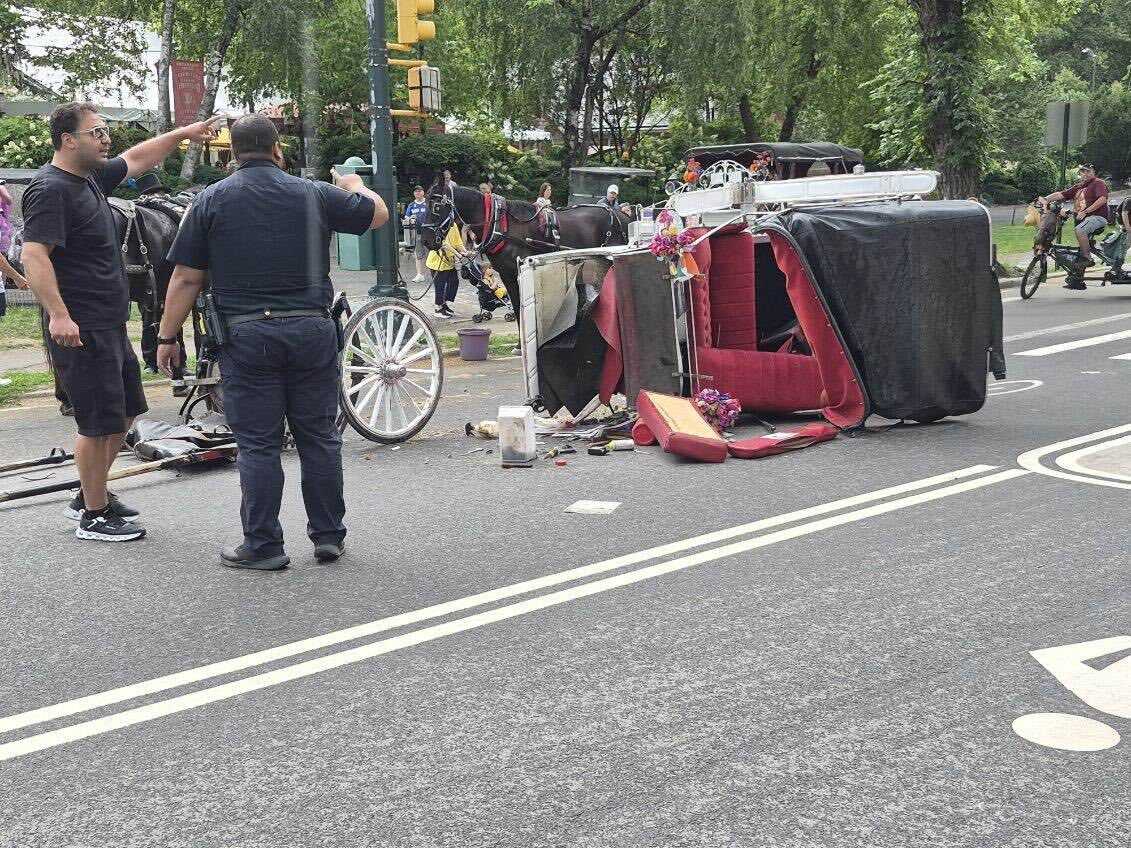
In the aftermath of 18-year-old Romanch Mahajan’s tragic death during a carriage horse accident earlier this week, the union representing industry drivers says it is committed to a “Vision Zero” approach for the industry going forward.
After halting carriage horse operations inside Central Park on Thursday, the union, TWU Local 100, announced it would continue fighting to keep the drivers it represents employed amid mounting pressure to scrap the industry altogether.
That pressure was most evident in the hours after Mahajan’s death on June 17, when City Council Speaker Julie Menin announced that Ryder’s Law, a bill to ban horse carriage operations in New York City, would get a hearing next month.
Mahajan was killed when the horse pulling the carriage he was riding in bolted after its driver had disembarked to take a picture of his passengers, according to a source familiar with the investigation into the debacle. The carriage then flipped over, causing Mahajan to experience severe head trauma — later dying at a nearby hospital from his injuries.
It falls into a pattern of recent, dangerous snafus involving carriage horses, in which both pedestrians and the horses themselves have been placed in harm’s way.
Local 100 Administrative Vice President Alexander Kemp, during a virtual press conference on Friday afternoon, said Mahajan’s death was “eye-opening” — noting that a person has never been killed in a carriage horse incident before.
“It’s something that we never could have prepared for,” Kemp said. “It’s something that you never would think could happen, would happen.”
Critics of the industry — including numerous elected officials and animal rights groups such as New Yorkers for Clean, Livable, and Safe Street (NYCLASS) and PETA — have argued for years that horse carriages are dangerous for park-goers and inhumane for the animals themselves.
But Kemp also said the union is using the tragedy as a moment to reevaluate its practices.
“You kind of have to take it and take a step back, identify, you know, ways to prevent it from happening again, and use it as, although extremely unfortunate and sad, a springboard to make the industry safer,” Kemp said.
Horse carriages on a ‘safety stand-down’
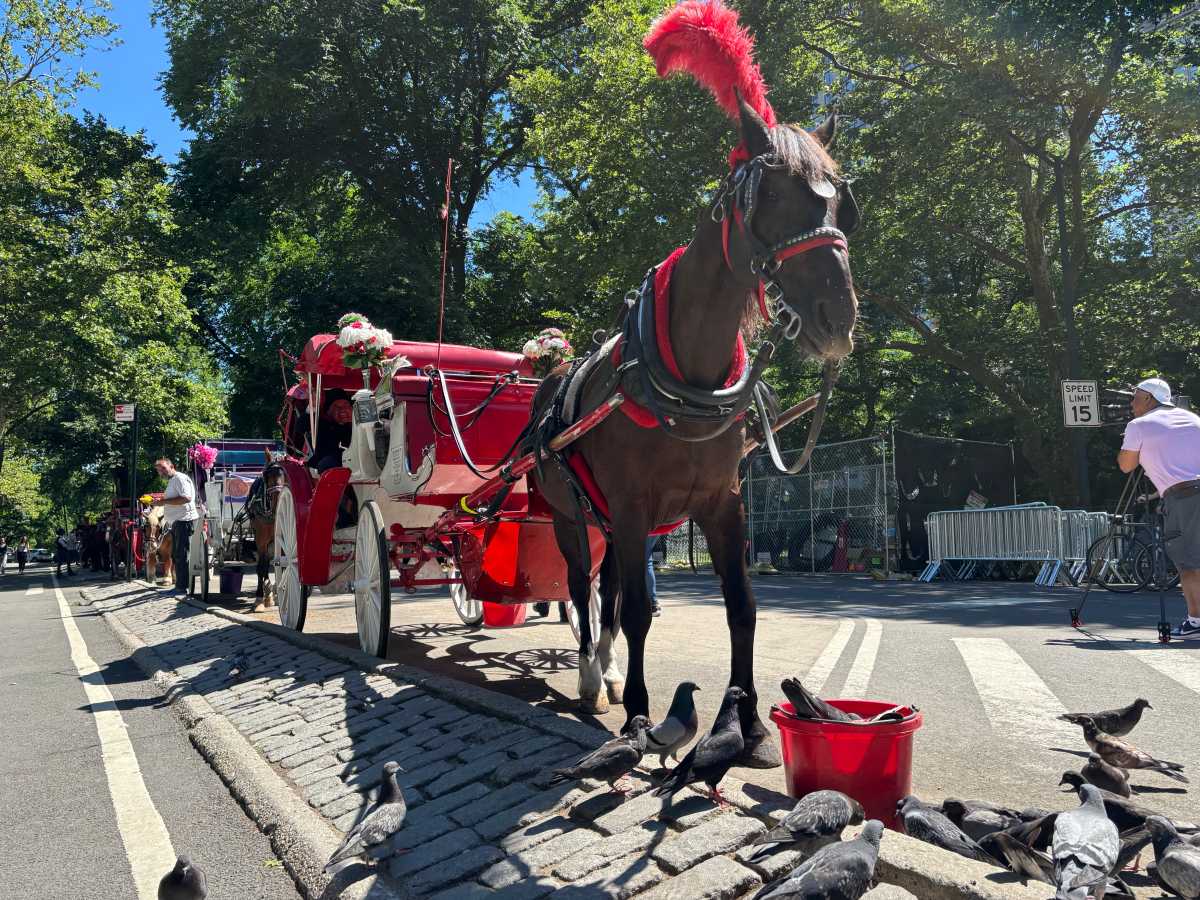 FILE – A carriage horse near Manhattan’s Grand Army Plaza at the southeast corner of Central Park. Tuesday, June 16, 2026.Photo by Ethan Stark-Miller
Those steps include a “safety stand-down” that began Thursday and will last through Sunday, the union said.
During the stand-down, there are no carriage horse rides taking passengers around the park. However, carriage drivers and stable staff will still take horses out of their stalls for exercise on those days.
Over the weekend, Kemp said Local 100 will hold meetings with drivers to review current regulations and procedures governing carriage horse operations, including how to maintain control over the animals, and come up with new ways to prevent dangerous incidents in the future. He said they will also host a “refresher training” to go back over what drivers initially had to learn to obtain their licenses on Monday inside of Central Park — before bringing back passenger rides on Tuesday.
“It’s the equivalent of you maybe losing your license or getting a DWI and having to go back through driving school,” Kemp said. “You want to make sure that you are not only using the industry standard, but you’re adding extra measures that potentially don’t exist. But that’s where right now we’ve taken a pause to try to identify what ways that we can do that.”
Local 100 spokesperson Pete Donohue said the union is developing the new training protocols “as we speak.” He said those include having drivers double-check to ensure their horses are hitched properly when leaving the stable, always walking and not trotting their horses, tethering the horse at every opportunity, and not leaving the driver’s seat until passengers have disembarked.
Furthermore, Local 100 called on the city Department of Health (DOHMH), which is responsible for testing drivers to obtain licenses, to begin regularly checking drivers on-site in the park to ensure they are following proper operational protocols. The union said DOHMH could check to make sure drivers are in their seat and holding the reins before passengers board; either in the same position or standing at the front of the horse while at a carriage stand; and tether idle horses to something sturdy.
Finally, Local 100 wants the city to help it identify locations for hitching posts, which Donohue said it could begin doing immediately.
“Due to the immediacy of the situation, the urgency of the situation, it would seem common sense for the city to stick a couple poles in the ground and prevent this,” he said.
The DOHMH said it welcomed the industry “taking a hard look at any steps it can take to maintain safety.”
“This week’s death associated with a carriage horse ride is a horrible tragedy. The NYC Health Department already requires carriage horse drivers to ensure that a horse is not left to roam freely and possibly cause harm to the public or itself, and the Department trains drivers on this and other health and safety requirements,” a DOHMH spokesperson said. “The department also conducts inspections at the stables and Central Park, as well as outreach and education for owners, to promote compliance with health and safety mandates.”
‘Ryder’s Law’ says union effort is moot
But Christopher Marte, the Manhattan City Council member sponsoring Ryder’s Law, feels the changes Local 100 proposed can only go so far.
“No amount of safety measures can change the basic reality that horses can spook and bolt in an instant,” Marte spokesperson Simon Kostelanetz said in a statement.
“It only takes one second for an 1800 lb. horse to become impossible to control in a crowded public park, and that is how tragedy happens,” he continued. “This week’s fatal crash made clear that the issue is not a lack of small reforms; it is that horse-drawn carriages are inherently unsafe in New York City. The Council must pass Ryder’s Law and end this industry while creating a real transition for workers into safer, stable jobs.”
The Central Park Conservancy, which manages the park, is a sharp critic of the industry and also supports Ryder’s Law. Animal rights groups — such as NYCLASS and PETA – have also long pushed for it.
But Kemp insisted that while the union is taking the tragic incident as a gut-check, NYCLASS and others are seizing on it to push their longstanding desire to ban the industry.
“You cannot throw the baby out with the bathwater, and you cannot use this as a springboard to make an argument that you’ve made for 10 years,” Kemp said. “This circumstance, indeed tragic, indeed horrific. But I feel, we feel, that it should not be used as a measure to push a long-standing narrative against what the industry is relative to this isolated incident.”