
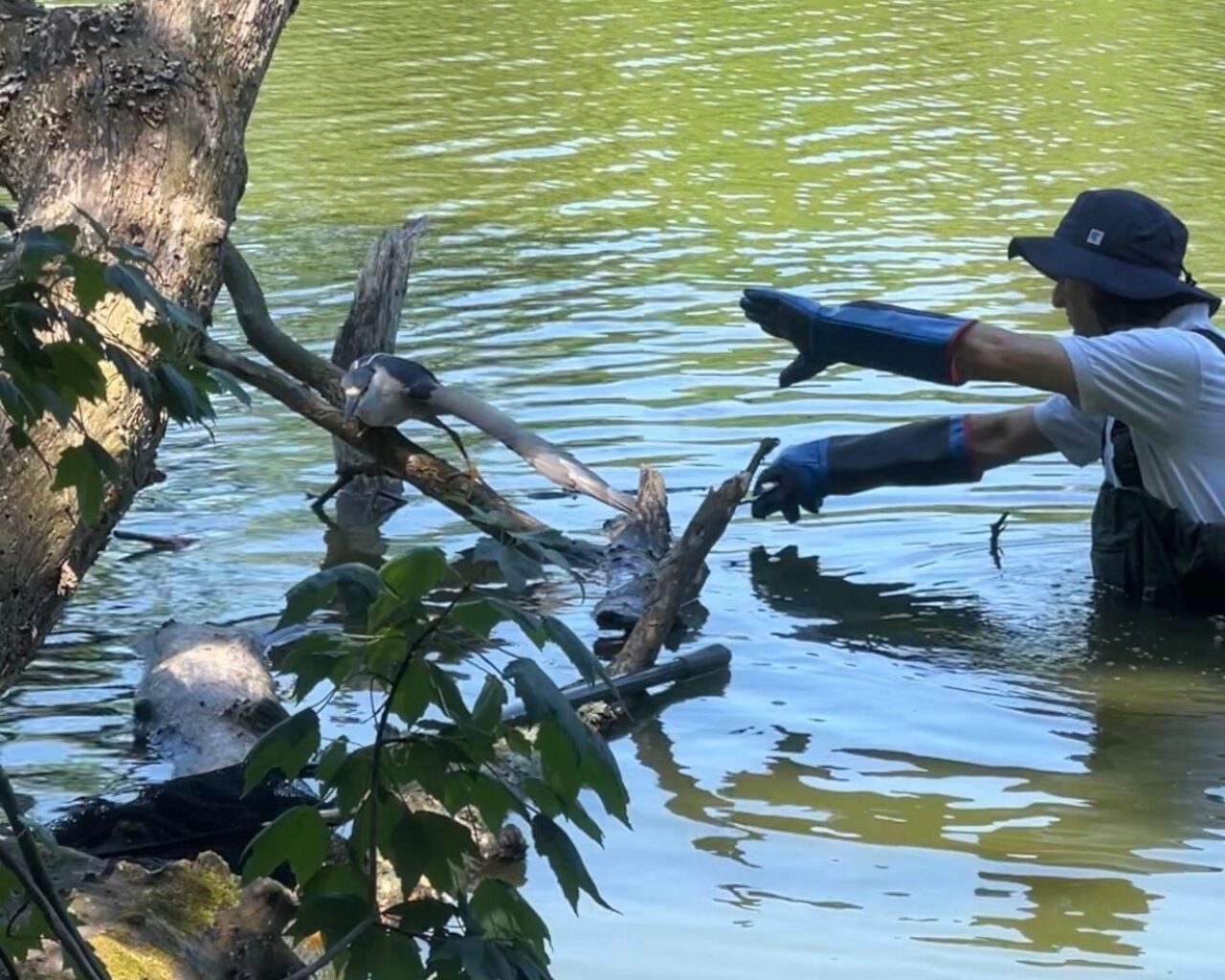
STATEN ISLAND, N.Y. — Tonja Fenton was on one of her regular, midday fishing expeditions when she noticed a small bird lying on some tree branches near the water.
This is a common sight at Wolfe’s Pond Park in Prince’s Bay, which has an extensive bird population living at its beach and in its waters, but this was no ordinary bird sighting. This was a Black-crowned night heron, a largely nocturnal bird known for its stocky appearance and piercing red eyes.
The species is common in New York, but a recent Audubon New York City Bird Alliance study found that there has been a dropoff in Black-crowned Night Heron numbers.
According to Audubon, the herons have lost more than half of their breeding population and are at risk of disappearing completely in the next decade. Possible reasons for this decline include pesticides, predators and human disruption.
“It’s common, so it didn’t really dawned on me until some passersby looked around, and said, ‘Well, what kind of bird is that?’,” shared Fenton. “At that point, I realized, well, he’d been in the same spot quite some time, and that’s what made me take notice that he was stuck.”
Fenton immediately sprung into action, alerting a New York City Parks Department employee, who she identified as Jorge, of an injured and trapped bird. Jorge, along with a supervisor who she identified as Andrew determined that the blue and white bird was tangled in fishing wire and likely had been struggling overnight.
“The bird was actually trapped in a fishing line that was wrapped around a branch, and his wing was entirely caught, so he was just there. I guess he had given up the struggle because he had stopped fighting at that point,” Fenton recalled.
Within minutes, Andrew fearlessly waded into the dark water and began cutting at the wire. The heron, scared and in pain, attempted to snap at him, but Andrew continued on, eventually freeing the bird.
Fenton had never seen anything like it, and had only previously interacted with the park staff to ask for directions or fishing questions. While they had always been very welcoming and helpful, she was shocked to see how quickly they responded and how crucial they are at protecting the space.
“I honestly believe that had they not jumped into action and got him out when they did, while the hawks were circling around… it was good to see them rescue him,” Fenton said. “Had they not jumped into action when they did, the way they did, it could have gone a whole different way.”