
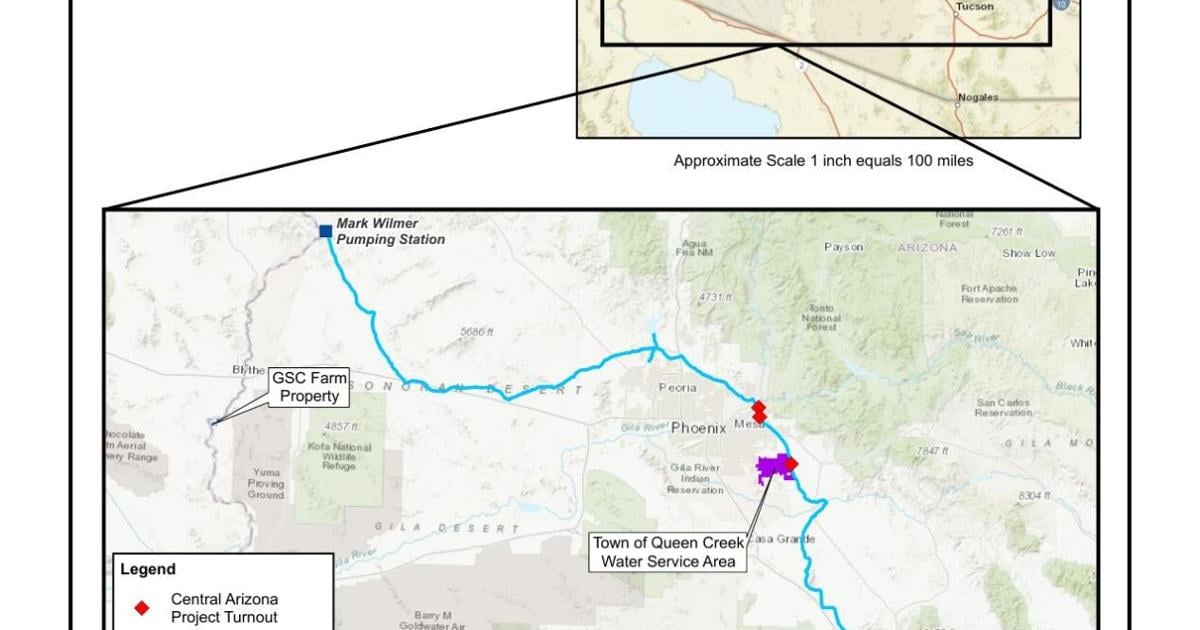
Queen Creek Town Council this week is scheduled to take a step toward a possible $240 million deal to purchase Colorado River water from western Arizona landowners.
On the agenda is the transfer of nearly $45.7 million in unused or excess funds from the town’s capital project accounts toward the deal, which will be part of an overall purchase scheduled to go before Council on Nov. 19.
Town Manager Bruce Gardner told Council in a memo that Queen Creek “has an opportunity to purchase an additional 12,000 acre-feet to reduce its reliance on the Central Arizona Groundwater Replenishment District and provide an assured water supply to its residents.”
He added the offering price of $20,000 per acre is good until Feb. 15.
In advance of Council’s meeting, the town will hold an informational session for the public at 6 p.m. Nov. 10 at Community Chambers, 20727 E. Civic Parkway “to provide information about an upcoming decision related to investing in the Town’s water future,” according to a town release.
“Investing in the strategic source of water would allow the Town to become a designated water provider earlier than projected, reduce local groundwater pumping and move away from the Central Arizona Groundwater Replenishment District (CAGRD),” the town said.
“Queen Creek continues to take important steps to secure a reliable, long-term water supply for residents and businesses. Since purchasing its first water company in 2007, the Town has worked to manage water service levels and costs with the goal of becoming a Designated Water Provider, a certification granted by the Arizona Department of Water Resources (ADWR),” the release said.
“This designation, already held by most Valley municipalities, ensures a 100-year assured water supply for the community.”
Noting the town already has an agreement in place to buy 5,000 acre-feet annually from the Harquahala Groundwater Basin, the release said Queen Creek “locked in a price to secure up to 12,000 acre-feet of additional water.
“This additional supply would fill the final gap Queen Creek has to prove a 100-year assured water supply, without relying on additional local groundwater, opening the door to become a Designated Water Provider,” it said, adding that town officials “worked quickly to identify and lock-in an allocation” of addition water supply from the Harquahala Groundwater Basin to beat out competition from other area municipalities.
The announcement also said that Council on Nov. 19 not only will vote on the agreement but will “establish a future Water Resource Fee”.
“Currently, Queen Creek delivers treated groundwater to customers. Under Arizona’s 1980 Groundwater Management Act, all groundwater pumped must be replenished.
“To meet this requirement, most Queen Creek customers are members of the CAGRD, which is included in their property tax bill (properties developed prior to 1996 are exempt).”
It noted that most CAGRD customers “may not be aware of the full cost of these fees, as the Town of Queen Creek has been utilizing water credits to offset these costs for its customers.”
“Depending on the year the community was developed, these costs were reduced anywhere from 33% to 100% – saving Queen Creek water customers approximately $58 million since 2018,” the town said, warning the use of water credits “cannot continue indefinitely, so whether or not Queen Creek becomes a Designated Water Provider, these fees cannot continue to be offset.”
The town said once it becomes a Designated Water Provider, it can become become a CAGRD Member Service Area and eliminate the fee from property owners’ tax bill.
But it warned that while a water rate increase remains to be determined, “current CAGRD members will see the costs similar to those on their property tax bill move to the water bill, along with the amount that Queen Creek has been offsetting over the past seven years.
“To some residents, this may feel like an increase as the property tax is normally paid through the escrow account and not paid monthly like the water bill.”
The town also stressed it will undertake hearings and that a final decision on the size of the fee won’t be determined for as long as two years.
The transfer of capital project funds is necessary because “the purchase of water resources was not anticipated in the town’s 2025-26 budget,” Gardner wrote.
Although the town declined comment on the overall deal, the unspent capital funds from 19 capital projects as well as additional carryover funds from the capital budget will provide part of the cash needed to close it.
Most of the money from the individual projects is well under $1 million, though $20.8 million will come from money originally set aside for fleet expansion.
Other larger transfers include $3.24 million in unused funds from the aquatic center project, $3.24 million from the public safety complex and $1.5 million for a traffic signal at Combs Road and Sangria Lane.
Other projects involve road, water and wastewater projects with unspent funds ranging from $79,292 to $934,327.
Broken down, $16 million will be moved from drainage and transportation projects, $3.85 million from water projects, $1.55 million from wastewater projects and nearly $25 million from the general capital improvement project budget.
“Projects whose work spans more than one fiscal year are eligible to carry forward open purchase orders and remaining available budget from one fiscal year to the next,” the memo states.
Gardner said staff reviewed projects for committed dollars, budgets and actual spending to identify money that would not ebe used in the current fiscal year.
“If approved, this amount would be transferred to the Town’s CIP Contingency Fund to create expense authority for the water purchase this year,” Gardner’s memo states, referring to the $45.7 million.
Council has met several times in executive session on the purchase and has scheduled another closed-door session at Wednesday’s regular meeting.
The stated purpose of those sessions is an “agreement for purchase and sale of a lot of groundwater rights with Harquahala Valley landowners” in La Paz County.
Queen Creek is renewing a claim to almost a trillion gallons of Colorado River water a year.
The U.S. Bureau of Reclamation is undertaking an environmental impact study of Queen Creek’s claim.
It notes the claim would allow the town to continue taking 1,931 acre-feet of water annually from GSC Farms in La Paz County.
Officials in Mohave County – which also relies on Colorado River water – continue to challenge that proposed agreement and urged residents to speak out during the bureau’s public comment period, which ended Oct.15.
Queen Creek currently has an agreement to buy 2,033 acre-feet a year from GSC Farm in a $24 million deal.
Mohave County officials fought the agreement in federal court, stating it set a precedent for making the Colorado River a commodity that municipalities far away from it could try to purchase.
A federal judge called the Reclamation Bureau’s approval of the agreement “arbitrary and capricious” and ordered it to conduct an environmental impact study that won’t be completed until April 2027 at the earliest. However, the judge did not prevent the town and GSC Farm from going through with their agreement, at least until the bureau completes its environmental impact study.
“Queen Creek’s objective in acquiring the water entitlement is to diversify its water portfolio and reduce its dependence on groundwater,” the Bureau of Reclamation states.
On the other hand, it states, “GSC Farms “plans to develop rural housing and seek to transfer and assign its remaining entitlement to a municipal water service provider.”
The bureau concluded a 30-day comment period on Queen Creek’s proposal on Oct. 15.
Mohave County said the transfer of Colorado River water rights to a town 200 miles away would adversely impact wildlife and tourism for river communities. That county also relies on the Colorado.
Mohave County Board of Supervisors Travis Lingenfelt renewed the board’s opposition to Queen Creek’s latest request, stating in an address to citizens:
“Colorado River water allocated for use along the river should REMAIN on the river; serving the communities, economies and ecosystems that fully depend on it.
“Mohave County strongly opposes creating a precedent where distant Central Arizona municipalities or hedge fund speculators can purchase our water entitlements and transfer them away from our river communities.”
Mohave County officials could not be reached for comment on Queen Creek’s latest move toward that purchase.