

The Brooklyn Bridge most New Yorkers know is a slender wonder of steel wires, stone towers, and sweeping views.

But there’s a less visible part of the bridge at ground level. These are the anchorages—the masonry structures on both the Manhattan and Brooklyn sides that secure the cables supporting the bridge while also carrying approach roads.
Completed seven years before the bridge opened in May 1883, the anchorages are as stunning as the span itself, with their romanesque arches and rusticated walls of granite with limestone trim.
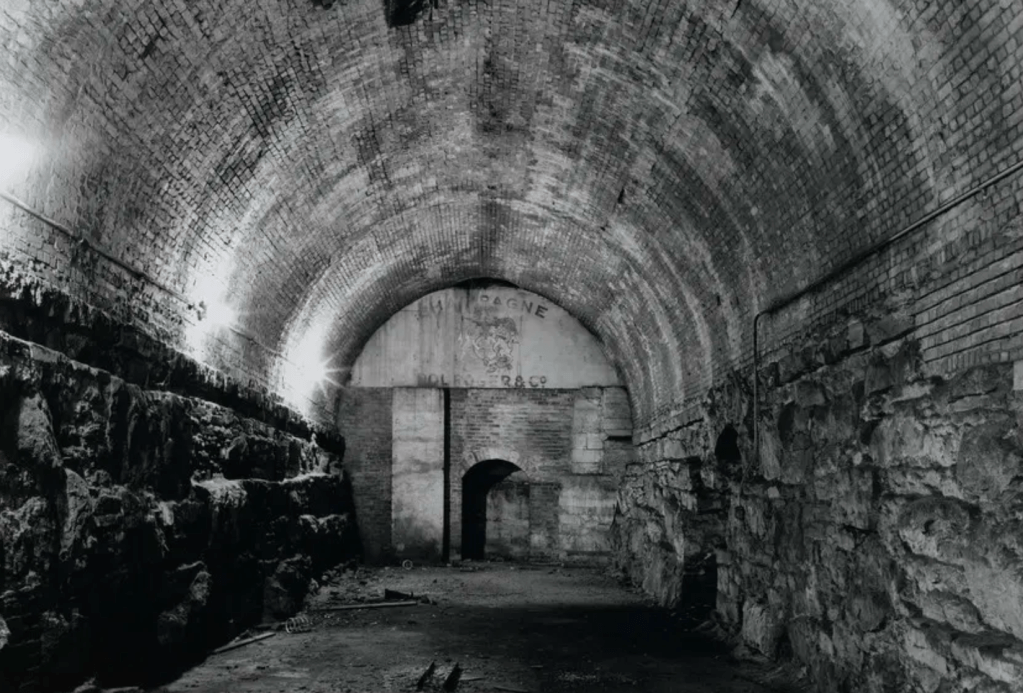
The interior, however, was said to resemble a cavern. The enormous spaces inside both anchorages were described as pitch dark, with barrel-vaulted ceilings rising up 50 feet and a consistent temperature hovering at about 60 degrees.
What could the engineers who were moving on to the next phase of bridge work—building the cables and deck—do with these empty caves?

Turn them into massive wine vaults, of course. Think of it as chief engineer Washington Roebling’s (third image) canny solution for two pressing problems that arose during the construction of the bridge.
The first issue was to address two liquor companies whose warehouses were in the path of the bridge and had to be demolished.
“”On the Brooklyn shore of the East River, Rackey’s Wine Company was doing steady business, and on the Manhattan side, Luyties & Co. sold its liquor to thirsty New Yorkers,” states a 2017 NPR article by Nicole Jankowski.
Renting two of the cavernous chambers to these businesses as wine cellars wasn’t just a convenient compromise.
It would help take care of the second problem Roebling faced: the $15 million debt incurred during the construction of what was then known as the East River Bridge.

“The design of the bridge would allow for two wine cellars, one on each shore, along with several other vaulted chambers, to be incorporated into construction,” states the NPR article. “The chambers would be rented out to local businesses, which used them mostly for storage, to help pay off the city’s debt.”
Along with the liquor companies, a variety of businesses rented space in the chambers, storing machinery, radiators, leather, lamps, grocers’ supplies, iron, and ship chandlery, wrote Philip Lopate in his 2008 book, Waterfront, per a Department of Buildings rent roll from 1898.
Stashing manufacturing equipment and gear seems ordinary; stashing wine sounds romantic. At some point in the late 19th or early 20th century, unknown revelers turned the vaults into a festive scene.

“The winding maze of caverns was transformed into a painted ‘labyrinth,’ with the names of French streets—Avenue Les Deux Oefs, Avenue Des Chateux Haut Brion—stenciled overhead,” according to the NPR article.
“Over time, the cellar walls were festooned with illustrations of provincial Europe; designs of sinewy leaves and purple grapes trailed along the stucco in subdued hues.”
The party didn’t last. As Prohibition approached, the wine was removed—replaced by newspapers from the Evening World and then city equipment.
In 1934, the vaults were reopened, and a few hundred lucky New Yorkers were led through passageways to celebrate the restocking of the chambers with wine from liquor dealer Anthony Oechs & Company.

“Visitors crowded the tap room this afternoon, musicians played Viennese waltzes, champagne corks popped and nobody remembered that above the trolleys and the elevators, the automobiles and the rushing pedestrians still hurried back and forth across Brooklyn Bridge,” wrote a 1934 newspaper.
These days, the former wine vaults are home to city maintenance equipment—though people have occasionally inquired about moving in, according to a 1999 New York Times FYI column.
The space beside the anchorage on the Manhattan side is a new city park, Gotham Park.

The anchorage spaces might not be empty for long. Earlier this spring, the City Council proposed unsealing the vaults and using rents to generate revenue. If the proposal becomes law, it’s only fitting that a wine bar be the first occupant.
[Second image: Stanley Greenberg, 1992, via Brooklyn Museum; fifth image: kidsdiscover.com; sixth image: NYPL Digital Collections]