
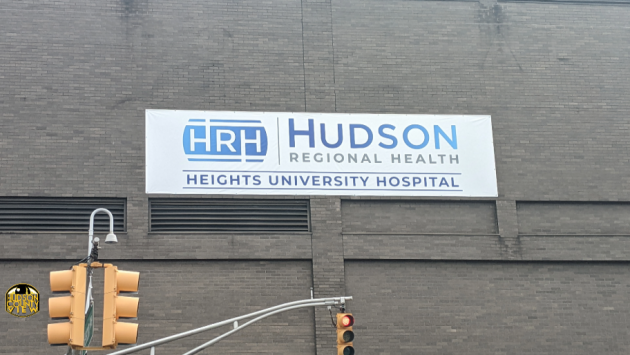
The temporary restraining order (TRO) granted to Hudson Regional Health’s (HRH) Heights University Hospital against the New Jersey Department of Health (NJDOH) was vacated, Hudson County Superior Court Assignment Judge Brian Katz ruled on Thursday.
By Dan Israel/Hudson County View
There were three motions before him, including a motion made by HRH to make the TRO a preliminary restraining order as the injunction proceedings continued, the motion to intervene made by property owner Avery Eisenreich, and a motion to dismiss due to lack of jurisdiction made by the NJDOH.
Arguing on behalf of HRH, attorney Joseph Franck told Katz that HRH has the ability request to withdraw the CN application to close Heights University Hospital, and that request meant that no further consideration or review will be given.
According to Franck, if the application were to proceed, it would result in the hospital “being punitive to operate,” and prevents the hospital from reopening without having to restart the CN process.
He also argued there was no harm to the NJDOH for not moving forward with the CN application. Although, that it is a mandated process that every other hospital that closed had to go through prior to shuttering.
Franck claimed that HRH didn’t want to close the hospital, and wants it to reopen.
“Nobody wants a closing. We don’t. We’re trying to stop it,” he insisted.
Franck said that not going through with the CN process is in the public interest as “service could be restored in the community,” also levying that the NJDOH was “exceeding their regulatory authority” by having HRH complete the state-mandated process.
According to Franck, that’s why HRH was seeking to make the TRO a preliminary restraining order as the court proceedings on their injunction to essentially stop the CN process and prevent the State Health Planning Board (SHPB) meeting from occurring.
Arguing on behalf of the state and NJDOH, attorney Francis Baker felt the court didn’t have jurisdiction to adjudicate the CN application, and was asking for a motion for dismissal on those grounds.
Baker argued that the administrative proceeding through the NJDOH is still ongoing, and believes dismissal is appropriate in this case.
“The hospital’s been closed for seven months now at this point … I know that they don’t want to talk about that, but … it’s the whole reason we’re here. It’s the whole reason the certificate of need was filed in the first place,” Baker argued.
In addition to not seeing any patients in months, he said Heights University Hospital lost their accreditation and their license is void because they’re not providing the services required in the hospital by the NJDOH.
“When you observe the facts, which are that the hospital is, in fact, closed, it would be absurd for the department to allow the applicants to withdraw their application,” Baker said.
“Frankly, what’s the point of having specific regulations at that point?”
Baker responded to Katz’s inquiry that the NJDOH would use facts obtained through their CN application and during the SHPB public hearing to make a determination as to approving the closure post-haste or denying it and forcing the hospital to reopen.
“The process, which is supposed to occur in a very different order, has shifted into something of a rescue operation … where we’re trying to sort of get the attitudes of this and that clear read of the landscape,” he asserted.
” … This isn’t about money. This is about exercising regulatory oversight for the healthcare, the health, safety, and welfare of the city.”
According to Baker, the hospital license may be preserved or surrendered following the outcome of the SHPB meeting.
Baker argued that while HRH and Eisenreich have discussed reopening the hospital in another location, that too would require a certificate of need, which they withdrew in April, thus restarting the process.
While Franck asked for two years for HRH to figure it out, Baker said that the community is left in the lurches in the interim.
He added there is no precedent for letting a hospital close for months to years without proper oversight, aka the CN process, from the NJDOH to address public health needs.
Attorney Lee Vartan, on behalf of Eisenreich, explained his ask for a motion to intervene stating that Eisenreich is an interested party with the ability to intervene.
Vartan asserted that this intervention would not prejudice either the plaintiff nor defendant, but would harm Eisenreich if not granted.
He told Katz to “his understanding” that Eisenreich’s property company is differently owned than the operating company at Heights University Hospital.
According to Vartan, the intervention is seeking declaratory judgement action against both the plaintiff and defendant, noting there is “adversity” against Eisenreich.
He said the hospital only opening “in some capacity” is not good enough under the lease, which defaults if the facility is not in operation as a 349-bed hospital.
“It’s not even a minor default, of course. It is a grievous default. It is a material default,” Vartan declared.
He also said Eisenreich has a superior interest in the license and can take ownership of the certificate of need to operate the hospital themselves or through another entity, while simultaneously applying for another CN.
Additionally, Vartan again argued the license isn’t void, but now belongs to the landlord, to which Franck stated the license is not void with no action taken by the NJDOH or Washington.
It was then Franck argued that HRH simply “suspended services” at the hospital, not closing the facility “because the intent is to reopen.”
“We have an intent to reopen and operate,” Franck repeated.
Renée Steinhagen, an attorney at the legal non-profit New Jersey Appleseed who was representing the Save Our Hospitals Coalition, filed an amicus brief supporting the NJDOH, noted that the hospital’s license actually recently expired.
Steinhagen challenged the assertion that Eisenreich and HRH weren’t coordinating on the hospital, noting “there is a connection here.”
She argued that the community wants the CN process to continue, stating there’s a need for a second acute-care facility in Jersey City.
Steinhagen, even if HRH and Eisenreich opened a hospital in a new location, conditions need to be met in the interim like completing the CN process and the aforementioned satellite ED, nevertheless a new CN process for the new facility.
She said HRH can appeal decision after the SHPB meeting and Commissioner Washington’s rulings, not now in court pre-decision but already post-hospital closure.
According to Steinhagen, HRH have not been operating in good faith, noting a redevelopment application for luxury housing advanced for the site.
“Filing an application to do a residential development is not sincere efforts to keep that hospital open. This is nothing other than a leverage and negotiations in your real estate deal,” she stated.
Steinhagen also said Eisenreich has intervened at Heights University Hospital previously, allegedly preventing the sale of the hospital to RWJBarnabas Health in 2022.
“They use healthcare as a means to make money for themselves,” Steinhagen expressed.
She said the state is trying to do its job to protect residents and provide healthcare through the CN process.
Steinhagen opposed the motion to intervene as an attempt to “hijack this as part of their difficulties and their negotiations with their operator.”
“Both parties have unclean hands here from the perspective of the people,” she said.
Another attorney for HRH, Mohammad Nabulsi, said its their own application, so they can request to withdraw and have it honored, also claiming there has been no harm to the community since the facility closed.
“It’s been seven months. There has been no public health emergency declared. The DOH has not taken urgent action,” he expressed.
Nabulsi said the NJDOH is trying to “dodge the issue” of demonstrating the public is going to be harmed when there is “no such harm.”
Vartan said that request to withdraw is final with no further consideration or review for the application, that the process is voluntary from the start, and that application is allowed to be withdrawn before a SHPB hearing.
As a matter of fact, that’s exactly what HRH and Eisenreich wanted to do, but were denied by NJDOH leading to the TRO.
Vartan furher argued there was other framework for the state to take action against the CN or license and that the CN process was not that.
He tried to say the state was “hell bent” on seeing the closure through when there’s “appetite” by the plaintiff and landlord to come to alternative solutions.
Vartan concluded by restating the process is voluntarily, and while HRH wanted to close, that’s no longer the case.
Baker disputed that there is no harm to the public, which is something that would be on display at the SHPB’s public hearing.
“That’s what the certificate of need review process is for, to measure what the effects are,” Baker said.
“We’re not able to do that. We’re able to find out what the impact is on the community by engaging in the certificate of need review process.”
Katz decided to reject the motion for a preliminary restraining order during the proceedings, and vacated the TRO against the NJDOH, allowing the SHPB meeting to move forward, barring an appeal.
In his ruling, Katz felt Franck’s arguments weren’t sufficient to uphold and expand the TRO amid the injunction court proceedings, seemingly somewhat agreeing that the CN process should continue to hear the community’s healthcare need.
In that scenario, the NJDOH can make an official decision on the facility’s closure, after which HRH can appropriately appeal the matter likely in the more-fitting Appellate Division of Hudson County Superior Court.
He also set June 23rd at 2:30 p.m. as the next court hearing on the matter, when he will rule on the other two motions, although it is not clear when the next SHPB meeting on HUH will be yet.
“As has been stated numerous times, a plethora of challenges beyond HRH’s control contributed to the extremely precarious financial state of Heights University Hospital,” noted HRH spokesman Vijay Chaudhuri.
“These include tens of millions of dollars of cuts to county, state and federal funding, an antiquated building that has lived well past its useful life, a majority underinsured patient population, and serious mismanagement by the prior owner, among others. Nonetheless, HRH is fully committed to rebuilding the healthcare system in Jersey City in coordination with various stakeholders and its property owner, in a way that is financially sustainable.”
Now the NJODH can move forward with SHPB meeting, which was previously cancelled by HRH at the eleventh hour via a previous court injunction by HUH, although electeds and residents turned the opportunity into an impromptu “Save Christ Hospital” rally.