
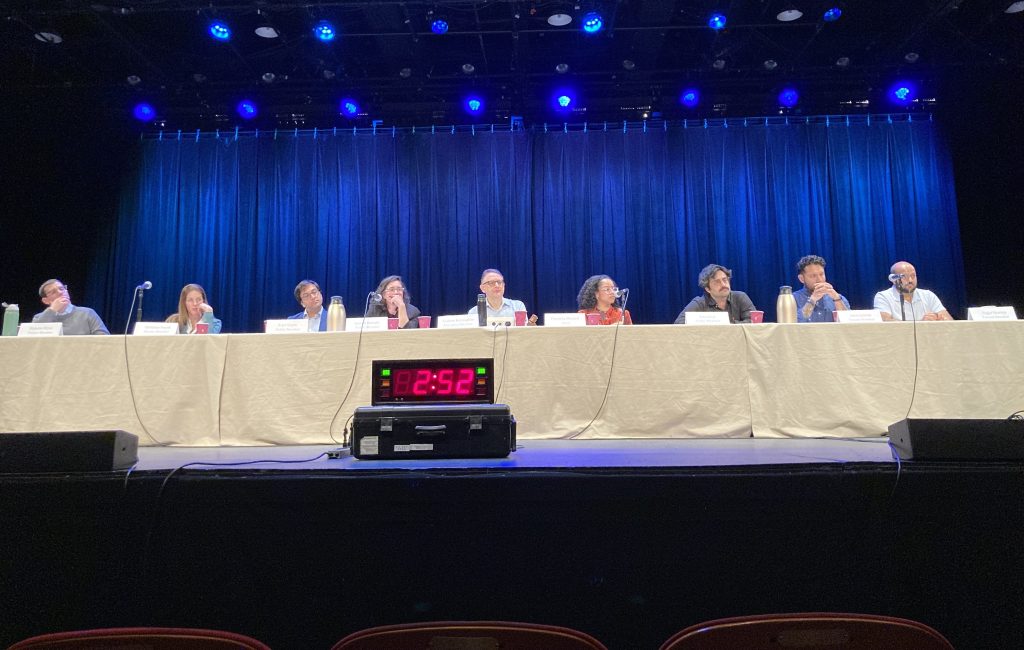
Tomorrow night, the nine members of the city’s Rent Guidelines Board have a legal duty to evaluate the statistics and economic data collected by the agency’s professional staff on the cost of housing for rent regulated apartments and come up with a fair number that properly factors in inflation. But a rash mayoral campaign promise of a rent freeze must not be one of those factors.
A 0% increase sounds nice when trolling for votes, but have landlord costs for labor, insurance, fuel, utilities, maintenance, repairs and taxes actually been flat? Doesn’t seem so. The pleas at the public hearings held around the city to freeze the rent (or from landlords saying that they will go bankrupt) should not be what sways the board members. Just the facts, please.
We sat in at the final hearing, last week, which went for many hours, with each person given a few minutes to speak. One of the board members was absent, but he missed little that hasn’t been said again and again. Even so, such testimony is not what needs to be used in determining any increase in rent.
Mayor Mamdani, without looking at any of the numbers, wants a rent freeze. By our read, 2% increases on 1-year leases and 4% on 2-year leases are sound.
Should Mamdani prevail, any temporary relief of a freeze will come with some steeper long-term consequences. Costs are indeed rising for residential landlords, some for reasons that the city can also help control — including its nonsensical property tax system, which tends to punish affordable housing — and some it can’t quite wrangle on its own like inflation.
If the owners of stabilized units cannot raise rents for a year — or, presumably, the four or eight years of a Mamdani mayoralty — then their expenditures will grow and their revenues won’t, and that money has to come from somewhere.
Advocates of a rent freeze would argue that this will come from landlords’ increasing revenues, eating into profit margins, boo hoo, and indeed there are some large landlords, particularly among the increasingly dominant private equity owners, that can easily eat some profit loss.
The trouble is that there are many others, particularly small landlords, who are not only not profiting but barely hanging on, some with revenues that have in inflation-adjusted numbers actually declined. In these cases, everyone loses, including the tenants, whose landlords find themselves sometimes unable to make repairs or otherwise properly operate buildings. Already, many smaller landlords find themselves on the back foot after former Mayor Bill de Blasio’s low-increase tenure, which featured three freezes.
This is why the RGB has the unenviable task of finding the correct middle ground; significant rent increases have real consequences for New Yorkers who can get pushed out of apartments with limited other options in a very tight rental market. Even if they manage to scrape by, it means less money for other basic necessities, let alone for things like investing and starting businesses.
But low or no rent increases also can have consequences, putting repairs on hold and pushing more of the housing stock out of the hands of smaller landlords that cannot absorb these costs and into the hands of the larger, more profit-driven enterprises.
We’ll say as we’ve said before: perhaps it doesn’t make much sense to have a singular rule apply to all stabilized units citywide, whether they’re large or small, in entirely stabilized buildings or one of a handful, owned by single landlords and enormous conglomerates, with and without records of housing violations and so on.
We understand that drawing these distinctions would make this process significantly more complex, but the reality is that the New York City housing market is incredibly complex regardless. A fairer system would be one where a multi-billion-dollar multinational and an individual who inherited a single property from their parents are not on the same footing.