
President Trump plunged Congress into chaos on Wednesday as he abruptly canceled the signing of a celebrated bipartisan housing measure and issued new demands that Republicans pass legislation imposing voting restrictions despite their protests that the votes don’t exist to do so.
Just hours before an explosive closed-door session in which he angrily confronted Senate Republicans, Mr. Trump again blindsided his allies on Capitol Hill by declaring that he would not sign a housing measure at the center of congressional efforts to rein in costs, even as the stage for the ceremony was being erected in the Capitol’s Statuary Hall.
The bill signing had been intended to project the image of a unified Republican Party working to address Americans’ concerns over high costs ahead of the midterm elections, an issue that polls show to be top of mind for voters.
But in summarily dismissing his party’s heralded domestic achievement as “of minor importance,” as he put it in a social media post, the president emboldened right-wingers in the House who had been seething over the housing measure. Not long after the president’s post, they essentially shut down the floor in protest of the Senate’s failure to approve the voting bill, leaving the Republican agenda stalled in advance of a Fourth of July recess.
Mr. Trump’s decision further inflamed weeks of tumult that have marked an increasingly bitter relationship between the president and prominent members of his own party in the Senate, particularly Senator John Thune, Republican of South Dakota and the majority leader.
Wednesday’s meeting was already expected to be fraught, as Mr. Trump has been in a simmering feud with Mr. Thune over his refusal to weaken the filibuster to pass the election overhaul bill, which would require proof of citizenship to register and substantially reduce the opportunity for voting by mail.
As he scuttled the housing ceremony, Mr. Trump once again urged Mr. Thune to eliminate the filibuster and to “get the bad Republicans to approve” his voting legislation, known as the SAVE America Act. But Mr. Thune has said repeatedly that there is not enough support among Republicans to do so, a reality that has been demonstrated in test votes.
Lawmakers from both parties were shocked by the president’s decision to call off the housing ceremony. Many of them regarded it as the latest move by Mr. Trump to undermine the efforts of his own party to protect its congressional majorities in the November elections.
At the moment that Mr. Trump sent his social media post, House Republican leaders were celebrating their legislative success and Mr. Thune was on the Senate floor. As he left for his office, he appeared almost dazed, telling reporters he had little to say about the president’s announcement.
Hours later, Mr. Thune said that the decision to cancel the bill signing was the president’s call, but noted that “it’s an affordability issue, and eventually I hope he’ll find his way to sign it.”
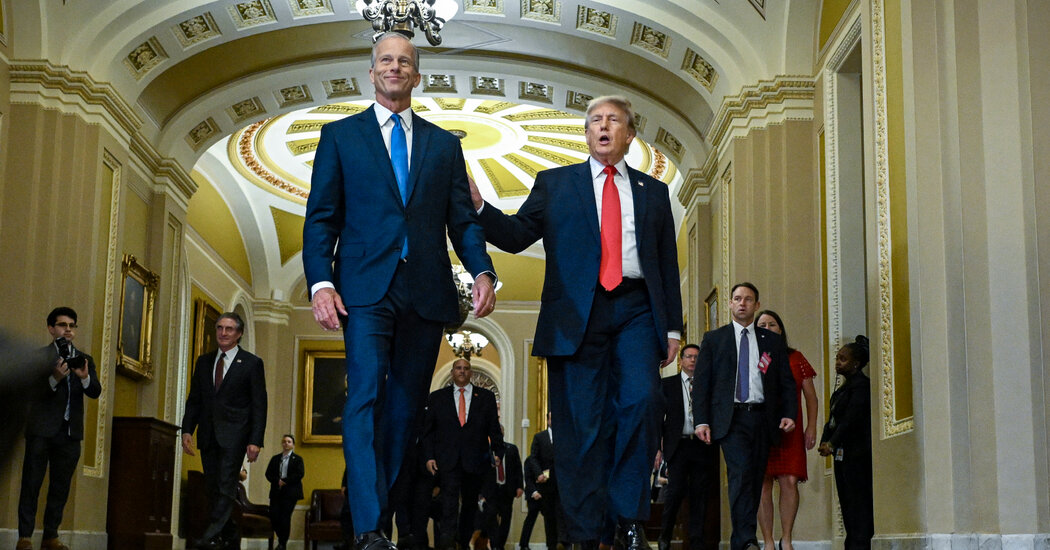
Still, when Mr. Trump arrived at the Capitol, he and Mr. Thune tried to appear harmonious, chatting cordially. The president ignored a shouted question about their relationship, instead telling reporters that the war in Iran — which he has said is over — was “going very well” and then criticizing Democrats for “pushing communists” as election candidates.
The facade of unity quickly dissolved behind closed doors. Those participating in the private meeting said that Mr. Trump arrived in an angry mood and launched into a “harangue” over the Senate’s vote a day earlier to challenge his authority to wage the war in Iran as he attacked some Republicans for joining Democrats in the vote.
That, those attending said, led to a shouting match between the president and Senator Bill Cassidy, the Louisiana Republican who recently lost his primary after the president endorsed an opponent. In the meeting, Mr. Trump referred to Mr. Cassidy as a “loser.”
Those attending said the president made a series of highly personal attacks against other Republican senators who have bucked him, including Lisa Murkowski of Alaska and Mitch McConnell of Kentucky, who is currently hospitalized and did not attend.
Mr. Trump also reiterated his frequent demands to gut the filibuster and eliminate Senate “blue slips” that give senators veto power over certain judicial and law enforcement posts, and he lamented his own indictment before being returned to office. Participants said that there was little exchange over policy and little engagement with Mr. Thune, and that the session mainly appeared to be an opportunity for Mr. Trump to express his grievances.
Mr. Trump was initially invited to the Capitol by Senator Rick Scott, Republican of Florida, to address a weekly lunch gathering he runs that typically draws the more conservative faction of G.O.P. senators. It was a break from norms, since a president would typically be invited by the party’s elected leader to address the entire conference at its regular luncheon on Tuesdays, or a special gathering hosted by the leadership.
Mr. Scott, who lost badly to Mr. Thune in his bid for majority leader in 2024 after pitching himself as the Trump-aligned candidate, said he had been speaking to the president on the phone last Friday about a number of issues, including the voting bill, when he suggested that the president come to the meeting on Wednesday.
“I just bring people to lunch and create a conversation, and I think there’s a greater chance something good will happen,” said Mr. Scott, who said he hoped Republicans would also discuss a plan to avoid a government shutdown at the end of September. But, he added, Mr. Trump “continues to want to pass the SAVE America Act, and there’s other issues — cost of living, stuff like that.”
Senator Rick Scott said he had been speaking to Mr. Trump on the phone last Friday about a number of issues, including the voting bill, when he suggested that the president come to Wednesday’s lunch meeting.Credit…Kenny Holston/The New York Times
The president’s visit to the Senate also unfolded amid growing dissent within his party over his handling of the war with Iran. On Tuesday, the Senate adopted a resolution directing Mr. Trump to end the conflict or seek congressional authorization to continue it, a mostly symbolic but nevertheless remarkable reprimand of the president, made possible by G.O.P. defections.
Hours later, Mr. Trump denounced the four Republicans who joined Democrats in supporting the measure, calling them “losers” in a social media post and accusing them of giving “aid and comfort” to Iran. But an even broader group of Republican senators, including some of the president’s closest allies, has questioned the deal his administration is negotiating to end the war.
His anger at the vote was one reason for Mr. Trump’s sudden decision early Wednesday to scrap his plans to sign the housing measure, according to two people familiar with it who discussed it on the condition of anonymity.
The dispute over the voting legislation is resurfacing amid mounting bitterness between Mr. Trump and Senate Republicans, many of whom have been livid at the president’s decision to back successful primary challenges to two Republican senators he considered disloyal.
It has also exposed rifts among Senate Republicans themselves about the elections measure, which does not have sufficient support from Democrats to overcome the 60-vote threshold required to move most bills through the Senate.
Mr. Thune has said that there was no practical path to move the measure. Mr. Cassidy, one of the bill’s co-sponsors, said on Monday that “it doesn’t have the votes, and so it’s time to talk about something else.”
But Senator Mike Lee, Republican of Utah, suggested that his colleagues needed to fight harder for the legislation. In a social media post on Tuesday, he criticized Mr. Thune for suggesting that senators needed to tell Mr. Trump that the bill was dead.
Furious that the elections bill had stalled in the Senate, a group of hard-line conservatives threatened this week to seize control of the House floor and prevent Speaker Mike Johnson from bringing key legislation, including annual spending bills, to a vote.
Mr. Trump’s actions on Wednesday, and his insistence that the SAVE America Act was his party’s most critical priority, appeared to have energized that faction, and Republican leaders were forced to postpone planned action, lacking the votes in their own ranks to move ahead.
Robert Jimison, Catie Edmondson, Olivia Diaz and Tyler Pager contributed reporting.