
Tuesday’s primaries in New York City were a show of strength for Mayor Zohran Mamdani, as the three congressional candidates he endorsed emerged victorious. Elsewhere, a Kennedy scion fell short, and two longtime incumbents fended off challengers.
Precinct-level results from key races highlight the neighborhoods and demographic groups that propelled candidates to victory:
13th District
Darializa Avila Chevalier unseated the district’s longtime incumbent, Representative Adriano Espaillat. She was endorsed by Mr. Mamdani and was supported by a coalition of voters similar to the one that brought him to victory in last year’s mayoral primary.
Ms. Avila Chevalier’s strongest areas were in Manhattan, particularly the neighborhoods of Inwood, Hamilton Heights and parts of Morningside Heights — areas where Mr. Mamdani did well last year.
Mr. Espaillat performed well across many older and majority-Hispanic areas that have formed a longstanding base of support for him, including the eastern part of Washington Heights, as well as parts of the Bronx and Marble Hill. Many of these areas had also favored former Gov. Andrew M. Cuomo over Mr. Mamdani last June.
Mr. Espaillat, who like Ms. Avila Chevalier is Dominican American, campaigned heavily in Harlem, hoping to overcome his complicated electoral history there. When he was first elected to represent the district in 2016, he won a contested primary, seizing a House seat long controlled by Black leaders. But the precinct-level results show that his support in this predominantly Black area was not enough to tip the scales in his favor.
12th District
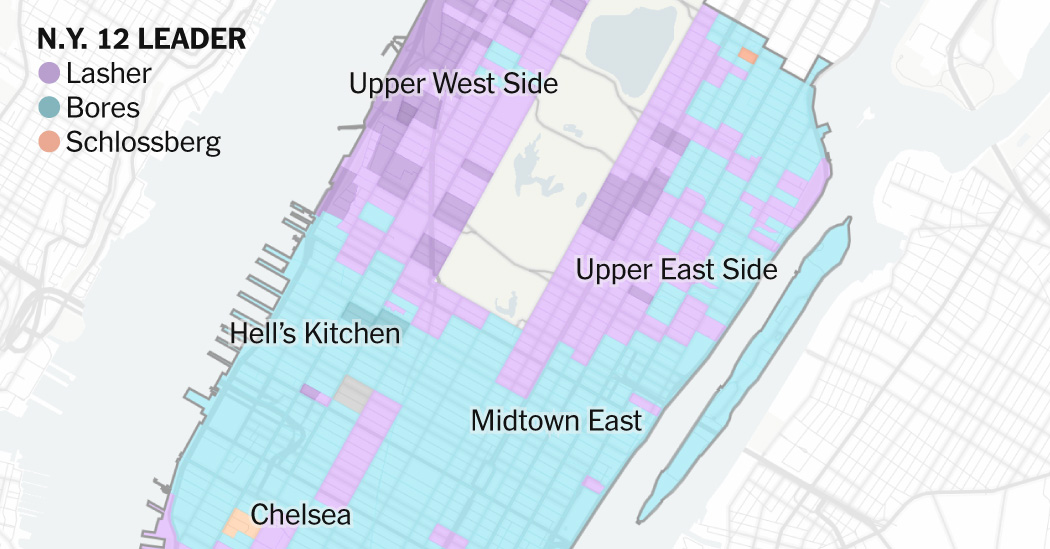
Micah Lasher narrowly defeated his fellow assemblyman Alex Bores in the open race for the Democratic nomination in the 12th District. Jack Schlossberg, the grandson of John F. Kennedy, came away with just over 10 percent of the vote.
Mr. Lasher ran up his margins in stretches of the 12th District on the Upper West Side, where he grew up. He also performed well on the Upper East Side, including large portions of Mr. Bores’s assembly district — territory that includes Temple Emanu-El, a prestigious Reform synagogue.
Mr. Bores won the areas he represents by around two percentage points, compared with Mr. Lasher’s 15-point victory in his own assembly district. Mr. Bores carried the precincts he represents in Midtown East and Murray Hill, where younger voters are clustered, and extended that coalition to the younger areas of Hudson Yards and Kips Bay.
10th District
Brad Lander won a resounding victory over Representative Dan Goldman in the 10th District, which spans parts of Lower Manhattan and Brooklyn. Mr. Lander, who rose to power in Brooklyn, led by 11 percentage points in the Manhattan portion of the district, which was previously a base of support for Mr. Goldman.
Mr. Goldman found support in the higher-income precincts on the west side of downtown Manhattan and those neighboring the East River — areas that also had formed part of Mr. Cuomo’s coalition in his mayoral primary run.
Mr. Lander was bolstered by Mr. Mamdani’s endorsement, but he had longtime ties to the district and won it by a larger margin than Mr. Mamdani did in last year’s mayoral election. In particular, Mr. Lander dominated the swaths of brownstone Brooklyn in the district — areas that he represented on the City Council for more than a decade.
Mr. Goldman’s loss spanned nearly every demographic group and corner of Brooklyn, though he did win by overwhelming margins in the Orthodox Jewish precincts of Borough Park.
Ninth District
Yvette Clarke, the daughter of Jamaican immigrants, has represented the Ninth District for two decades. She held off two challengers — Mike Goldfarb and Josh Bristol — and ultimately received nearly 70 percent of the vote.
While neither of Ms. Clarke’s opponents mounted a particularly prominent campaign, over 30 percent of voters opted to vote for an alternative. Her support was strongest in the majority-Black region of East Flatbush, where she lives.
Mr. Goldfarb, who finished with around 15 percent of the vote, centered his campaign on criticizing Ms. Clarke for being insufficiently supportive of Israel. He won the majority-white, less educated precincts — including a smattering in Midwood and the eastern half of Borough Park, home to large pro-Israel Hasidic Jewish communities that also supported Mr. Cuomo in 2025.
Mr. Bristol, a member of the Democratic Socialists of America, also came away with nearly 15 percent of the vote, but he did not win any precincts outright. He placed second behind Ms. Clarke in many of the more college-educated precincts throughout Prospect Lefferts Gardens, Crown Heights, Flatbush and Ditmas Park — areas that Mr. Mamdani won last year.
Seventh District
Claire Valdez, a democratic socialist and assembly member who was endorsed by Mr. Mamdani, beat Antonio Reynoso, the progressive Brooklyn borough president, by more than 20 percentage points in the Seventh District.
Ms. Valdez’s support was broadly distributed, tracking closely with the areas where Mr. Mamdani ran strongest in last year’s primary. The chief exception was Cypress Hills, a predominantly Hispanic neighborhood, where Mr. Reynoso, who is Dominican American, maintained a strong base of support.
Some of Ms. Valdez’s widest margins came in the Ridgewood area, where Mr. Mamdani won easily last year, and where Ms. Valdez’s own assembly district is based. In the Queens portion of the district, she beat Mr. Reynoso by more than 40 percentage points.
Support for Mr. Reynoso, who was the chosen successor of the district’s incumbent, Representative Nydia Velázquez, was largely confined to South Williamsburg, where he grew up and where, earlier this month, a coalition of Orthodox Jewish leaders from several major Hasidic communities endorsed his candidacy. This area and Cypress Hills were among the strongest pockets of support in the district for Mr. Cuomo in last year’s mayoral primary.
Mr. Reynoso did not, however, carry Los Sures, the historically Latino section of South Williamsburg where he was born and raised.
Sixth District
Grace Meng was re-elected in the Sixth District by 14 percentage points — a narrow margin for an incumbent. Her strongest showing was in Kew Gardens Hills, a historically Jewish area that has a sizable Orthodox Jewish population. Ms. Meng’s vocal support for Israel may have driven some of this support.
Ms. Meng also found strength in the majority-white neighborhoods of Maspeth and Middle Village, with a particularly strong showing in the precincts surrounding Middle Village that Mr. Cuomo won.
Chuck Park, Ms. Meng’s progressive challenger, received less institutional support than more prominent left-wing candidates. Nonetheless, he drew support from diverse areas across the district, including Forest Hills, Bayside and Rego Park.
Mr. Park, who is Korean American, won many of the precincts with comparatively higher shares of Korean residents in Flushing. His best numbers came in Woodside, which includes the places in the district that Mr. Mamdani won by large margins during the 2025 mayoral primary.