
New York has never been just New York, argues historian Mike Wallace in Gotham At War, which hit bookstores just weeks before the city’s mayoral elections — set to take place this Tuesday and, according to all polls, likely to be won by Zohran Mamdani, a Democrat, Muslim, and socialist. Those circumstances give particular weight to the title Wallace chose for his book.
The volume is a masterclass in the lessons of history. Covering the period from 1933 to 1945, its underlying narrative is the steadfast resistance New York mounted against the advance of fascism as its shadow spread across Europe with the rise of figures like Hitler and Mussolini, and the global danger that followed — eventually culminating in a world war in which the United States played a decisive role.
Given the size of the immigrant communities from central and southern Europe, the atrocities committed by the Nazis and fascists — as well as those that took place during the Spanish Civil War — were felt by the city as wounds of its own. Gotham at War recounts with chilling precision how the echoes of events across the Atlantic resonated intensely along the Hudson, as New York became actively involved in a collective resistance movement that included all manner of protests — from a boycott of products from Nazi Germany to demonstrations against Hitler and Mussolini, and support for the Spanish Republic, including facilitating the departure of the Abraham Lincoln Brigade to fight in its defense.
The city experienced those conflicts viscerally, and Wallace’s work clearly reveals the parallels between that era and the present — New York once again serving as both symptom and reflection of what’s happening in the nation as a whole. Trump has threatened reprisals if Mamdani wins the election. New York is, once again, a city at war.
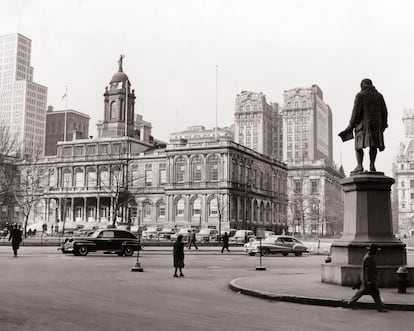 The 1940s. Statue of Benjamin Franklin in front of City Hall, Manhattan, New York, United States.H. Armstrong Roberts/ClassicStock (Getty Images)
The newly released one-thousand-page volume marks the conclusion of a trilogy that crowns a lifetime devoted to researching the history of Gotham — a name that Washington Irving found in medieval English chronicles and decided to apply to New York. By the late 1930s, the term had also come to designate the city that served as the setting for Batman’s adventures. Wallace includes details, such as that in 1941, the cover of the Timely Comics issue featuring the first appearance of Captain America — the future Marvel hero — showed him punching Hitler in the face. The comic sold one million copies in record time.
It borders on the miraculous that Gotham at War ever saw the light of day — not only because it’s hard to believe that a work of such magnitude could be completed by a single person, but also because the author’s declining health had raised fears he might not be able to finish such a monumental task. Fortunately, he did. On October 8, the day of the book’s official launch, over 500 people filled the auditorium next to the Gotham Center, which Wallace himself founded and which is housed at the CUNY Graduate Center on Fifth Avenue.
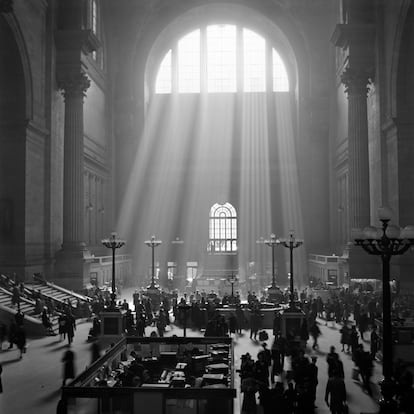 The 1930-1940s period. Interior of Pennsylvania Station in New York, with sunlight streaming through the window.H. Armstrong Roberts/ClassicStock
The 83-year-old author was present but unable to take the stage to participate in his own tribute, suffering from a serious neurological condition that, while allowing him to remain fully aware of everything around him, prevents him from moving freely or speaking. That made the moment all the more emotional when one of the presenters read a proclamation declaring October 8 as “Mike Wallace Day,” issued by outgoing New York mayor Eric Adams. (Adams recently withdrew from the mayoral race to make way for the candidate polling second after Mamdani — former New York governor Andrew Cuomo.)
Visibly moved, the most the historian could do to thank the audience — who rose in heartfelt applause — was to struggle to his feet from his front-row seat and, supported by his wife, the Mexican writer Carmen Boullosa, offer a slight bow amid a long, thunderous ovation.
Born, like Donald Trump, in New York’s Queens neighborhood, Wallace earned his bachelor’s, master’s, and doctoral degrees at Columbia University, a liberal institution with a long history of activism in which he participated during the civil rights struggles of the 1960s. Gotham, the title of the first volume in Wallace’s trilogy dedicated to his native city, was coauthored with the late Edwin G. Burrows and was awarded the Pulitzer Prize in 1998.
That volume traces the city’s history from its origins — beginning with the arrival of the Dutch in the 17th century — to New Year’s Day, 1898, when the four independent boroughs surrounding Manhattan (Brooklyn, Queens, Staten Island, and the Bronx) merged to form a single metropolis.
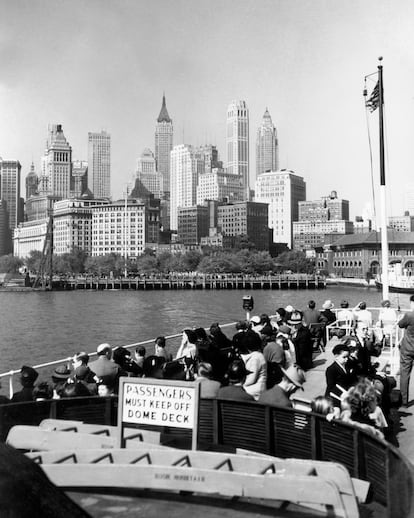 The 1930-1940s period. View of the New York City skyline from the upper deck of the Statue of Liberty boat, New York, United States.H. Armstrong Roberts/ClassicStock
The second volume, Greater Gotham (2017), covers just two decades — from New Year’s Day 1899 to the end of 1919 — but does so with a level of rigor and meticulousness that combines scrupulous attention to detail with a broad and lucid vision on major historical events. Similarly, the final installment of the trilogy, Gotham at War, weaves a dense tapestry encompassing all the social classes and human groups that come together in what Wallace calls “the capital of capitalism.”
Across 168 “cultural mosaics,” the book presents figures as diverse as Joe Louis, Frank Sinatra, Franz Boas, Max Ernst, Claude Lévi-Strauss, André Breton, Cardinal Spellman, Franklin Delano Roosevelt, and Lucky Luciano. Wallace explores social, cultural, and religious movements; racism, jazz, comic books, the publishing world, the recording industry, labor struggles, the rise of abstract expressionism, and scientific developments such as the atomic bomb and the invention of radar.
Weaving it all together, the book tells a story of resistance, highlighting that — then as now — New York has always been an incubator of alternative movements and a defender of rebel causes.
Sign up for our weekly newsletter to get more English-language news coverage from EL PAÍS USA Edition