
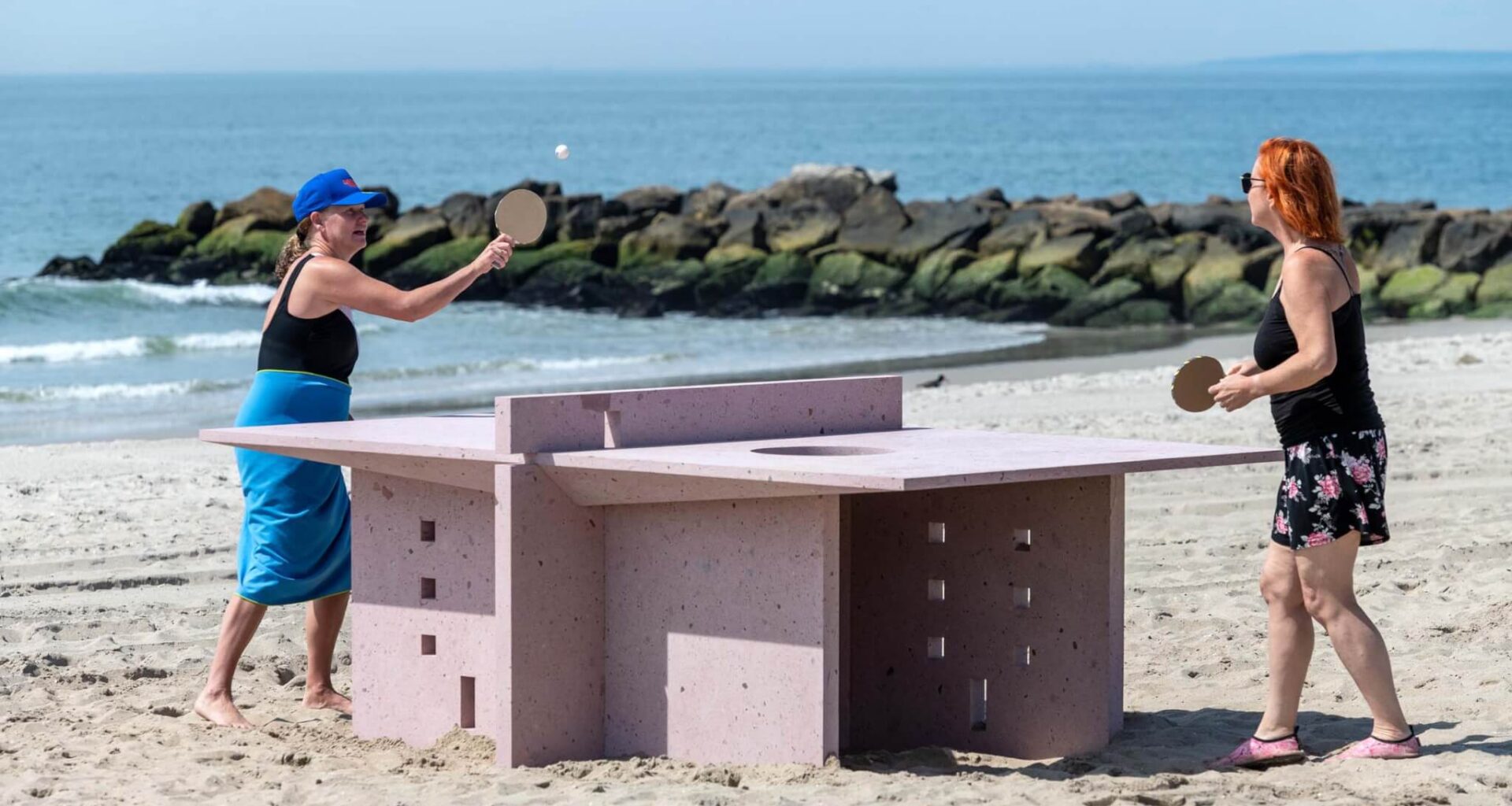
In Victorian England, table tennis, or ping-pong, was a recreational activity enjoyed after dinner. Since its days in the royal court the racquet sport’s ubiquitous table has become a fixture in finished basements, central to Timothée Chalamet’s recent flick Marty Supreme, and more recently the subject of an art installation staged on Queen’s Rockaway Beach this summer.
Between Tides, a Public Art Fund–backed installation, located at Beach 67 in Rockaway Beach, Queens, commissioned six artists to envision their own ping-pong tables. Some of the play objects keep the well-known form of the table intact—legs and a rectangular flat top—while others turn the game’s structural elements into bespoke sculptural objects.
Each of the six designers—Moko Fukuyama, Ilana Harris-Babou, Las Hermanas Iglesias, Carlos H. Matos, Amalia Pica, and SUPERFLEX—came up with their own thematic rendition for their table design. Each playing surface is unique in its execution, and no two tables have the same surface, legs, or net.
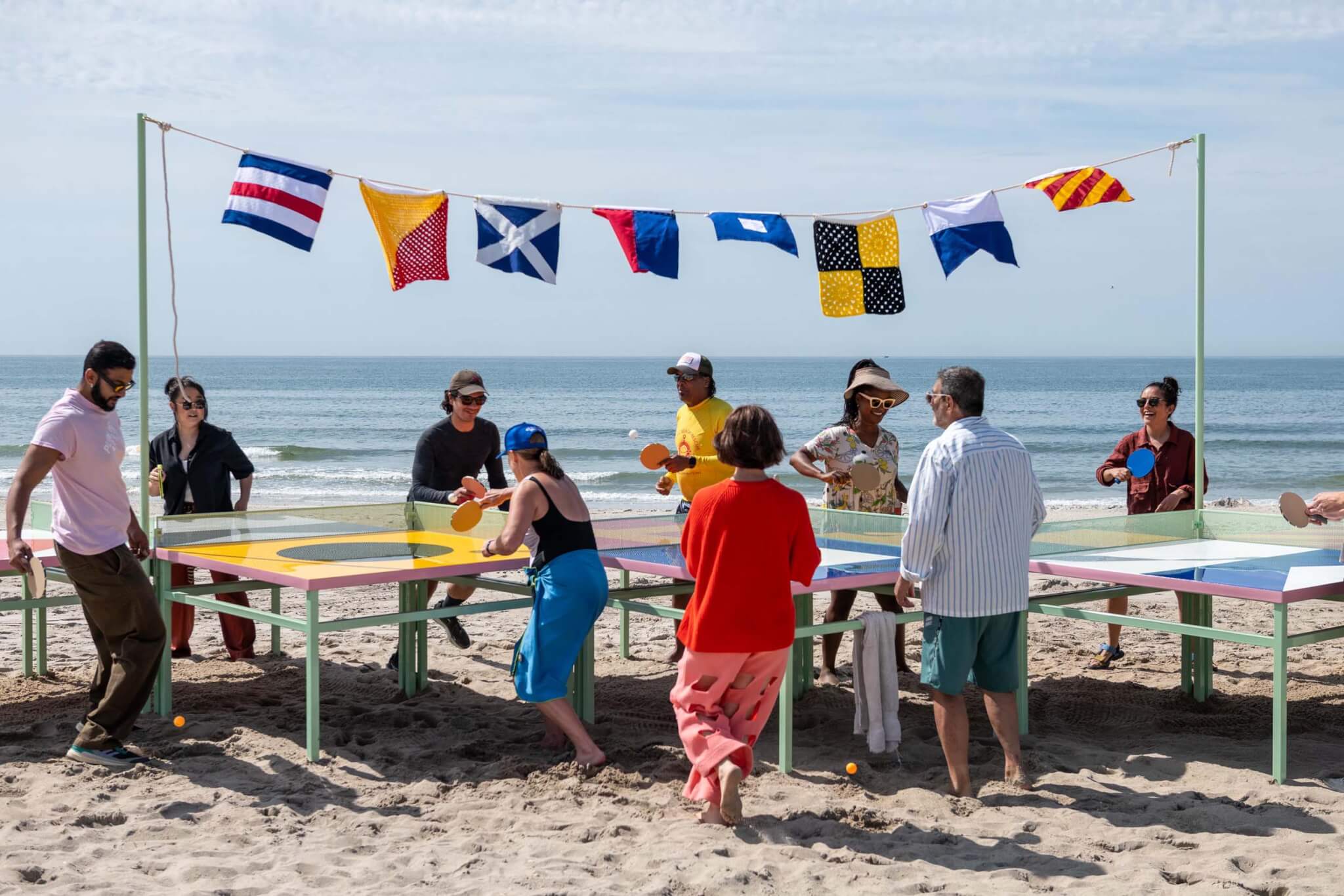 Amalia Pica enlarged and replicated the colorful patterns of maritime signals across the halves of the playing surface table. (Timothy Schenck/Courtesy Public Art Fund)
Amalia Pica enlarged and replicated the colorful patterns of maritime signals across the halves of the table. Rather than just one table for play, the Argentinian artist combined several play tables together in a boxy arrangement, allowing multiple games to take place simultaneously.
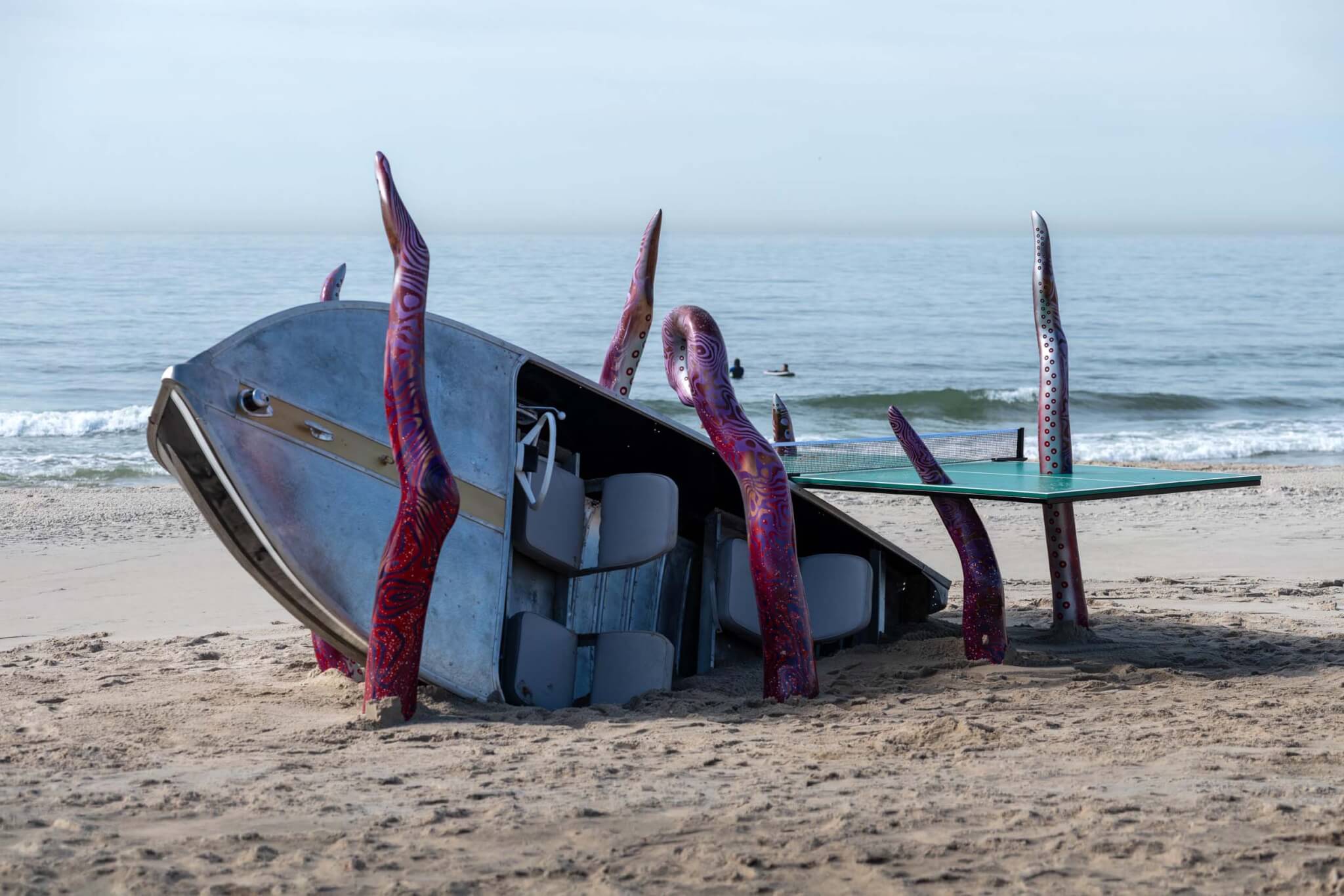 Tentacles wrap around a salvaged boat and pierce through the ping-pong table.(Timothy Schenck/Courtesy Public Art Fund)
Moko Fukuyama also deployed a sea theme; her work Old School locates a boat, salvaged from nearby Marina 59, next to the play object. Wrapped around and inside the boat and table are tentacles from a sea creature that appears to be emerging up from the sand.
A table built out of pink Cantera stone takes cues from Brutalist architecture and housing blocks in the Rockaways. Its pinkish hue is known to promote coral growth and holes cut into the playing surface and its legs form habitats where, if submerged in the ocean, microorganisms would set up life. For SUPERFLEX, the Copenhagen-based collective behind the design, the work is a continuation of its research into “interspecies living.”
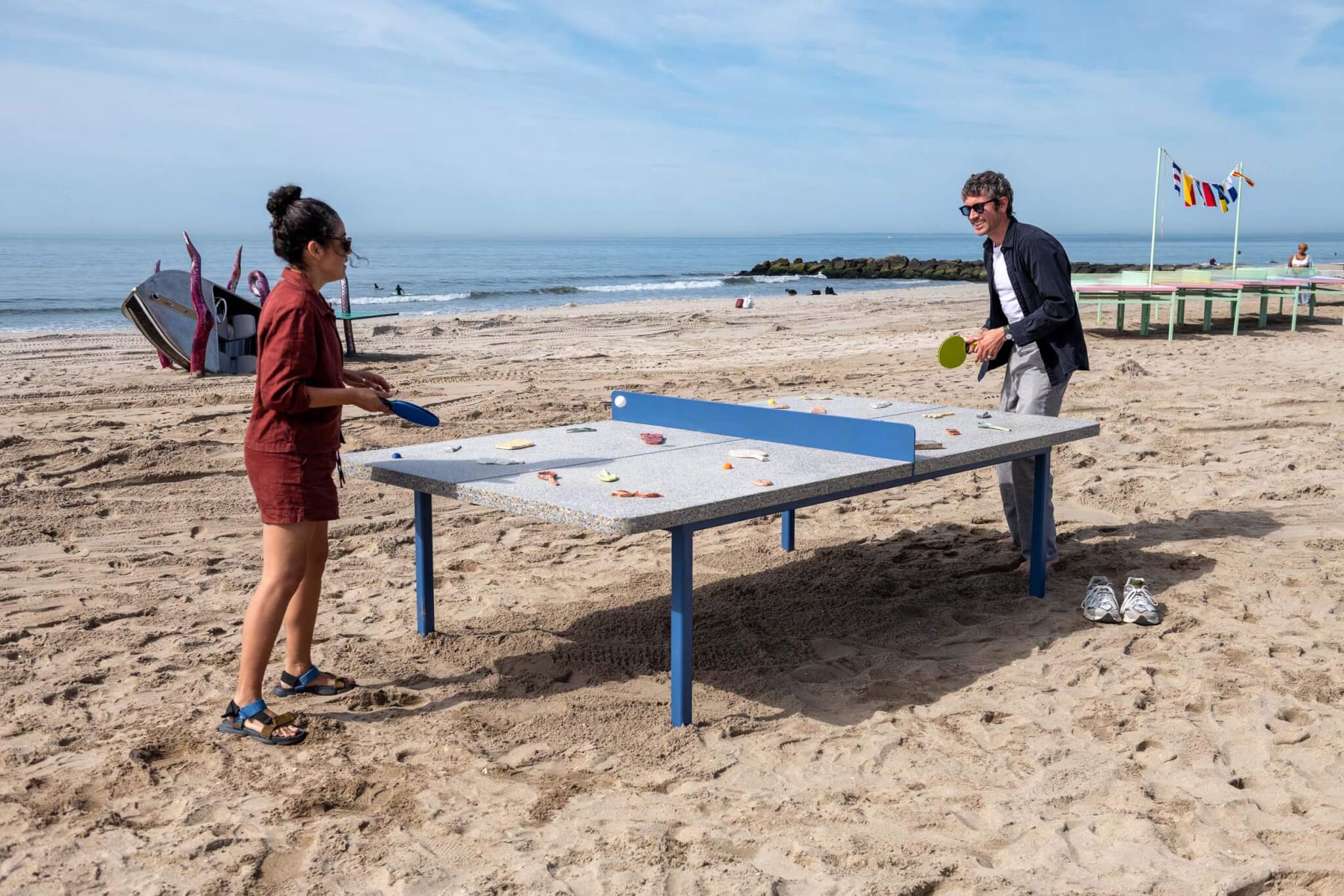 Objects synonymous with the beach were replicated in ceramic and scattered on the tabletop, creating obstacle for paddle play. (Timothy Schenck/Courtesy Public Art Fund)
The design by Ilana Harris-Babou also found influence in the beach. Arranged atop the playing table as obstacles for the game are several typical beach objects rendered into a ceramic form: a pair of sunglasses, a beach read, and a flip-flop. The tabletop was made from terrazzo, while its “net” was creatively crafted out of the same powder-coated steel used on the legs.
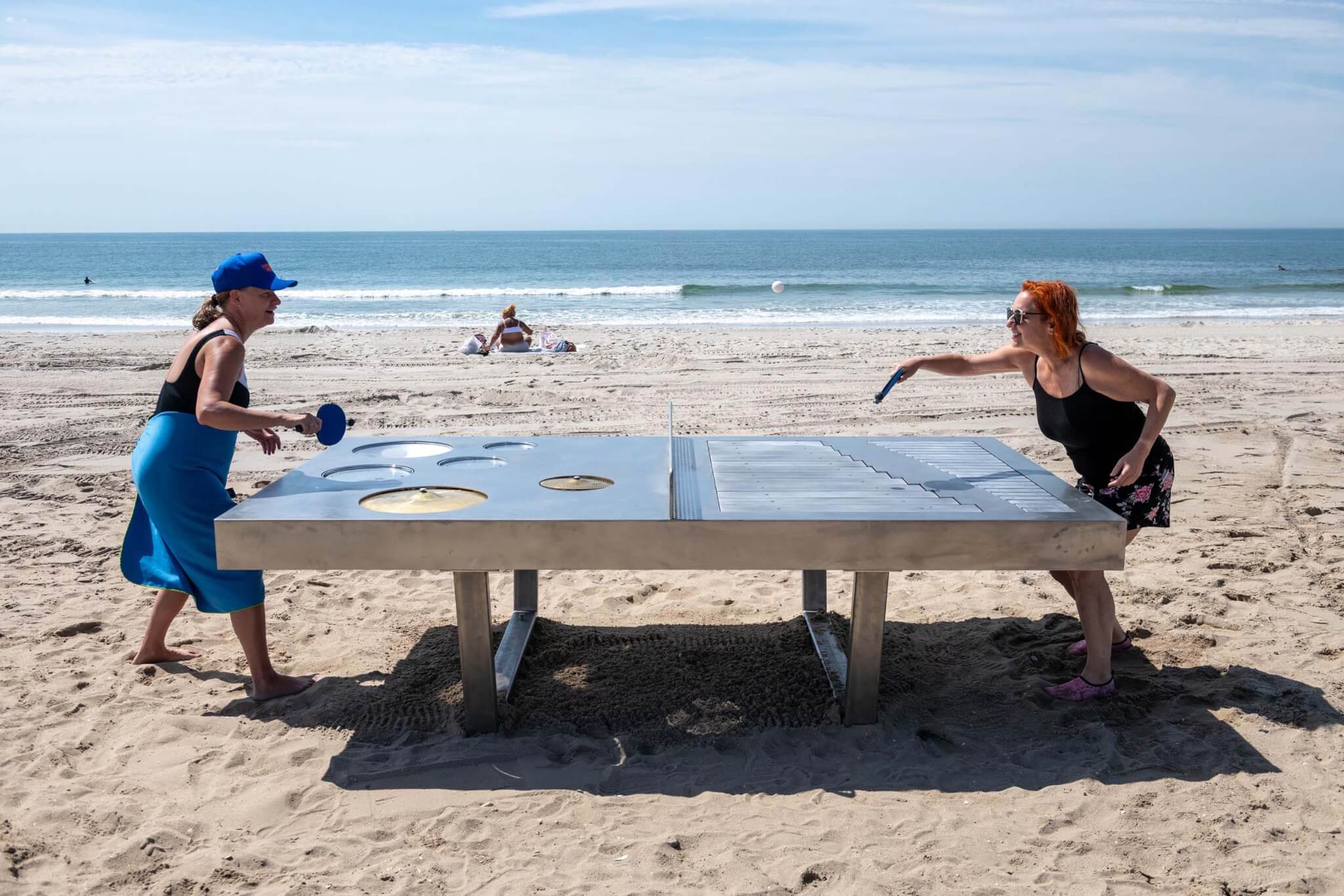 Cymbals and xylophones were inserted into this playing surface. (Timothy Schenck/Courtesy Public Art Fund)
Las Hermanas Iglesias incorporated sound into his design. Instead of the plastic clink of the ball hitting the racquet and table, the playing surface, finished in stainless steel, also incorporates cymbals and xylophone instruments to bring orchestral sounds to the ocean. For the artist, the musical instruments also nod to ancient Indian temples and jazz, which Queens lays claim to be the home of.
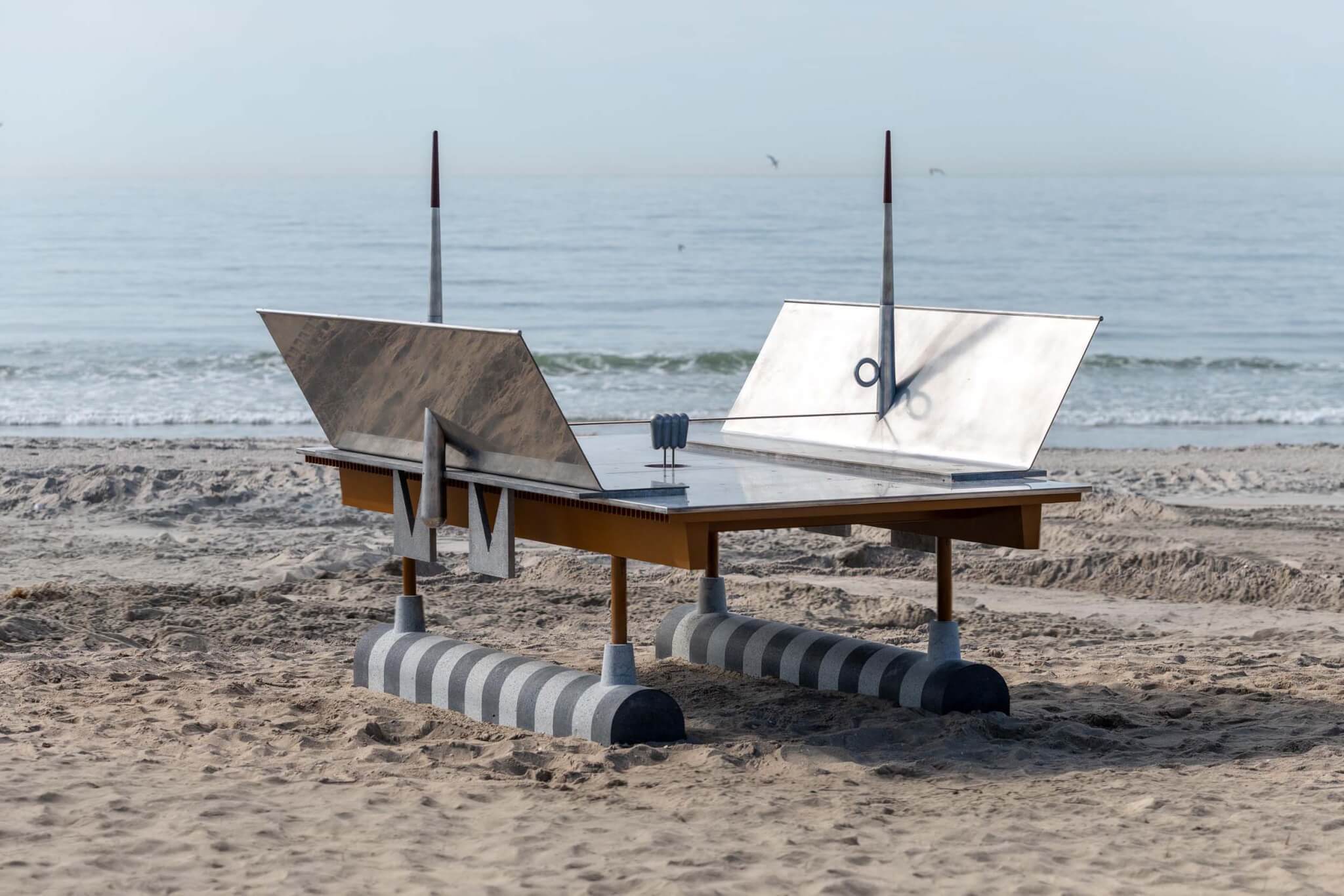 Carlos H. Matos’s Tlachco, combines ping-pong with Ulama, a Mesoamerican ballgame. (Timothy Schenck/Courtesy Public Art Fund)
Another design with ancient roots is Carlos H. Matos’s Tlachco. Here, ping-pong is combined with Ulama, a Mesoamerican ballgame. Matos scaled down Ulama—an early sport played on a field that measures approximately 225-feet long and 13-feet wide. In the Mesoamerican game players use their body to hit the ball through hoops and, with Tlachco, Matos mimicked this sort of play by constructing angular walls and small hoops attached to pointed poles.
The six ping-pong tables are on view, and available for play, through September 13. On August 22, they will host a ping-pong tournament.