
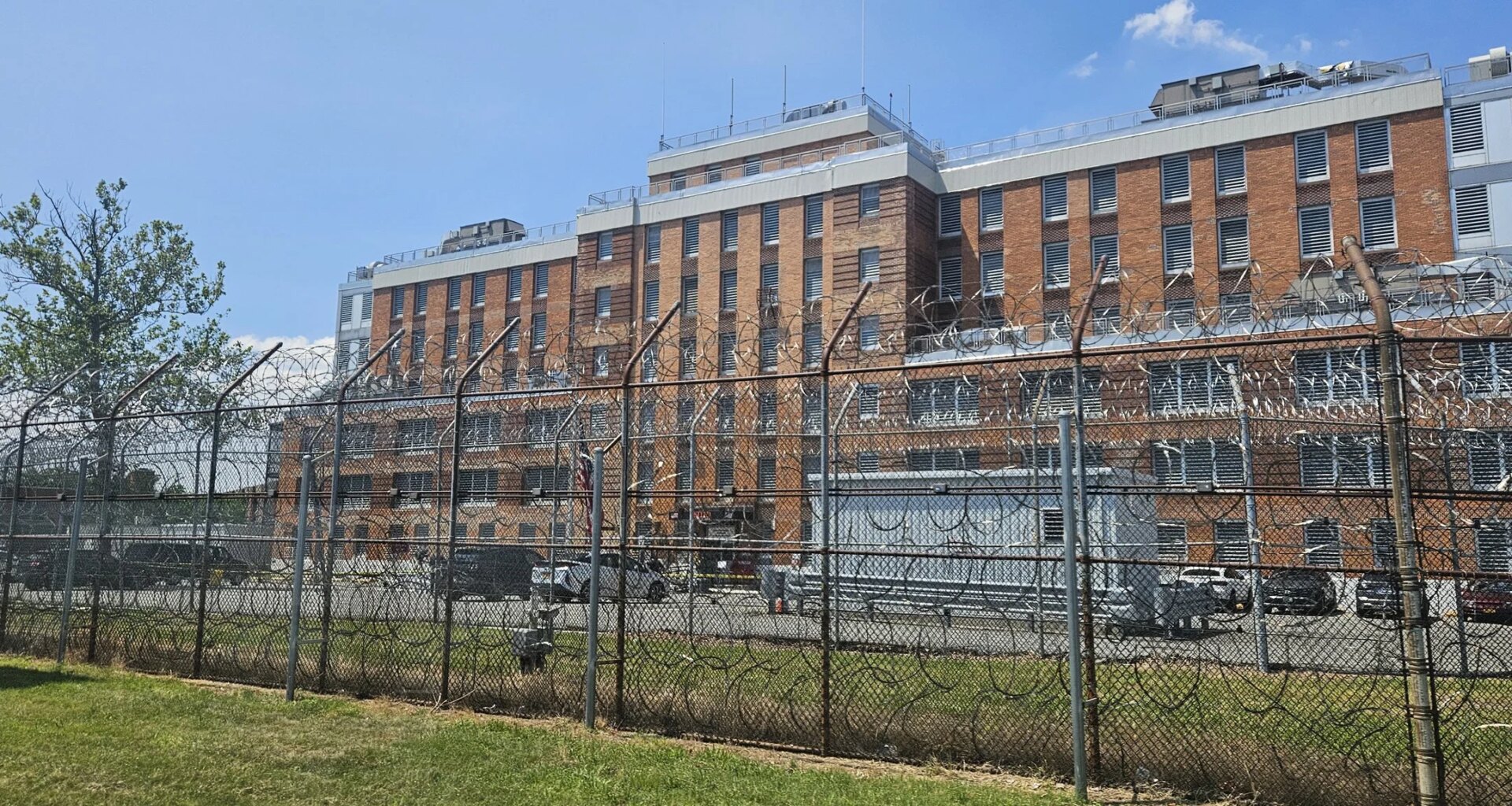
The building is now under the full control of DCAS, which will use the building for renewable energy projects and other public purposes.
“We’re responsible for facilitating the relocation of city offices and operations and delivering the city government’s compliance with its climate mandates, and today marks the beginning of a particularly significant project for us – reimagining the future of Rikers Island – and taking a major step forward to closing these facilities,” DCAS Commissioner Yume Kitasei said.
DCAS has yet to determine exactly what NIC will be used for, Kitasei said.
Alongside NIC, the DOC also handed over control of portions of the Anna M. Kross Center and the George Motchan Detention Center.
As of Monday, the empty housing units inside AMKC and GMDC were transferred to DCAS, but certain building functions, like the kitchen in AMKC that supplies most of the meals for the island or the training academy annex in GMDC, remained under the control of DOC.
AMKC was once one of the largest jails on Rikers Island, with the capacity to hold 2,300 detainees – nearly a third of the jail complex’s current population. Originally opened in 1978, AMKC deteriorated to the point that it was too costly to make safe, and the DOC shuttered it in July 2023.
GMDC also shuttered in 2018, and DOC used the building as a training academy annex.
AMKC and GMDC have sat empty of incarcerated individuals for years, but DOC officials in the past were hesitant to relinquish control, stating they may need to use the facilities in the event of sudden surges of the jails’ population.
Facility transfers from DOC to DCAS were originally supposed to take place every six months starting in 2021 to help facilitate the city’s plan to turn the island into a renewable energy hub once the jail permanently closes. DOC transferred a jail facility and 43 acres of land in 2021 under former Mayor Bill de Blasio, but the decommissioning process completely stalled under the Adams administration.
But under Mamdani, the city appears recommitted to at least attempting to meet their legal obligations to close the jail island for good.
Richards, the first formerly incarcerated person to lead the DOC, has repeatedly affirmed he was committed to resume the transfers.
“We’re going to operate with dignity and humanity centered in every decision we make, every strategy we deploy, every bit of our work,” Richards said on Monday. “The time of ‘out of sight, out of mind,’ the time for who’s wrong and who’s right, is over.”
Public Advocate Jumaane Williams called the transfer a milestone in fulfilling the city’s promise to close Rikers. Williams also criticized the Adams administration for delaying the transfers and making it unfeasible for the city to close Rikers by the deadline.
“It is truly indefensible that under the previous mayoral administration, the transfer on these properties was delayed for years,” Williams said. “I know we’re not going to hit the mark, but I want you to understand the difference between an administration that may miss the mark while trying to get the thing done, and an administration that wouldn’t even try.”
“Obstinate obstacles every step of the way,” Williams added.
But while the transfer was celebrated by lawmakers and advocates on Monday, the city has a long road ahead before Rikers can be shut down and replaced by four borough-based jails.
The new jails, including the one that will be built behind Queens Criminal Court in Kew Gardens, are years behind schedule. The first of the new borough-based jail facilities likely won’t be completed until 2029, two years after the current closure deadline, and the final jail isn’t expected to be completed until 2032.
Queens City Councilmember Selvena Brooks-Power said that work still needs to be done to lower the overall jail population so Rikers Island can empty out more housing units and transfer more facilities to DCAS. Brooks-Power, who chairs the City Council Committee on Criminal Justice, said one of the biggest roadblocks to meeting that goal is delays in case processing in the courts.
“Closing Rikers requires more than transferring buildings, it requires transforming how our entire criminal justice system operates,” Brooks-Power said. “Today, more than 85 percent of people in our city jails are awaiting trial. Many remain incarcerated, not because they have been convicted, but because their cases take far too long to move through the courts.”
“Reducing case processing times is one of the clearest opportunities we have to safely reduce jail population while protecting due process and public safety,” Brooks-Power added.
Queens Borough President Donovan Richards celebrated the closure and transfer of the three facilities on Monday, and called on the city to continue to push for the closure of the “hellhole” that is Rikers Island.
“Closing Rikers is not just good policy, it’s a moral imperative,” the BP said. “Every time I’m here, I see young men and women that remind me of myself at that age. I was the lucky one to break free…but I don’t want to be the lucky one anymore.”
In 2025, 15 people died while in custody on Rikers Island. So far this year, four people have died in DOC custody.