
Queen’s University Canada engineering students have spent three years developing a mechanical, electronics-free 3D printed prosthetic for above-elbow amputees, filling a design gap that left migrants on the Thailand-Myanmar border without options.
Biomedical computing student Emese Elkind has led a Queen’s engineering team working with the Burma Children Medical Fund (BCMF), an NGO near the Thailand-Myanmar border, to produce 3D printed prosthetics for migrants affected by one of the world’s longest-running civil conflicts. The university’s ties to BCMF stretch back nearly 20 years, when researchers Eva Purkey (Family Medicine) and Colleen Davison (Public Health) began making annual trips to a northwestern Thailand clinic to support health workshops and policy reform.
Over time, that relationship expanded, BCMF grew its services to include eye screening, wheelchair distribution, and surgical access for underserved communities in Thailand and Myanmar. In 2019, with backing from an Australian donor and technical training from Thai Reach, the organization launched a dedicated 3D prosthetics program. The academic dimension followed when Purkey and Davison connected with computing faculty Gabor Fichtinger and Parvin Mousavi, who brought engineering expertise and secured funding through MITACS and the Faculty of Arts and Science, enabling formal 90-day student placements at BCMF.
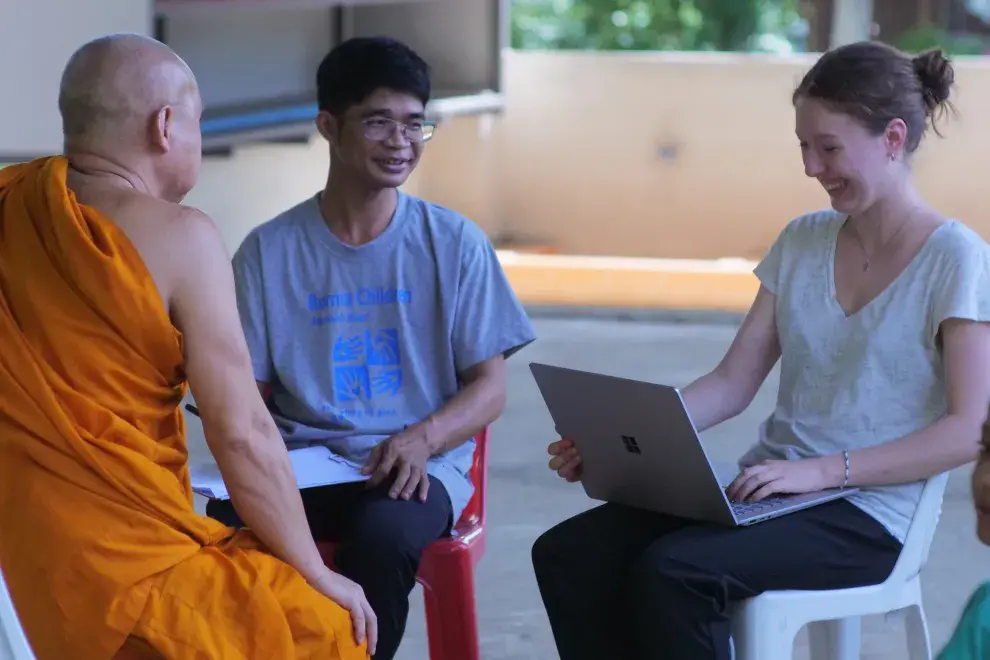 Emese Elkind, right, has gained a powerful undergraduate experience developing and creating 3D printed prosthetics for migrants . Photo via Burma Children Medical Fund.
Closing a Critical Design Gap
Student placements have run consecutively since 2023, Olivia Radcliffe was first, followed by Elkind in 2024 and Amina Najib in 2025. This year, Cole McCauley and Hailey Parker are on the ground through a new three-way partnership with Inter Pares, an Ottawa-based international cooperation organization. Each placement builds directly on the last, maintaining continuity across the engineering work and the relationships with BCMF staff and patients.
“This is an example of a really special collaboration that I believe is truly mutually beneficial both to the students and to the host organization,” Dr. Purkey said. “These types of experiences are difficult to find. They can be transformative for students, and it is so important that they be useful for hosts as well.”
BCMF had open-source prosthetic designs and donated printers in place, but a critical gap remained: no open-source solution existed for above-elbow amputees. This population presents a harder engineering challenge, both elbow movement and hand function must be reproduced simultaneously.
Most available designs address this through electronics, which are costly to source, difficult to maintain, and entirely impractical in a low-resource border setting. Back at Queen’s, Elkind mobilized the Queen’s Biomedical Innovation Team (QBiT) to tackle the problem directly. After two years of iterative prototyping, the team developed a fully mechanical harness system capable of moving the elbow and each finger independently, requiring no batteries, motors, or external power of any kind, and operating solely through the patient’s own body movements.
“We collaborate with BCMF on anything they need, including modifications to existing prosthetics and software user interfaces, but the main project is the above-elbow prosthetic, which is complex because we need to recreate both elbow movement and hand function simultaneously, by only using the patient’s body movements,” Elkind said.
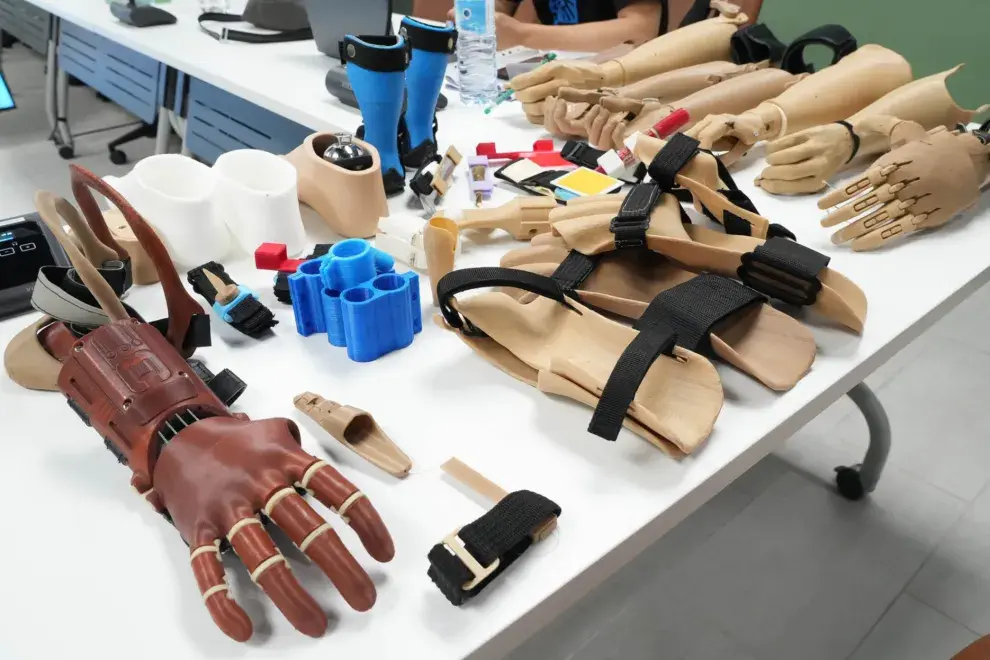 Queen’s students continue to work on developing and fine-tuning designs for prosthetics that can be created using a 3D printer. Photo via Burma Children Medical Fund.
Recognition That Gives Back
The project has drawn competitive recognition across North America. The team placed first at the RESNA Conference in Chicago and finished as runners-up at a Rice University competition in Houston, and donated half of all prize money directly to BCMF, funding surgeries, translation services, and temporary housing for patients who cannot access care locally. Queen’s also extended free access to professional design software to the BCMF team, adding a practical resource dimension to the academic partnership.
For the students involved, the placements carry weight beyond the technical work. Conducting patient interviews and writing donor reports put the stakes in direct terms, prosthetics here are not design exercises but functional tools that determine whether someone can work, earn, and support their family.
“BCMF’s patients often need to work every single day to support their families. Having a prosthetic that is durable, functional, and useful to them can completely change what they’re able to do independently,” Elkind said. “This experience has been life changing, and has reshaped the way I think about engineering, where our job isn’t just to make new technology, it’s to solve real problems. Of course, none of this would be possible without my team and the support and mentorship I’ve received from my professors.”
As Elkind moves into a master’s program, she is transitioning to a senior advisory role and has worked to build a structured leadership pipeline within QBiT, so that students returning from placements can carry the project forward without institutional knowledge walking out the door with any single individual.
The Open-Source Gap in Complex Prosthetics
While 3D printing has transformed access to basic prosthetics, the technology has consistently fallen short for amputees with complex joint loss, particularly above-elbow cases. That gap has left some of the world’s most vulnerable amputee populations, including migrants, conflict survivors, and displaced communities, without viable options.
The broader field has begun to acknowledge this disparity. Open Bionics, through its Hero FLEX system, has worked to extend 3D printed bionic arms to above-elbow amputees, a population it describes as historically the least served by the prosthetics industry, where anatomical variability and mechanical complexity have kept device options narrow and prices high. According to Psyonic, advanced prosthetic arms remain out of reach for roughly 90% of patients who need them.
In humanitarian contexts, the gap is even wider. The Enable Community Foundation has deployed open-source 3D printed prosthetics in Haiti, where a large number of upper-limb amputees were left without care following the 2010 earthquake. Similarly, Ultimaker donated 3D printing systems to a fabrication lab in a Jordanian refugee camp to produce hand prosthetics for displaced Syrians. These efforts, however, have largely focused on simpler designs, leaving above-elbow cases unaddressed.
The Queen’s-BCMF collaboration is one of the few documented efforts to close that gap with a fully mechanical, open-source solution designed specifically for field conditions where electronics are not an option.
3D Printing Industry is inviting speakers for its 2026 Additive Manufacturing Applications (AMA) series, covering Energy, Healthcare, Automotive and Mobility, Aerospace, Space and Defense, and Software. Each online event focuses on real production deployments, qualification, and supply chain integration. Practitioners interested in contributing can complete the call for speakers form here.
To stay up to date with the latest 3D printing news, don’t forget to subscribe to the 3D Printing Industry newsletter or follow us on LinkedIn.
Explore the full Future of 3D Printing and Executive Survey series from 3D Printing Industry, featuring perspectives from CEOs, engineers, and industry leaders on the industrialization of additive manufacturing, 3D printing industry trends 2026, qualification, supply chains, and additive manufacturing industry analysis.
Featured image shows Queen’s students continue to work on developing and fine-tuning designs for prosthetics that can be created using a 3D printer. Photo via Burma Children Medical Fund.