
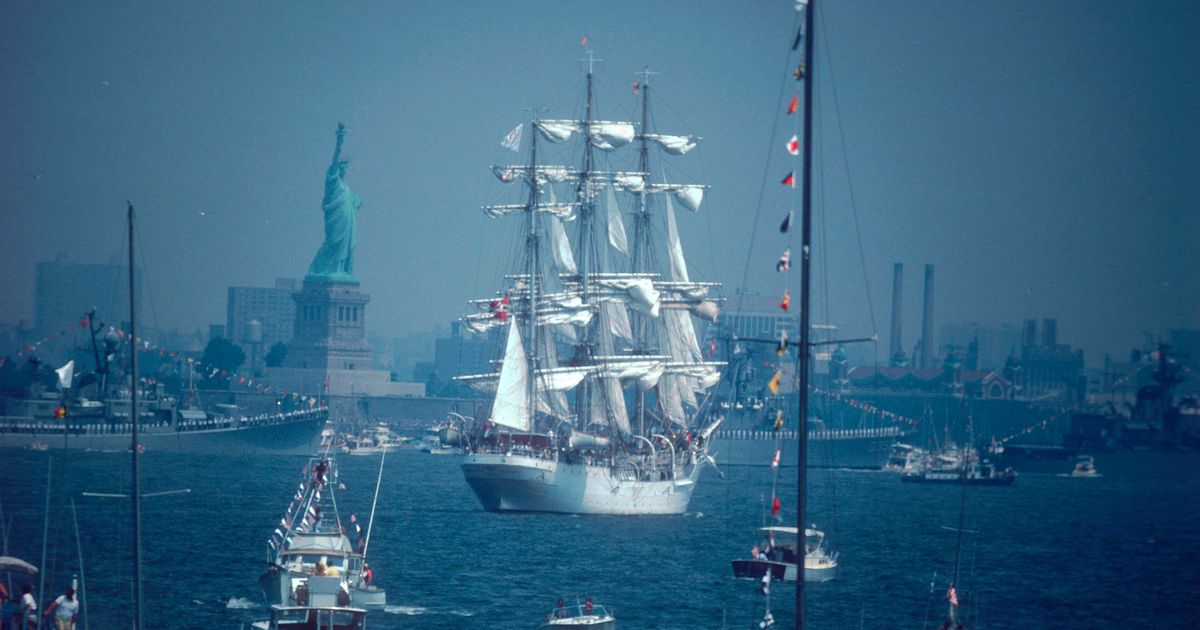
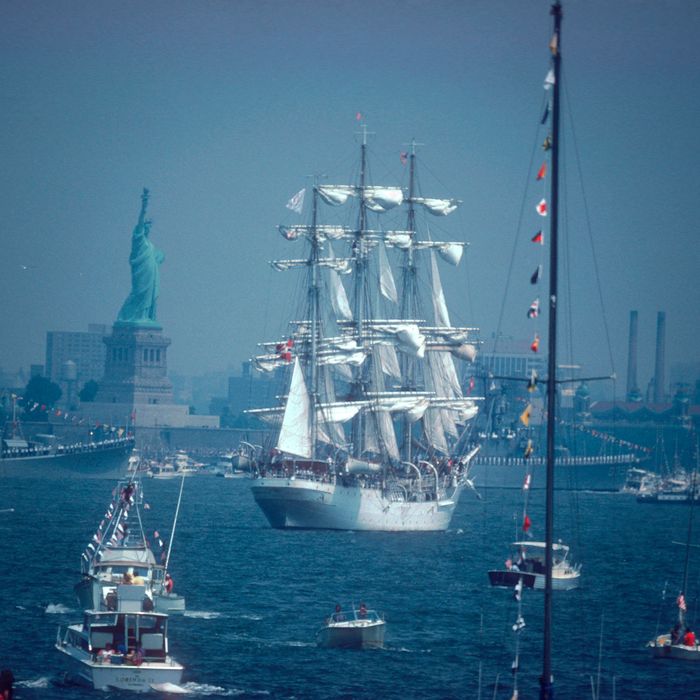
Tall ships paraded in New York Harbor for the Bicentennial.
Photo: ©Burt Glinn/Magnum Photos
On the Fourth of July, New York Harbor will fill with white canvas and slender hulls. The city would have been jumping all weekend even without the arrival of the tall ships — hosting a World Cup match, an unprecedented three-site fireworks display, Times Square ball drops, the rumored Taylor Swift wedding in the Garden, a Blue Angels flyover — yet the floating parade will be, at least visually, the centerpiece. The Amerigo Vespucci, in from La Spezia with 406 people aboard, will unfurl its 28,363 square feet of sail and glide beneath the bridge named for its countryman Giovanni da Verrazzano. It is one of 21 participating Class A ships — the big ones, 40 meters or more in length — from Portugal and Poland and Peru as well as Milwaukee and Key West. They will pass Cunard’s Queen Mary 2, not a sailing ship but the world’s last active ocean liner, supplying a different flavor of maritime history. More than a dozen smaller Class B sailing ships will join the parade after their own procession on the East River the previous afternoon. So will an array of about 40 warships from around the world, anchored in the harbor as the sailing vessels go by.
Now known as Sail4th 250, the parade of ships is a successor to Operation Sail, the international flotilla of schooners and barques and windjammers brought into New York Harbor half a dozen times starting in 1964. This is shaping up to be the biggest one of all, and it will be twinned with the Seventh International Naval Review, for which 37 warships will assemble along the Hudson for inspection. And there you have America’s semiquincentennial summer in a nutshell: An idealistic wind-powered celebration will share the harbor with a flex of battleship-gray imperial brawn.
Fifty years ago, to mark the American Bicentennial, a similar event took place in New York Harbor. Operation Sail ’76 was paired with Macy’s first Independence Day fireworks show in what President Gerald Ford called “the greatest Fourth of July any of us will ever see.” One person onboard a tall ship that headed down from Hell Gate described faces appearing in every single window and lining the shore, much as you’d see on Central Park West on Thanksgiving morning. It seemed to strike a special chord among the immigrants, by then elderly, who had come to New York in steerage 60 or 70 or 80 years before.
That extraordinary response stemmed partly from the scale of the thing. Leading up to Sunday, July 4, 1976, more than 100 large sailing ships, including 16 square-riggers, came into the harbor en masse — and on the day itself, they were joined by perhaps 5,000 small craft, from tiny catamarans to good-size yachts. Any amateur skipper could join the party as long as he or she kept safely out of the way of the big ships. The lower Hudson River was, for a few hours, blanketed in billowing fabric.
In the harbor that same day lay a group of more than 50 military vessels convened from 22 countries, lined up for Ford’s presidential review. It was an unprecedentedly low point in public perception of the military; the last helicopter out of Saigon had lifted off barely a year earlier. In 2026, the array of warships will be similarly formidable. And if the tall ships convey mostly maritime elegance, the message the gray hulls send, international participation notwithstanding, is tougher and harder-edged. It will be difficult to see them at this moment without thinking of empire run amok, of a very recent war fought for the vaguest of reasons and conceded as soon as Donald Trump got bored with it. Notably, the current commander-in-chief will skip the event, leaving the naval reviewing to Pete Hegseth, Marco Rubio, or some similar character.
That said, the EPCOT of it all is hard to deny, and in the arrival of the tall ships, at least, you can still feel it. The lower Hudson, one of the greatest natural harbors in the world, is an ideal place to provoke those thoughts, setting all those puffy sails against the Statue of Liberty, Ellis Island, and what remains of the piers that immigrants both built and disembarked upon.
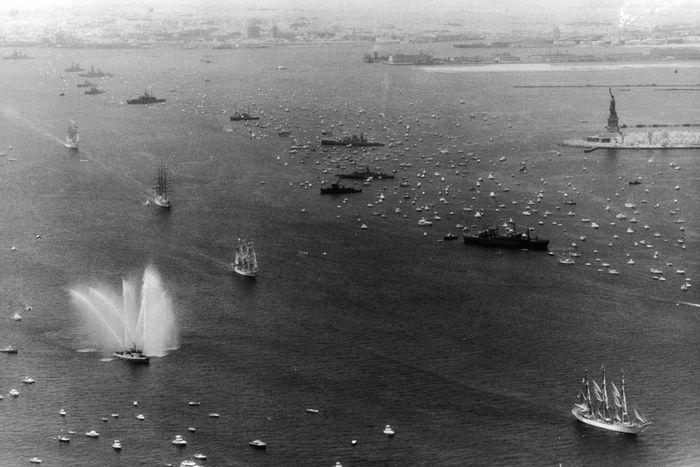
During OpSail ’76., thousands of small craft joined the celebration.
Photo: Pictorial Parade/Getty Images
Most of the sailing ships that will be here are newer than they look: built in the 20th century rather than the 19th, with steel hulls instead of wood, powered by diesel engines on days without wind. They’re heavily scheduled as working training vessels and ambassadors of goodwill, and merely getting on their itineraries required planning that began in April 2020. (A leap of faith, given what was going on at the time.) Since then, there have been endless rounds of logistics, spearheaded by Chris O’Brien, who ran OpSail and is president of Sail4th 250. His group has to coordinate the Coast Guard, all the navies, the Port Authority, the harbor pilots who know how to ease a vessel into the port without running aground, the cops, and McAllister Towing, whose tugboats will nudge everyone in the right direction. Even the Sanitation Department is in on the planning because the garbage barges need to get out of the way.
How does it all work on the big day? Each ship gets a set of navigational positions to hit — the term for this is scheme of maneuver — on the morning of the Fourth. “Every ship knows where they’re supposed to be,” O’Brien says. “Every ship navigates to a course that is drawn up the harbor with what we call waypoints.” That effort is marshaled partly to avoid a crash like the one in which the Mexican tall ship Cuauhtémoc struck the Brooklyn Bridge last year, killing two people and injuring more. What if there’s no wind? The backup engines will come on. How about too much? “Well,” O’Brien says, “it’s up to the master of the vessel to either set sail or not,” unfurling as much canvas as needed.
On the Fourth, the main event will start at 7:30 a.m., beginning with the naval review that proceeds past the anchored gray hulls south from the George Washington Bridge. Then come the tall ships, starting at 9:27 a.m., six minutes apart, alphabetically by nation, Argentina to Uruguay, moving under the Verrazzano and past the Statue of Liberty up the Hudson. At the GWB, they will each turn — hence the tugboats — and proceed back downtown. All those little unofficial participants, the sloops and ketches that will join the festivities, will be restricted to nine holding areas. The only others moving freely about the harbor will be the waterborne traffic cops: NYPD vessels, Coast Guard patrols. Afterward, some of the tall ships will linger in town for a few days, so you can clamber onboard for tours.
Like this 250th-birthday celebration, the Bicentennial arrived at a divisive moment in American politics, two years after Richard Nixon had, in his own private scheme of maneuver, brought the nation right up to the edge of a constitutional crisis. That year’s celebrations were both extremely earnest and a little cheeseball: We got everything from a major refurbishing of the Washington Monument to sealed souvenir containers of Bicentennial air. It was a year of extremely earnest schoolroom pageants. A^t mine, the teachers put us each in a straw-boater-style hat (more 1896 than 1776) with a red, white, and blue paper band. This being the 1970s, the hats were made of molded polystyrene and thus still exist somewhere in a New Jersey landfill. We all marched and cheered.
The mood that summer, much like today’s, was not uniformly joyous. “Some wondered if the United States had anything to celebrate,” wrote Hyla M. Clark in a subsequent book about OpSail, noting that people were “bombarded by commercialism.” There were complaints about the car traffic and the financial cost to the broke city. Yet on the day, wrote Clark, “all of a sudden, there it was.” One of the creators of OpSail, the maritime historian Frank O. Braynard, who beforehand had said he was going into the day with “a combination of dread and hope,” later wrote, “It happened and amazed everyone.” There may not be quite as many small-time sailors in the harbor this time, owing to the rigidity that has become inevitable since the 9/11 attacks, but plenty of weekend captains will make their way here. And when the big sails sweep in that morning, it will, however fleetingly, be beautiful.
Thank you for subscribing and supporting our journalism.
If you prefer to read in print, you can also find this article in the June 29, 2026, issue of
New York Magazine.
Want more stories like this one? Subscribe now
to support our journalism and get unlimited access to our coverage.
If you prefer to read in print, you can also find this article in the June 29, 2026, issue of
New York Magazine.
Related