
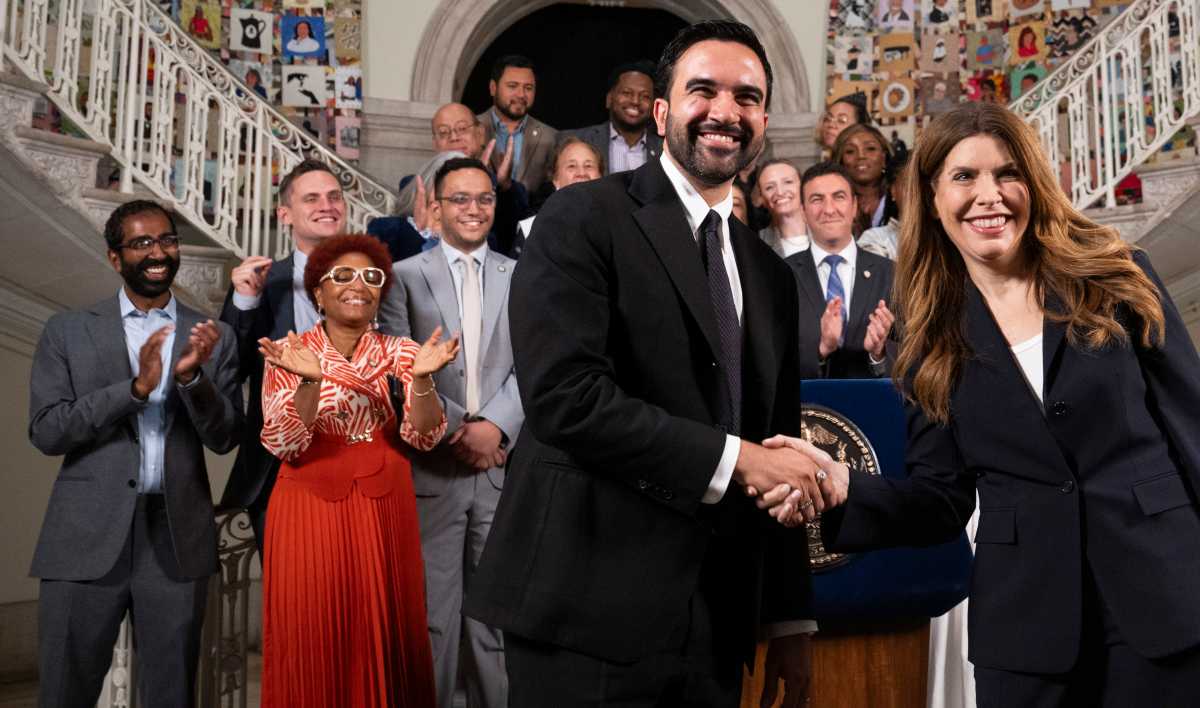
Mayor Zohran Mamdani and City Council Speaker Julie Menin shook hands Tuesday on a $125.8 billion NYC budget that holds NYPD headcount flat, funds a public portal for post-9/11 air quality and health records and adds hundreds of millions of dollars to city reserves.
The agreement, Mamdani’s first budget as mayor, came hours before the city’s June 30 deadline and capped weeks of negotiations over policing, affordability programs, public services and the city’s long-term fiscal health.
The final budget does not include an increase in NYPD headcount, a win for Council progressives and public safety advocates who had pushed back after Police Commissioner Jessica Tisch previously said the department planned to hire 580 additional uniformed officers.
Asked after the handshake why the budget did not include increased staffing, Mamdani said he and Tisch had found savings while keeping the department at its “originally authorized” level.
“I’ve been talking to all agency heads about ways to find savings, and Commissioner Tisch and I were able to identify ways to keep the NYPD headcount at the originally authorized 35,000 while also meeting all of our crime-fighting needs and implementing the new programs that were announced earlier this year,” Mamdani said.
Queens Council Member Tiffany Cabán, co-chair of the Council’s Progressive Caucus, praised the decision.
“I am proud to have worked closely with the Mayor and public safety advocates to ensure there was no increase to the NYPD’s headcount in this budget,” Cabán said in a statement. “Every dollar we spend on policing and incarceration means money we can’t spend on housing, mental health care, substance use treatment, and economic stability: the proven policies that actually keep our communities healthy and safe.”
NYC budget includes 9/11-related items
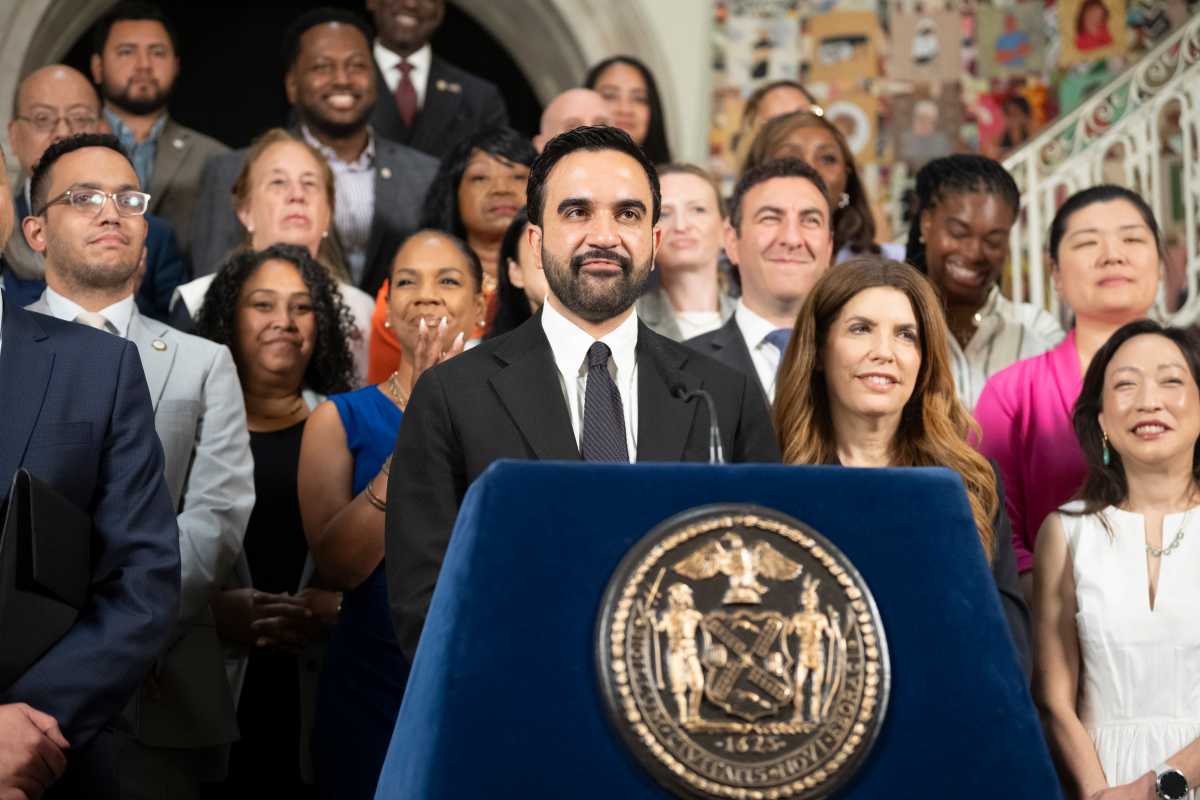 Mayor Zohran Mamdani speaks about the FY2027 NYC budget inside the City Hall Rotunda on June 30, 2026.Photo by Lloyd Mitchell
The budget also includes $34.2 million to create an online portal for city records related to post-9/11 air quality and health risks, according to City Hall. The first batch of documents is expected to be released before the 25th anniversary of the Sept. 11 attacks, with additional records added on a rolling basis.
The funding marks a win for City Council members and 9/11 health advocates who have pressed the administration to fund a Department of Investigation probe into what the city knew about Lower Manhattan’s air quality after the attacks and when officials knew it.
The Council had sought $4 million for DOI to carry out that investigation after passing a law last year mandating the probe. Advocates have long accused the city of stonewalling requests for records from the weeks and months after the attacks, including risk assessments and communications between city agencies and the federal government that could shed light on why the public was told Lower Manhattan was safe to return to.
The Council said the budget includes $6.25 million for DOI, including $4 million to complete and release its report on 9/11 toxins, as well as $1 million for 9/11-related field trips for students.
Housing vouchers and rental assistance
After a fraught few days leading up to the handshake, Mamdani and Menin reached a deal to create a new rental assistance program for New Yorkers facing eviction or homelessness, after budget negotiations initially stalled over funding for CityFHEPS.
The agreement includes $175 million in Fiscal Year 2027 and $125 million baselined starting in Fiscal Year 2028 for a new voucher program administered by the Department of Housing Preservation and Development. Council officials said the program could potentially reach 30,000 additional New Yorkers who are not currently eligible for CityFHEPS.
The agreement also sets up the end of the city’s litigation in the long-running lawsuit over the Council’s 2023 CityFHEPS reform laws once the Council passes new legislation creating the voucher framework.
Asked why the CityFHEPS deal came together at the last moment, Mamdani said he had long supported the program and its goals.
“I’m proud that the speaker and I, and all of our teams, were able to come to an agreement that, as the speaker said, is a win for all New Yorkers,” Mamdani said. “I’ve been clear about my support for this program, my support for the intent of delivering for the neediest New Yorkers.”
Fair Fares
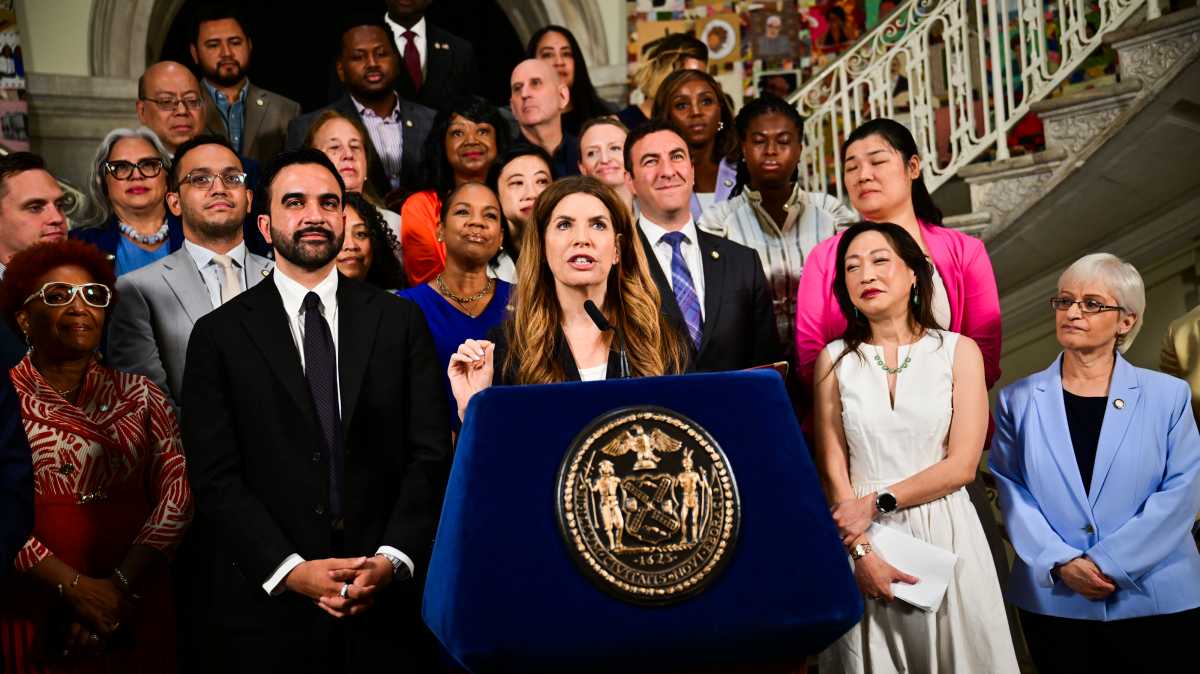 City Council Speaker Julie Menin speaks about the NYC budget in the City Hall Rotunda on June 30, 2026.Photo by Lloyd Mitchell
The budget also expands Fair Fares eligibility to New Yorkers earning up to 200% of the federal poverty level, up from 150%. The Council said the expansion would make an additional 340,000 low-income residents eligible for half-price subway, bus and paratransit fares, bringing total eligibility to about 1.3 million New Yorkers.
Asked whether the Fair Fares expansion was an alternative to his campaign promise of free buses, Mamdani said he remained committed to both faster and free buses.
“When I was running for mayor, I spoke about the importance of raising eligibility to 200% of the federal poverty level, and this does that,” Mamdani said. “We raise this Fair Fares eligibility to a historic amount, and we also do so while being fully committed to delivering buses that are not only fast but also free.”
Education, parks and cultural funding
The spending plan also includes a $53 million expansion of NYC Kids RISE that will provide $1,000 college savings accounts for every public school kindergartner.
Menin said the accounts could be used for vocational school, community college or a four-year college.
“This is simply one of the most effective ways we can truly address income inequality,” Menin said.
The agreement also restores funding for parks, libraries and cultural institutions, including library support, cultural community support, parks enforcement patrol, GreenThumb and stump removal. Menin said the budget also fully funds libraries at their highest level and includes capital funding to support affordable housing on top of some libraries, a Council priority.
The budget includes new funding for CUNY programs, including CUNY ASAP, CUNY ACE, CUNY Reconnect and disability services.
Mental health, meal programs and more
It also includes major investments in mental health services, including Assertive Community Treatment, Intensive Mobile Treatment, crisis respite centers and mobile treatment step-down teams.
Council Finance Chair Linda Lee said the mental health funding would support services for New Yorkers with severe mental illness and help reduce their contact with the criminal justice system.
“Our city’s mental health response is rooted in compassion to ensure that individuals receive the quality care that they need in their time of crisis,” Lee said.
The budget also restores immigrant legal services funding, an issue Lee tied to the recent return of a Council employee who had been detained by ICE for months after what she described as a routine appointment.
“We need to make sure that we’re giving our legal service providers what they need,” Lee said.
The agreement includes $12 million to increase reimbursement rates and expand home-delivered meals for older New Yorkers. Lee said the funding would help providers deliver culturally appropriate meals seven days a week.
Mamdani, who began the budget cycle with an inherited $12 billion deficit, praised staff on both sides of City Hall for helping to close the gap. Mamdani stressed that his administration had done so without slashing essential services, while Lee said the Council had believed from the start that the city could balance the budget without drawing on rainy-day funds or imposing significant property tax increases – as Mamdani had initially proposed before negotiations got underway and the city got major monetary assistance from Gov. Kathy Hochul.
“We worked together to usher in a new era of fiscal health for our city, one that is sustainable, one that is durable, and one that makes needed investments in a safer, more affordable New York,” Mamdani said.
Menin said the budget showed the city did not have to choose between spending restraint and public investment.
“It was frankly never a choice between one or the other,” Menin said.
Mamdani also said the city would send eligible nonprofits 50% advance payments, complying with a Council law intended to address cash flow issues for organizations that provide city-funded services.
The Council is expected to formally adopt the Fiscal Year 2027 budget at its stated meeting on Tuesday afternoon.
Other allocations in the budget include $700,000 for a pilot program to provide OMNY cards to CUNY students, $2.5 million for early childhood workforce development, $5 million for the Community Food Connection program, $2.1 million for a deliveristas support initiative, $1.5 million for free swimming instruction, $1.2 million for expanded Department of Sanitation lot-cleaning staff and $1.4 million for housing stability microgrants for survivors of domestic violence.
The spending plan also includes $5.15 million for homeowner stabilization services, including estate planning assistance, foreclosure prevention, deed theft and pre-purchase counseling; $2 million for heat pumps in environmental justice communities; $2.1 million for the Commission on Racial Equity; $1.6 million for the Commission on Human Rights; $750,000 for pet food pantries and free or low-cost spay and neuter services; $583,000 for the Maternity Infant Reproduction Program; and $450,000 for veterans outreach and services.