
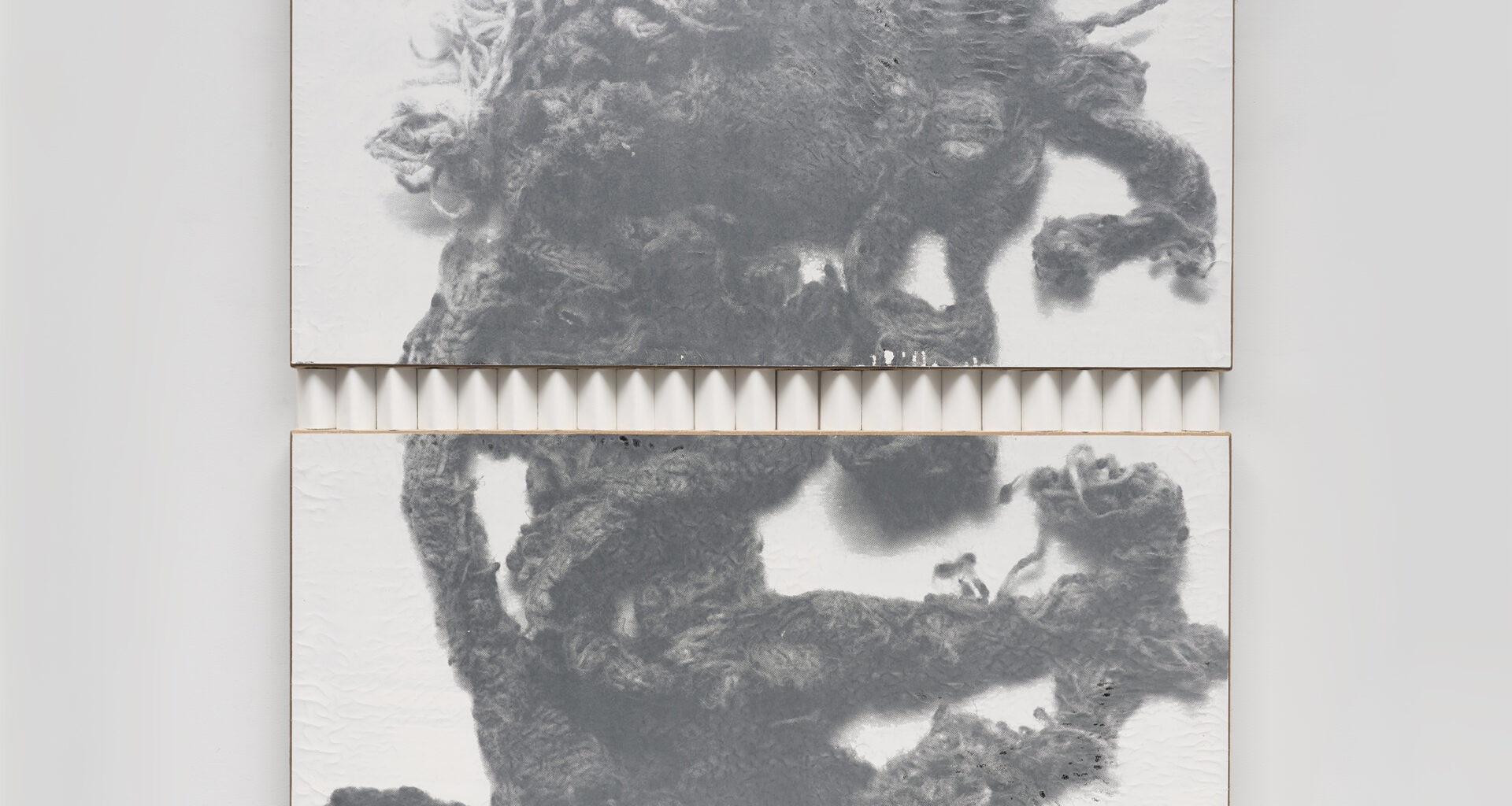
Geophilia
Hill Art Foundation
April 23–July 31, 2026
New York
In her essay that accompanies the Hill Art Foundation’s current exhibition, N. Dash: Geophilia, curator Suzanne Hudson develops an alphabetical, annotated list of the materials the artist deploys. From acrylic paint to Styrofoam, Hudson (a Brooklyn Rail editor-at-large) considers the ramifications of fabricating art from ingredients that decay or won’t, that are typically seen in fine art—such as stretched canvas—or that are newly elevated as display objects as opposed to the throw-away items that go into the making of art, such as nitrile gloves.
N. Dash’s process has long included this range of materials, which permits her to straddle a painterly and sculptural practice. At the Hill, we observe this in the first work we encounter, SG_26 (2026), a vertical picture onto which the artist has smoothed earth that is then covered in diagonal arrays of silkscreened dots and dashes that meet at points to form little stars. When seen from a distance, the dots and thickness of the earth converge to take on the appearance of a mottled and yet light-reflective gray. A length of string is tied around the canvas and holds a spade-shaped rock roughly in its middle. The rock in turn keeps the two sides of the string taut while creating real depth on the surface. In the right lighting conditions, it could cast a shadow.
Canvas, earth, ink, rock, string. These introduced, we are ready to encounter Dash’s fifteen additional works, all of which forthrightly make visible the ingredients used by the artist, a truth in materials or “principle of transparency,” as Hudson puts it. But we might still be surprised by the variety of her practice, as well as by an aspect not enumerated in the essay: the opportunity that the artist and curator have taken to explore installation as a medium, using the collections and the architectural quirks of the two levels of the Hill Art Foundation to build an exhibition that teases out the possibilities of siting and juxtapositions. It rewards the engaged viewer with play between Dash’s works, as well as between her works and the art historical objects included in the exhibition.
We can see this most immediately in the positioning in the main gallery of the Chelsea-billboard-sized RCU_25 (2025). It is composed of two equal sides, each painted green, the left a bright spring green while the right a darker Kelly green. On each panel, just inches from the center point of the diptych, Dash has inlaid strings at the same angle. At first glance, the panels seem like they could bear identical markings, though closer inspection shows that they neither mirror nor repeat. They also don’t bisect each other, as tempting as that might be. What the painting does bisect is the walls that stand before the Foundation’s floor-to-ceiling windows: Hudson and Dash have installed RCU_25 across the walls so that the center of the painting hovers between them.
Other plays occur throughout the exhibition. The bright blue of TRM_26 (2026) echoes the blue wall of the car wash visible through a southern window (the squeegees used in both may not be coincidental). On the northern side of the building, PR_25 (2025), with its silkscreened intimations of tufted threads, hangs in a corner near to the terrace, which permanently houses Christopher Wool’s own tangle, a monumental untitled sculpture from 2013.
Upstairs, Commuter_CM_26 (2026)—made of acrylic and paper—folds itself over a corner and ushers us toward the work hanging flush on the wall next to it, CS_26 (2026). Meanwhile, the tall and narrow HN_19 (2019) hangs by itself in a small nook across the hall, its earth and caution-orange acrylic covered by a veil of similarly colored agricultural netting. The netting isn’t pulled tightly across the canvas but is draped, which causes it to dangle somewhat apart from the support. Its hazy edges and fiery projections call to mind the colorful off-gassing that happens whenever Barnett Newman’s works are well-lit. The entire tight space opens as if it were a chapel, an impression reinforced by the sliver of Spencer Finch’s stained-glass Candlelight (CIE 529/418)(2022) glimpsed through the moveable walls left open just a smidge.