
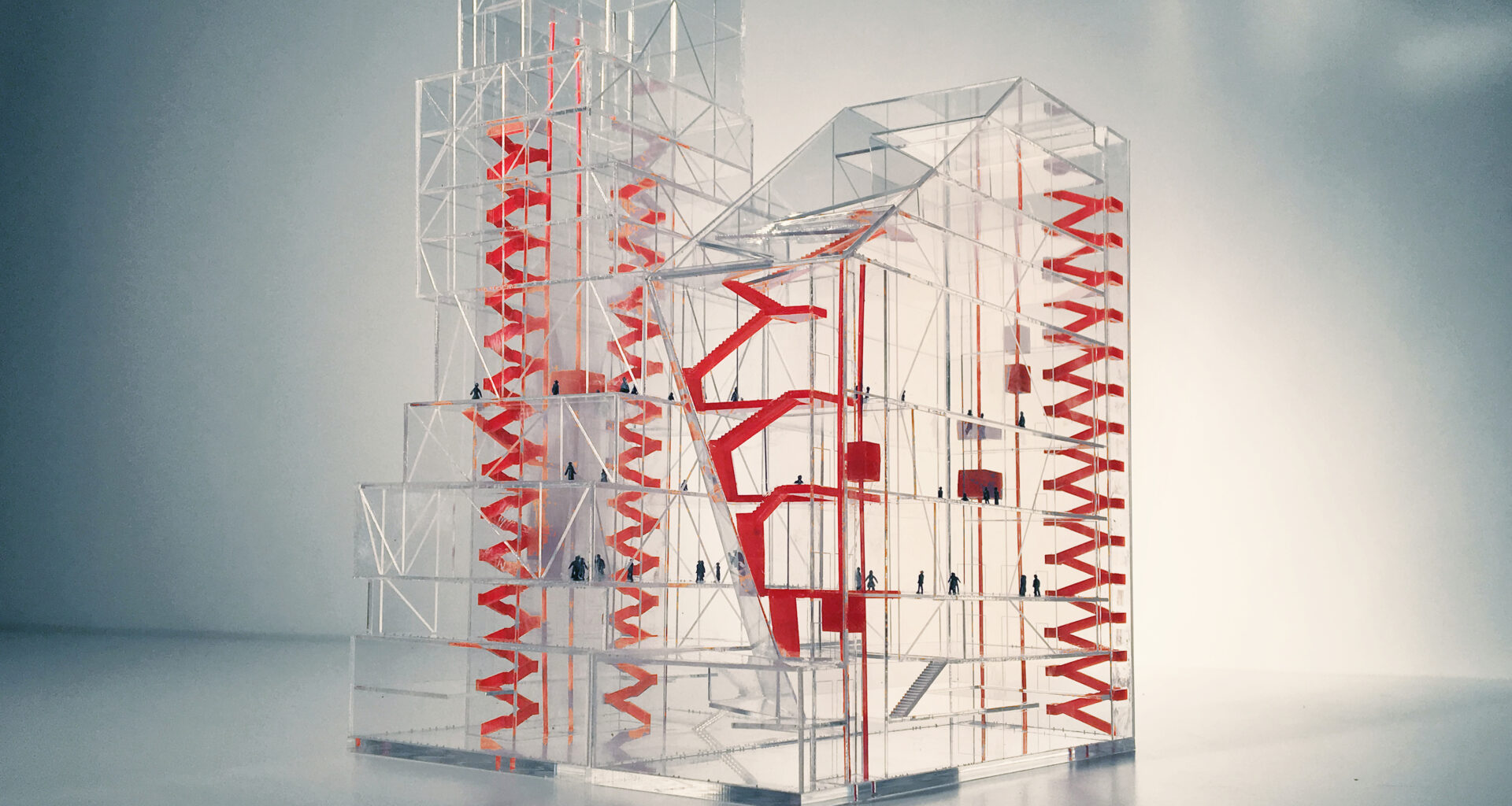
Two towers stand side by side on the Bowery, one opaque and stacked, one translucent and faceted, pressed together like shy figures meeting for the first time in an arranged marriage. No other museum in the world possesses this kind of dichotomy. The OMA expansion to the New Museum, which opened on March 21, 2026, alongside SANAA’s 2007 building at 235 Bowery, asks what newness actually costs in a city now dominated by speculative capital and risk management.
If SANAA is known for pushing the boundaries of thinnesses and transparencies, OMA is known for proposing jarring dissonances. A client, like Apple, who admires SANAA’s lightness but fears risk may settle for hiring Norman Foster, or worse, Bohlin Cywinski Jackson. For a client who admires OMA, who is the safe version? No one. Because OMA inherently identifies with danger. A critic once said that no one leaves a Koolhaas building without bruises, a claim anyone who has visited Casa da Música up close would find difficult to dispute. They invent new applications of cheap materials to provoke. They make changes until the last minute. They test every possibility. They accept mistakes. They deny the clean slate.
Le Corbusier opened Towards a New Architecture in 1923 with a provocation that architecture had lost its way, and that engineers—those designing ocean liners, airplanes, and automobiles—were the ones producing genuinely new forms, because they were responding to new conditions with new means. The manifesto denied history and urban constraints as relevant to the architect, and instead, accepted heavy-handed authorship. This is what made twentieth-century New York icons, such as the Guggenheim Museum and the United Nations Headquarters, feel so new.
OMA founding partner Rem Koolhaas accepted metropolitan forces, theorizing architecture to be produced and regulated by the city itself. Delirious New York, published in 1978, includes a position from Hugh Ferriss that describes New York as a new Athens, where an “honest” building directly takes the form of the zoning laws around it. Today, American building codes are bloated with rules intended to reduce liability. Furthermore, the New Museum aspires to be a community anchor on one of the most contested blocks in the city, sitting at the literal convergence of the Bowery Mission’s homeless services and the luxury retail that has forcefully transformed SoHo. The responsibilities that the project assumes are formidable, yet the answer is not to deny authorship, which often is associated with anything different or new.
Newness often feels uncomfortable because it is unfamiliar. Much of the reception around the OMA expansion has criticized the design for being overly authored, while having poorly executed details and cleanliness on opening day. While Koolhaas can be credited for providing an architectural DNA, the partner-in-charge for this project is Shohei Shigematsu, and there has been a design team working tirelessly behind him since 2016. The building they produced deserves to be evaluated on fair terms that consider the multitude of stakeholders and pressures shaping an architecture project’s trajectory. Being disturbed by crumbs trapped under perforated metal steps or awkwardly mitered handrails rather than enjoying spatial accomplishments only reflects contemporary cynicisms rather than architectural failures.
The New Museum was founded in 1977 by Marcia Tucker with a commitment to new art and new ideas, to showing work that had not yet gained public acceptance. The institution had humble beginnings as a single room on Hudson Street operated by three volunteers. They were committed to only exhibiting living artists and later broadened their criteria, partially in response to the AIDS epidemic, as many of the most compelling artists of the time were recently deceased. What do institutions do as they mature? What does newness actually require? Today, isn’t every museum in New York City trying to be new? Isn’t every museum acknowledging that they are sited on Lenape land? And isn’t every museum operating with a long donor list, of which at least a few names can be found in the Epstein files?