
The Museum of Modern Art
May 12–August 22, 2026
New York
In 1964, four years before his death, Marcel Duchamp sat for a slide lecture called “Apropos of Myself” and walked an audience in Saint Louis through his career. The retrospective at the Museum of Modern Art begins where Duchamp himself opted to start his story. Not with his urinal, shattered glass, or his nudes, but with his Church at Blainville—an oil he painted in the summer of 1902, at the tender age of fifteen—depicting the fifteenth-century Saint-Michel in the Norman village where he was born. The painting is a tall, quiet canvas. The church sits back behind a tree that climbs the whole left edge, its leaves broken into the wet, bright lush greens of Impressionism. Sun warms the near gable to cream and pale ochre, the long roof falls away into a tender slate blue, and the two lancet windows of the transept dissolve into tonal shadow rather than resolving into anything as devout as tracery. At the peak, almost incidental against the flat sky, a small cross. A path enters at the lower right and goes somewhere or nowhere. It is an immutable Sunday, observed in the open air, signed in the corner by the man who would spend the next sixty years teaching the world that the eye was the enemy and that he had never much cared for paint.
That sentence is, more or less, the official story. And like most official stories about Duchamp, it is the work of a church erected in his name rather than historical reality. Around this artist a remarkable thing has happened: not one orthodoxy but several, overlapping, each canonizing a different article of faith, each requiring that some part of the actual work be kept out of view. There is the sect that venerates the readymade as the great unmasking of art-as-commodity, the urinal that shamed the marketplace. There is the sect for whom the abandonment of “retinal” painting in favor of “cerebral” art was an evolutionary ascent, mind shedding the dead weight of the hand. There is the sect that takes “the spectator makes the work” as a settled law of reception, a democratic gift. And there is the sect that crowns him the founding father of institutional critique, the installateur of the great leap from work to frame. The doctrines overlap and sometimes contradict, but they share a method: each one edits him dogmatically to make him fit into their orthodoxy.
MoMA’s retrospective—the first of its scale in North America in more than fifty years, organized by Ann Temkin, Michelle Kuo, and Matthew Affron—is an irreverent exhibition, which is harder than it sounds when the subject is a man whose admirers have spent decades polishing him into the messiah of art after modernism. The curators decline to genuflect, and they decline to debunk; they simply put the work in front of you and let it be stranger than its reputation. Armed with chronology as the organizing logic, strict and unforgiving, they allow us to watch the mind of the great mystic of demystification move in real time: changing gears, doubling back, worrying over the same few problems for sixty years, abandoning painting only to keep its questions alive by other means.
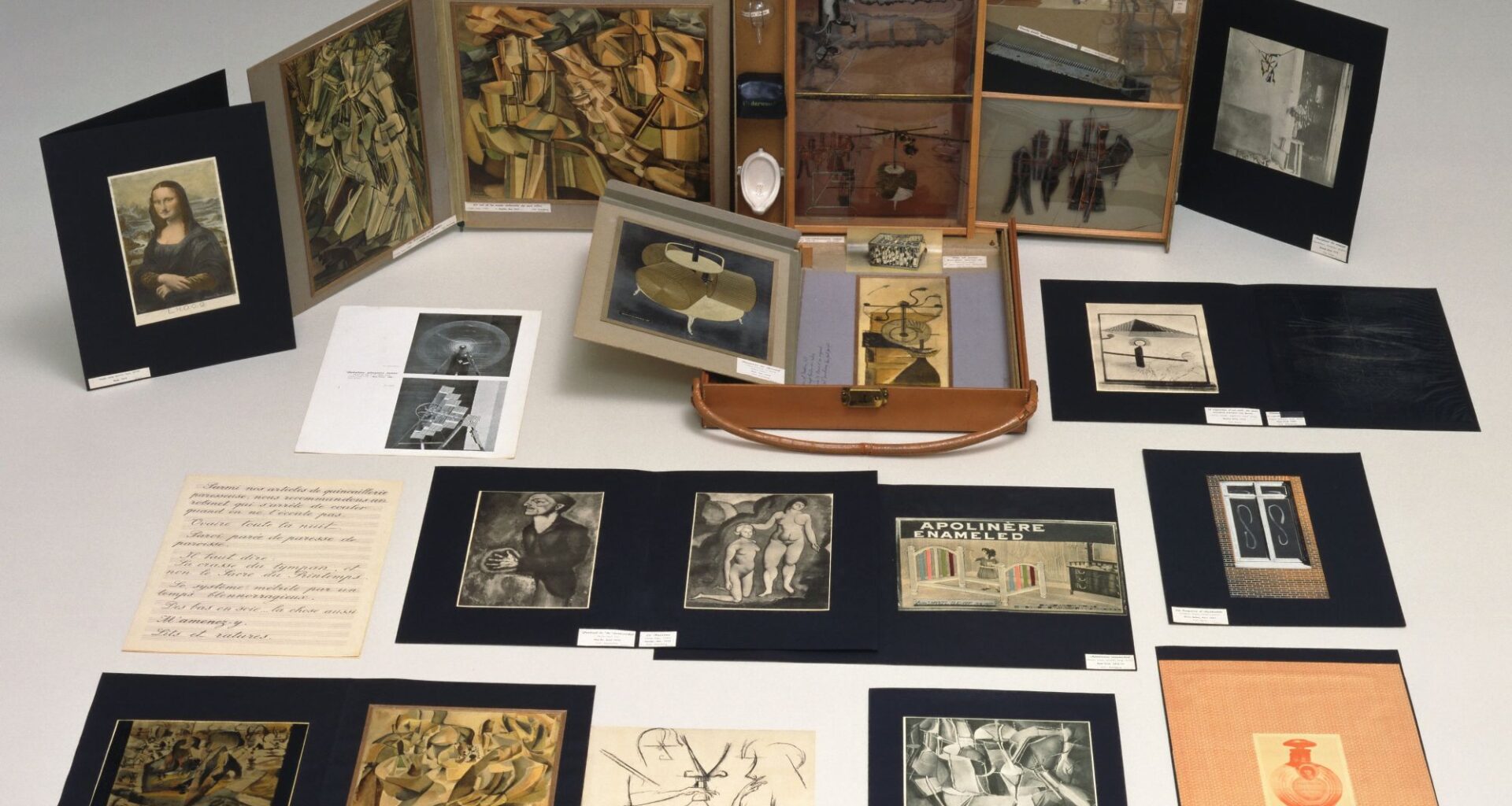
Take, for instance, the question of color, largely overlooked by many of his acolytes. It is worth dwelling on because color is where the gap between what Duchamp said and what Duchamp did opens widest. By 1910, the boy who painted a church in tender blue-grey is making the Portrait of Dr. Dumouchel in violent reds and acid greens, a halo of pure pigment swimming around the doctor’s hand; then he cycles through Paul Cezanne, then Paul Gauguin, as if to give each master three months in his restless and slightly Napoleonic quest to create a masterpiece. Here, the press has fallen into a trap of its own making, bickering over whether a boy of a little over twenty years of age was a “good” painter or a “bad” one, as though the early work were a skills exam he either passed or flunked. It is the wrong question. Instead, watch the color across the whole sequence unfold, watch when it goes underground only to get stranger. In Tu m’ (1918), he paints a row of overlapping color samples, a hand-rendered paint chart, color rationalized into a measuring instrument. In the Rotary Glass Plates (1920) and Discs Bearing Spirals (1923), he engineers machines to study what color does to the eye in motion. In the Green Box (1934) notes he distinguishes “apparent” colors from “native” ones, theorizes pigments whose hue inheres in the molecule rather than the light. And the 324 Boîtes-en-valise, issued in several series between 1941 and 1971, supposedly the driest archival gesture of all, turn out to have been hand-tinted through as many as thirty zinc stencils apiece, the artist crossing a continent to take color notes from his own canvases in the Arensbergs’s house rather than trust his memory, signing the results “Marcel Coloravit”—Marcel colored this. This is not a man who left the retina behind in 1912. This is a man who spent sixty years obsessed with how color is made, faked, measured, preserved, and perceived. The eye, in other words, never yielded to the mind; the two were yoked together by the insistence on manual labor. The myth of his ascent from eye to mind has exactly one author, and it is Duchamp—whose enigmatic pronouncements have been received as doctrine, ever since, and set above the evidence of his own relentless hands.