
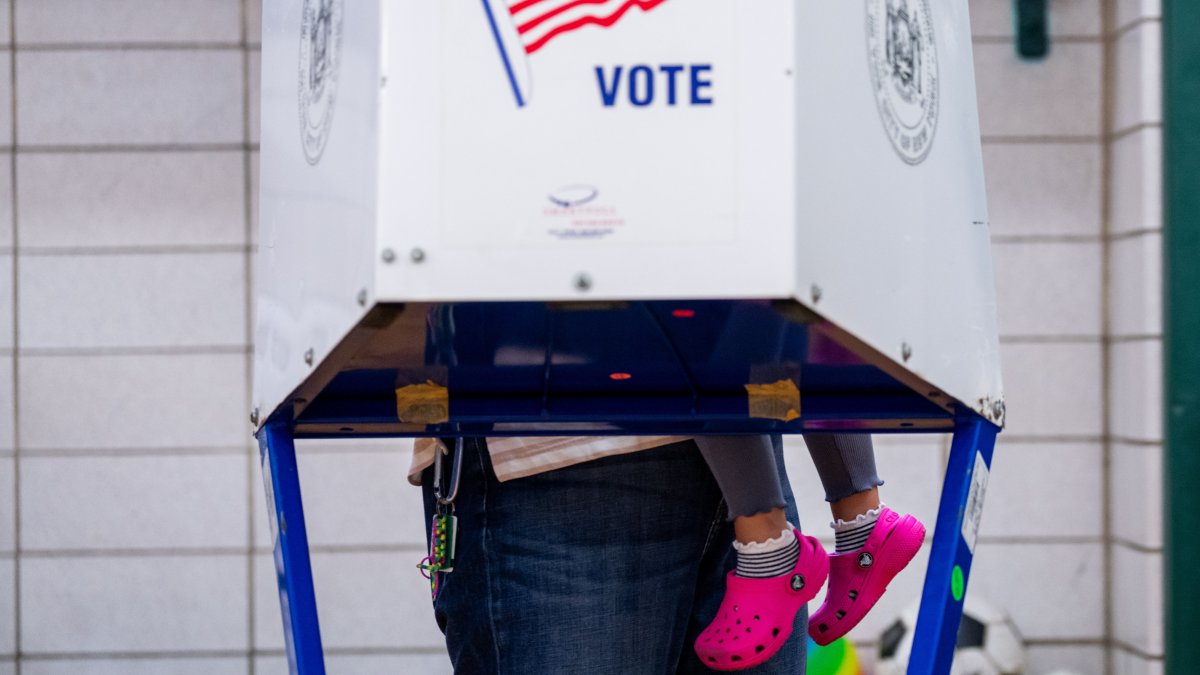
Low voter turnout has been a pattern in New York for decades, and this year’s primary election only continued that trend.
Why? Shouldn’t we do our due diligence and just vote?
There is not one single solution, but there are multiple factors playing into this issue.
By 3 p.m. on June 23, 2026, more than 330,000 New York City voters had cast ballots in the primaries. This is a major drop compared to more than 710,000 voters by the same time in 2025, according to Politico.
Much of last year’s turnout was driven by competitive races, such as the major wave of support behind Zohran Mamdani’s win in the Democratic mayoral primary.
Still, turnout remained a major concern going into this year’s election.
Bloomberg via Getty Images by Adam GrayBloomberg via Getty Images by Adam Gray
Zohran Mamdani, mayor of New York, during a “Get Out The Vote” rally ahead of a primary election at Kings Theater in the Brooklyn borough of New York, US, on Thursday, June 18, 2026. New York will hold its primary election on June 23.
Joshua Tucker, a professor of political science at New York University, says voting can come down to whether people feel it is “worth it” to vote.
“Voting is always a costly act — you could be doing something else with your time — so voters are more likely to turn out the more ‘worth it’ it is to them,” Tucker said.
Those factors include “the importance of the office for which the vote is being held (i.e., how much I care about the outcome) and how close the election is (i.e., how much my vote might matter),” he said.
Primaries often struggle with both.
“In terms of importance, primaries tend to feel less important to voters than general elections because it’s about choosing who is going to represent their side, not whether their side wins or loses,” he said. “In a primary all the candidates have the same party label, so figuring out which of those candidates you prefer is a much more costly and involved act.”
Andrew Gelman, a professor of political science at Columbia University, also cited several structural challenges:
Timing: The general election is always in early November. The primary election is at different times in different years, so it can come as a surprise to voters.
Less visibility: The primary election receives far less media coverage than the general election, making them easier to overlook despite mailers and phone calls.
Candidate similarity: The candidates within the same party often share similar views, giving voters less incentive to turn out.
Early voting numbers this year also reflect the trend. Just 172,743 New Yorkers voted during the nine-day early voting period that ended Sunday, according to the NYC Board of Elections.

Bloomberg via Getty Images by Adam GrayBloomberg via Getty Images by Adam Gray
Brad Lander, former New York City comptroller and Democratic House candidate for New York, left, and Zohran Mamdani, mayor of New York, during a primary election night watch party in New York, on Tuesday, June 23, 2026.
Mamdani acknowledged turnout often depends on the election.
“I think we’ll often see higher turnout for a mayoral election than we will for midterm elections,” he said. “However, we have seen an increase, especially over the last few days.”
Even so, this year’s primary continues to follow the same pattern. Even with competitive races, many New Yorkers still didn’t go to the polls.