
A Second Life
Tate Modern
February 27–August 31, 2026
London
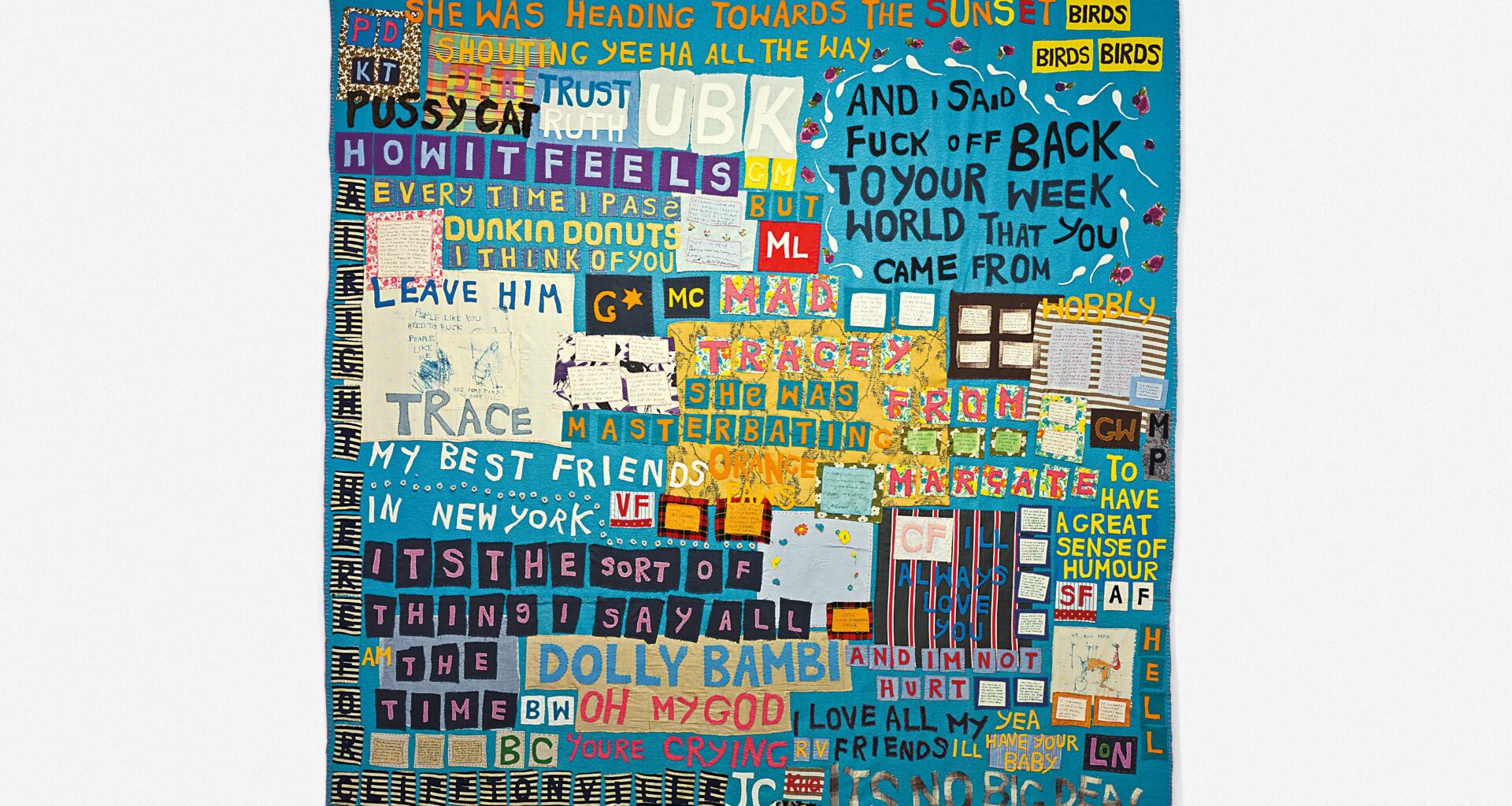
Still short of breath from my walk over the rain-whipped, muddy Thames, across Millennium Bridge then eastward on Bankside to the Tate Modern, I’ve reached the beginning of Tracey Emin’s blood-engorged retrospective, A Second Life. The artist offers up a spangled series of appliquéd blankets and quilts, foregrounding Hotel International (1993), fabricated stitch by stitch with textile scraps. Multicolored homemade letters adorn tapestries chronicling Emin’s Turkish-Cypriot, streetwise, squatter childhood and promiscuous school dropout teen years in the working-class neighborhood of seaside Margate. On a framed scrap of paper nearby, handwritten to appear hurried, but to me a deliberate poem, My Future (1993) captures the moment when an extracted dead tooth left “a large / ugly black hole — / But I didn’t care / I laughed out loud — And said / Brilliant / Fucking Brilliant.”
Just ahead, a huddled crowd stares at a screen emblazoned, “This is a true story, but it is my interpretation.” Before there is time to parse the ten words, a woman in her earlyish thirties, the artist herself, appears in close-up, talking to an off-camera videographer. She is smartly coiffed, lightly made-up, sporting rose-tinted glasses and a chalk-striped blazer with peaked lapels. Her dark hair frames a pale face by turns pensive, agonized, and crookedly smiling. She roams out and about through Central London, pausing at random corners to reflect upon the saga of her May 1990 near-death abortion—How It Feels (1996).
This feels like sick voyeurism, I think, immobilized with fellow gallery-goers in Beckettian frustration, wanting to “move on.” How can Tracey Emin be so un-self-pitying, never breaking beyond the verge of tears as she remembers an abstruse, paternalistic doctor and a vague, powerless boyfriend; the drab clinic waiting room with fifteen anonymous other women, eyes downcast; the ebb and flow of eviscerating pain, the botched, oozy outcome.
And one snags a tinge of regret when she enters a green park at midday, produces a crinkly packet of crisps, feeds a squirrel, purses her lips in bemusement and remarks that, “Everybody wants something small to take care of—it makes you feel more powerful.”
In a nearby video, a fuzzed cerulean ocean splashes in homage to a faceless man venturing toward the waves, while Emin’s voiceover, tender and evocative, speculates about intimacy truncated by thwarted affections. Just behind me are interruptions throughout the galleries—whimpering babes in arms and the occasional recalcitrant toddler, hushed and comforted by their mothers.
This haphazard chorus segues to the welcome onslaught of Tracey Emin’s paintings. While curator Maria Balshaw observes that “her work reminds us that issues around women’s rights, around their bodies and even their sexual and physical expressions, are still in great need of protection,”1 I gravitate toward visceral standouts. I needed you to love Me (2023), a nine-foot-long canvas, nakedly screams tortured abandonment in hectic black acrylic, shrouded by the blue, overwashed spirit of a recently departed partner (for lack of a better word). Depleted drips inch down the woman’s ravaged body onto the tossed ruins of a bed.