
What Everyone Knows
Art Students League
June 5–August 18, 2026
New York
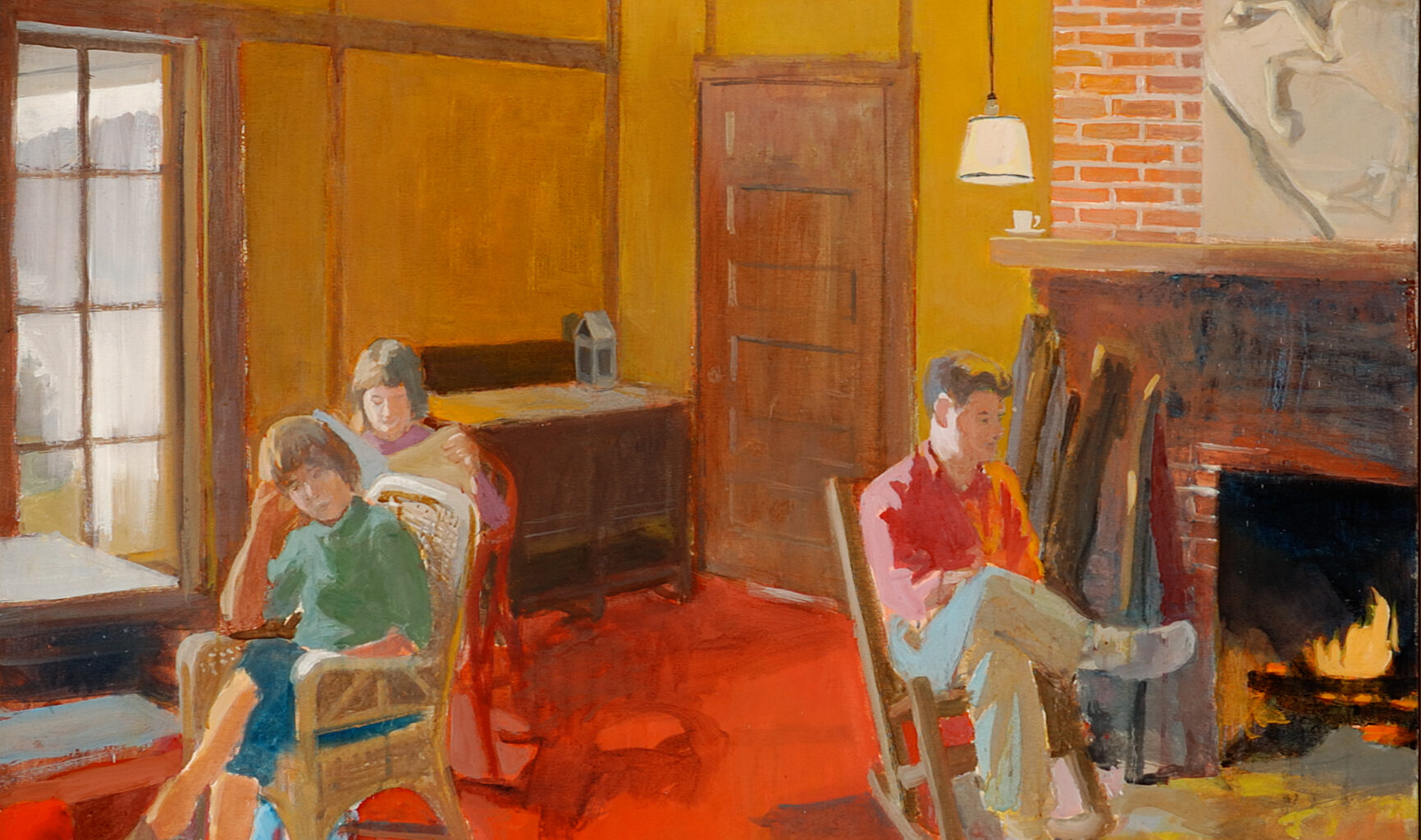
Though Fairfield Porter’s work can present itself as almost disarmingly bucolic, or psychologically detached, this first large-scale exhibition of the artist’s work in New York City in twenty-five years stages Porter as a figurative painter, operating where the dominant tendencies of the fifties collide and are renegotiated. Each of Porter’s canvases orchestrates these collisions, and in each case, realism is less a retreat than the point of re-entry where those pressures are brought back to ground. It is a mode of verité: the point at which abstract decisions are compelled to pass through the description of things. In Porter’s case, that double address generates a friction between formalism and lived experience that is neither resolved nor synthesized but is the condition under which the work proceeds. Self-criticality and medium specificity are folded into the paintings’ construction, which turns on color relations, scale, and the negotiation between flatness and depth. Like Édouard Manet’s realism, Porter’s is the site at which formal problems must answer to perception.
Across Porter’s pictures of interiors, yards, family gatherings, and coastal views, his ambition to redeploy Abstract Expressionism’s flatness, all-overness, and compositional structures within the genres of domesticity and landscape becomes apparent. Each canvas replays this situation from the inside, as Porter sets French intimism against the New York School’s brashness, high formalism against the order of a lived domestic milieu, and avant-gardism against the pastoral. Straightforward description, at the level of its construction, is a motif internalizing abstract painting’s strategies, so they can no longer operate in isolation. What appear to be different pictorial problems—a still life, a portrait, a landscape, an interior—are variations on the same underlying question: whether paint can simultaneously sustain its abstract conditions and its descriptive obligations.
Paintings such as Katie (1969), in which the ground is structured through a series of abstract motifs, neither disavow nor emphasize these conditions. Rather, they provide the context within which formal, painterly, and perceptual problems are worked out. Realism becomes a point of re-entry. The social world depicted in these paintings is not opposed to the abstract but forms the condition through which it repeatedly returns to experience. The snapshot quality is one means by which Porter injects realism into the work, preventing its modernist terms from stabilizing as autonomous and continually folding them back into the pictorial situations which they describe.
Painterliness, foregrounded by the debates of the fifties and sixties when painting had consolidated around critics for whom the abstract was the only viable path, informs Porter’s canvases. Though as a figurative painter he remains committed to realism, as a critic Porter writes in defense of Abstract Expressionism, arguing for its seriousness—but against its conversion into dogma. Each work negotiates between what critics prescribe and what painting actually offers: conditions that cannot be fully reduced to principle. His distance from much contemporary figurative painting becomes legible at this level. Unlike Porter’s paintings, the recent return to image-making has become naively anecdotal, even literary, collapsing into illustration and generalized stylistic effects.