
As I compose myself, I notice a duet—Koppe, in vivid purple, and Thornquest, in deep blue, quietly moving side by side at the wall. It’s like discovering a secret. One goes upside down while the other squats. They curl into opposite facing back bends. Their precision contrasts with the more slapdash Weyant (in maroon) and Maria Fleischman (in olive) pushing and pulling each other a few paces away. When a quartet forms at the center of the gallery, where dancers whirl, flinging their arms, it feels a tad risky for close viewing. But these are seasoned performers who can control their abandon. That said, partner work in Wandering stays low to the ground, lifts are rare. So when Zo Williams slings Soto over a shoulder, heads turn.
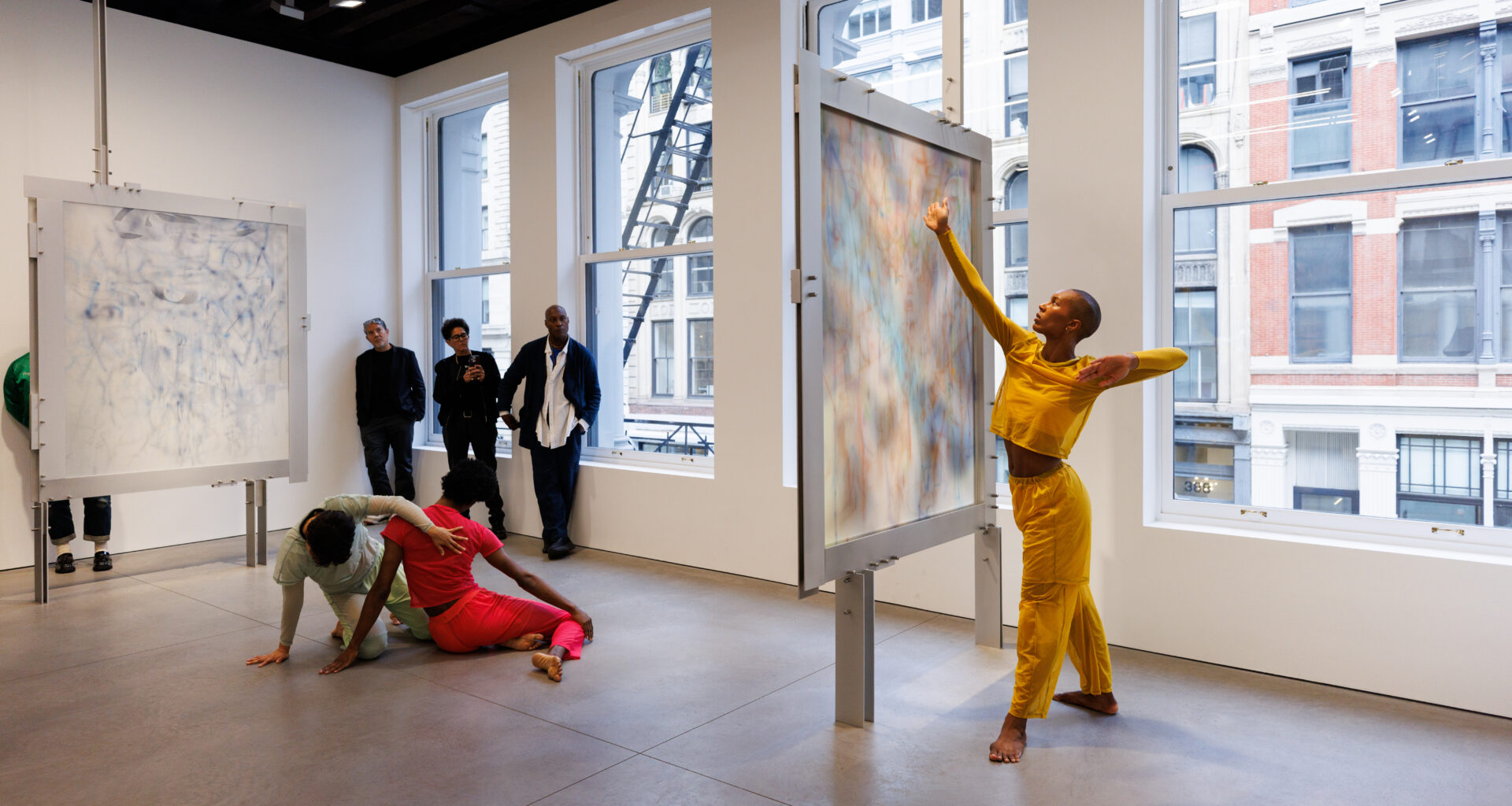
The dancers’ costumes for Wandering by MX Oops are made of transparent mesh that mimics the open grid surface of “TRANSpaintings / Upright Brackets.” You can see skin through the costumes and shadows through the paintings as people pass behind. The light catches Kirk as she performs near a window, casting the fleeting shape of a bird’s wing onto the back of TRANSpaintings (Angelus Novus) / Upright Brackets (2025–26). No viewer is likely to see everything of this show. As I watch, I’m acutely aware of what I’m missing somewhere else.
Stepping out of the elevator at floor three is like entering a dance party. I hear the lyric, “follow me,” repeat as composer Will Johnson plays DJ with a set-up near the doorway. Each painting here takes up nearly a full wall, with black backgrounds on which abstract patterns swirl like smoke. Weyant and Fleischman continue their duet, the movement liquid, the two always touching with at least one body part. I recognize a gesture from earlier: a hand reaching to grab the other’s neck. Jasperse deftly threads an action through from one sequence to another, one floor to the next, as a way to form a cohesive whole. Mehretu’s art has a similar quality. Her pieces each have their own personality, yet together bear a family resemblance.
The high point of Wandering is when a trio of gold, blue, and seafoam (Kirk, Thornquest, and Koppe—I’ve begun to track the dancers by their vivid costumes) take to a wall of third floor windows for a unison sequence. With a turn and kick, they each rest a foot against the wall at chest height. They shift in a row as if on a conveyor belt, and move out into the center of the space. I am charmed when they open their arms and dangle their hands from limp wrists—it’s an inviting, devil-may-care attitude. Happily, we get to see this bit again. Just as they seem to launch it for a third round, the dancers instead disperse.
Messy, annoying, and wholly original, Wandering is a kinetic experience that sweeps up the audience. We share space in this world, like it or not. In one moment I’m watching intently, engrossed in taking notes for this review, and then I turn to see that I am alone in the middle of the room. Everyone else had stepped back to the wall to give the dancers space. That I feel uncomfortable is part of the deal. Wandering continues for seven additional shows. I doubt it will look exactly the same way twice.
The final scene involves two mattresses slamming—mirroring the opening move forty-five minutes earlier—the performers pushing and flopping. Soon all seven dancers begin rolling on the floor like logs—or maybe, synchronized swimmers. They rise on forearms into a cobra position, and curve to side-lying. Each time they roll, one of them stands and exits until all have left.