
Sarah Minor
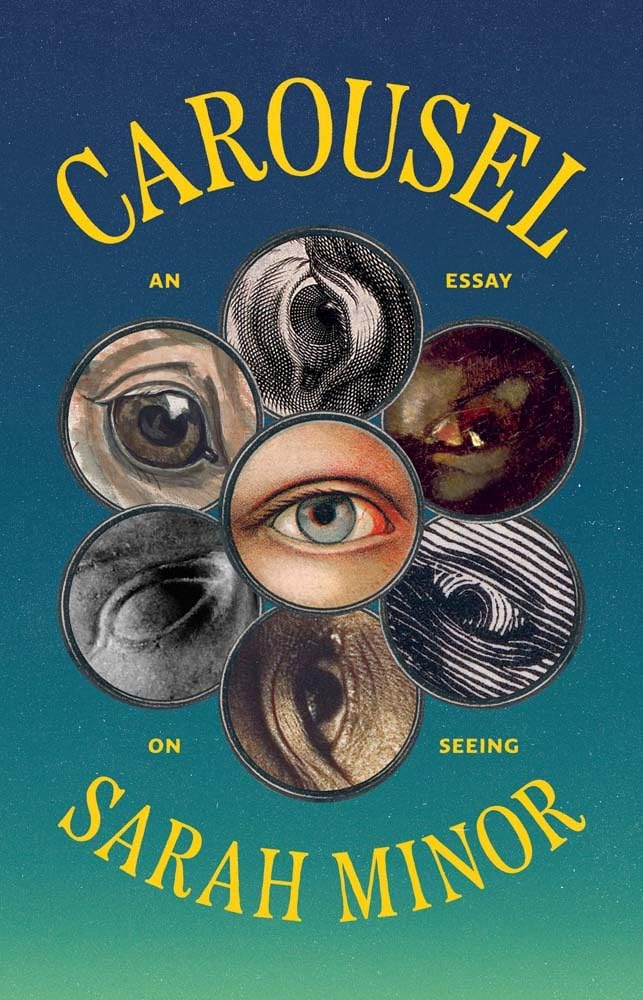
Carousel: An Essay on Seeing
Yale University Press, 2026
Sarah Minor is a master weaver, every bit as virtuoso as the artisans who stitched the eleventh-century epic clothwork that features in Carousel, her astute study of the panorama. The Bayeux Tapestry (which is not a tapestry per se, as she points out, but rather embroidery on linen) opens and winds through this compressed and elegant book as a paradigmatic example of the human urge to capture imagery “in the round”—never as straightforward, ahem, as it seems.
On the narrative hanger of delivering slide lectures for a class called History of the Panorama, Minor layers multiple ideas about observation in general and the inherent possessiveness of the wide gaze, starting with the medium closest to hand: the Zoom talk itself. The computer’s camera eye watches her watching her students watch her back, forming an episodic narrative out of its grid of individual frames. (“The fine-art school they attend believes that students should also be images,” Minor observes with customary shrewdness.) She introduces the subject of the famous tapestry relating the Battle of Hastings—“the world’s softest war monument,” she jokes—which is normally displayed in Normandy on a circular drum that reminds her of a baggage carousel. The tapestry then recurs through the rest of the book, a temporal unfurling of its meanings akin to the way the cloth is read by the viewer.
In the short vignettes, each no more than a page, that comprise the book she goes on to discuss the variety of ways the panorama has permuted throughout history, up to its current transformation, which she posits as the drone. But hold up. Lest I convey Carousel as some sort of dreary academic recitation, a grave misapprehension of Minor’s project as a writer, deeply intellectual though it is, I need to correct the record.
Minor excels at using form to create meaning, and vice versa; in her work, the medium is the message so completely that the literal shape of the work is its subject. This is most the case in her dizzying collection Bright Archive, a handful of intricately wrought “visual essays” in which, say, a river of white space cuts through a meditation on personal and domestic midwestern history, and the river that runs through it all; or text spirals like rope across the pages of an inquiry into eroticism and female trauma. The standard physical bounds of the book are not sufficient to contain her inventiveness: a pullout unfolds into an elaborate essay-poem pieced together in the shape of a log-cabin quilt. This is “experimental” writing at the level of NIH advanced study.
Carousel is far less multitudinous, perhaps because its scope is narrower. (Odd thing to say about panorama, but at least it is a unified subject rather than the almost-everything that overspills the pages of Bright Archive.) It is not wholly without visual sport, however: there is a flipbook element that animates a blank panorama condensing to a thin line before widening back out. Try it! It’s fun! Yet Carousel’s considerations are both tighter and lighter than her earlier books’: its bursts of insight about its subject are sharp and brief, its forays into memoir (the peculiar hallucinations her grandfather experiences as a result of Lewy body dementia; the landscape making of itself a moving panorama as she looked out the car window as a child) suggestive rather than analytic. Her idiom may be said to be scholarly x poetic x playful.