
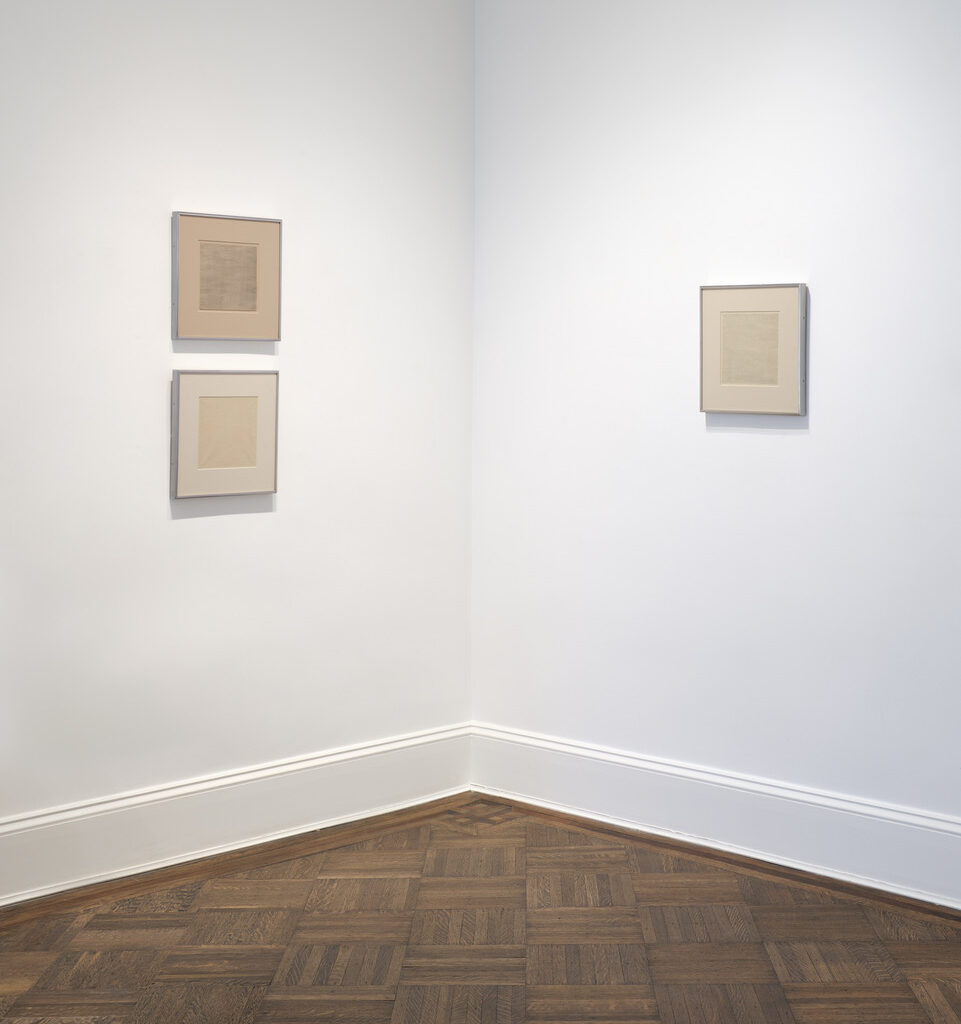
Works on Paper from the 1960s
The Elkon Gallery
May 15–July 24, 2026
New York
There is nothing about the life and career of Agnes Martin (b. 1912; d. 2004) that isn’t strange. Born in Saskatchewan—a huge abstract grassland defined only by surveyors and not by mountains or lakes—she had no real art career until her first solo show at Betty Parsons’s gallery in 1958, presenting work in a representational style totally unlike that of her mature years. After discovering her artistic identity during the early sixties, she abruptly stopped painting between 1967 and 1971, a move that effectively canceled her gallery career until 1975 when she joined the Pace Gallery. Hers was a life of periodic solitude, mental illness, and poverty, but a life lived as a quest for a painterly style capable of expressing the artist behind it.
The venue seemingly created to present Agnes Martin was Robert Elkon’s Gallery, which opened in 1961. There, starting in 1962, most of the fifteen works on paper included in this show (at the now Elkon Gallery) made their debut. Many remained in the families that made the initial purchases, and they now return to their point of departure. What is surprising about Martin’s shows with Elkon Gallery in the sixties is that they were warmly received by critics, including the prickly Donald Judd (b. 1928; d. 1994), whose own turn away from expressionism in favor of abstraction parallels Martin’s. All the more reason to find her abandonment of New York in 1967 baffling: to be sure, she was plagued by psychological crises, hospitalized, and ultimately released. She was alone with her demons in a solitude reminiscent of Saint Anthony the Great, who fled to the desert only to be tempted by the devil through visions.
The works on paper assembled here, all created between 1960 and 1966, constitute an ideal introduction to Martin’s oeuvre. Small in scale—the largest is 12 by 12 inches—they generate an intimacy not to be found in her daunting large-scale paintings. The gallery is important because it enables viewers, who should consider bringing a magnifying glass along, to study each piece, to make connections and to see divergences. The quietness of the venue reflects the utter silence expressed in the work.
The first issue to resolve is Martin’s use of the gridwork. Beginning in the sixteen-hundreds, artists used the camera obscura to project images onto a gridwork. This enabled them to create interiors in which perspective could be replicated with absolute accuracy, as in Vermeer’s paintings. But the gridwork is geometry, and as such it constitutes the imposition of an artificial order on a chaotic, mutating reality. So, Martin’s use of the gridwork as a datum plane marks her departure from representational art and her embrace of an artificial reality, one that she could control, absolutely. On the surface of this gridwork she may inscribe shapes, or she may let the gridwork speak for her.