
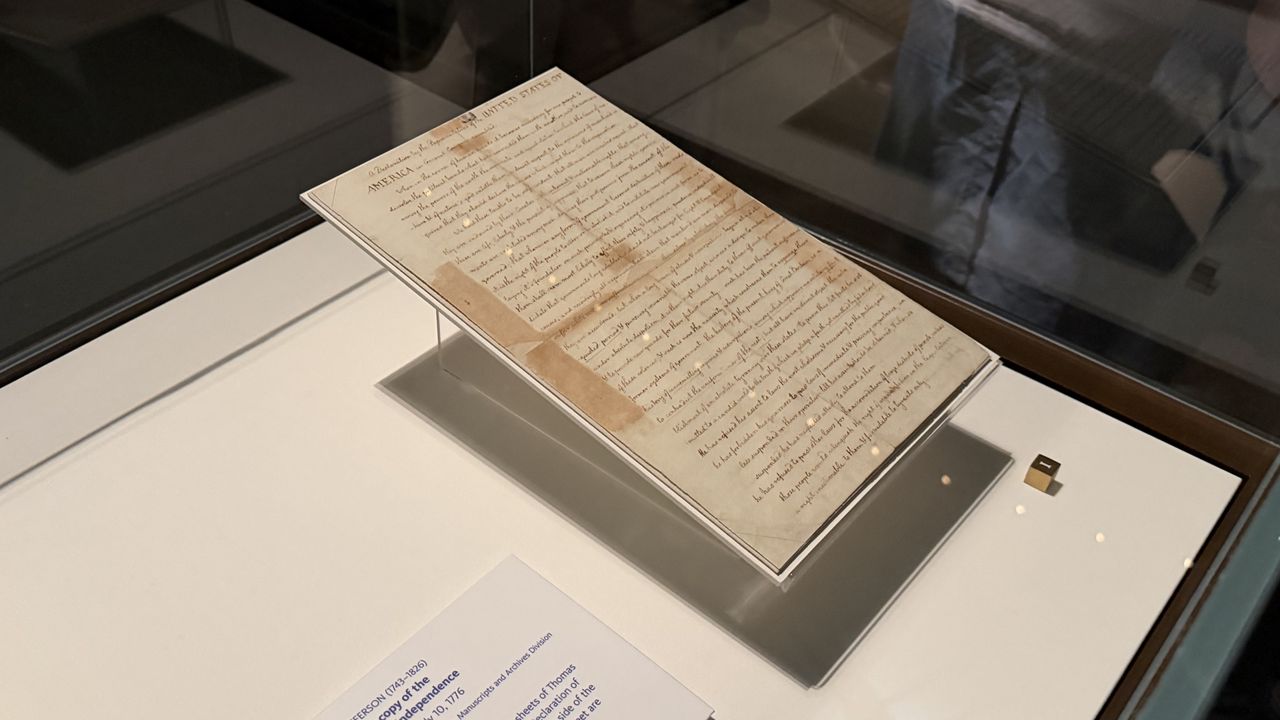
The New York Public Library is celebrating America’s 250th birthday with an exhibit that shares Revolutionary War stories and showcases historic items, including a rare copy of the Declaration of Independence.
What You Need To Know
The “Declaring America” exhibit is on display at the NYPL’s main library branch at 42nd Street and Fifth Avenue in Manhattan
“Declaring America: 1776 and Beyond,” is free and open to the public through Jan. 10, 2027. Thomas Jefferson’s handwritten copy of the Declaration of Independence is on display in one viewing area through July 7
Though timed tickets to view the Declaration are no longer available, the NYPL says it will be able to accommodate a limited number of walk-ins, space and time permitting
“Declaring America: 1776 and Beyond,” is free and open to the public through Jan. 10, 2027. Thomas Jefferson’s handwritten copy of the Declaration of Independence is on display in one viewing area through July 7.
Though timed tickets to view the Declaration are no longer available, the NYPL says it will be able to accommodate a limited number of walk-ins, space and time permitting.
The first person to view the exhibit, Reed Sparling, said he felt seeing it was a once-in-a-lifetime opportunity.
“It’s very moving, I mean, to see something in the original hand,” he said. “And it’s amazing how well they wrote. Not only how well they though out things, but their handwriting was so perfect you can read it exactly.”
Tony Marx, the president and CEO of the NYPL, said that the copy on display is possibly the rarest copy of the Declaration that exists. He said that the document showed Jefferson’s thought process while writing it.
It is considered rare because it is one of Jefferson’s original drafts of the Declaration from before it was published.
Jefferson wrote several copies of his original text to preserve his morals and opinions on the slave trade, which he was opposed to despite being a slave owner himself.
Parts of the Declaration were removed by the Constitutional Congress, including his disapproval of the slave trade, to win over the delegates from Georgia and South Carolina.
The copy on display was sent to his mentor a few days after the Fourth of July in 1776.
“So he could show his mentor what he had written and what he intended before the Continental Congress took some crucial things out. So, this is a document that shows the process of the Declaration in real time,” Marx said.
“It’s so powerful, because it says to all of us, especially to the kids, history isn’t fixed. It is made, it is debated, it is uncertain,” he added. “The outcome of the Declaration was uncertain.”
Marx noted that the “u” in “United States of America” was capitalized, possibly marking the first time “United” was capitalized.
“Instead of being plural states of America, at this moment with Jefferson’s capitalization, the idea of a single American nation is born, rather than a collection of states,” he said.
The “Declaring America” exhibit is on display at the NYPL’s main library branch at 42nd Street and Fifth Avenue in Manhattan.
In addition to the rare copy of the Declaration of Independence, the exhibit includes approximately 250 items from the NYPL’s collection.
Artifacts on display range from a letter Benjamin Franklin sent to George Washington on June 21, 1776, informing him that a “Declaration of Independence is preparing” to a rare silk banner that anti-slavery activists used to commemorate slavery’s abolition in Great Britain in 1834.
For more information about the exhibit, visit nypl.org.