
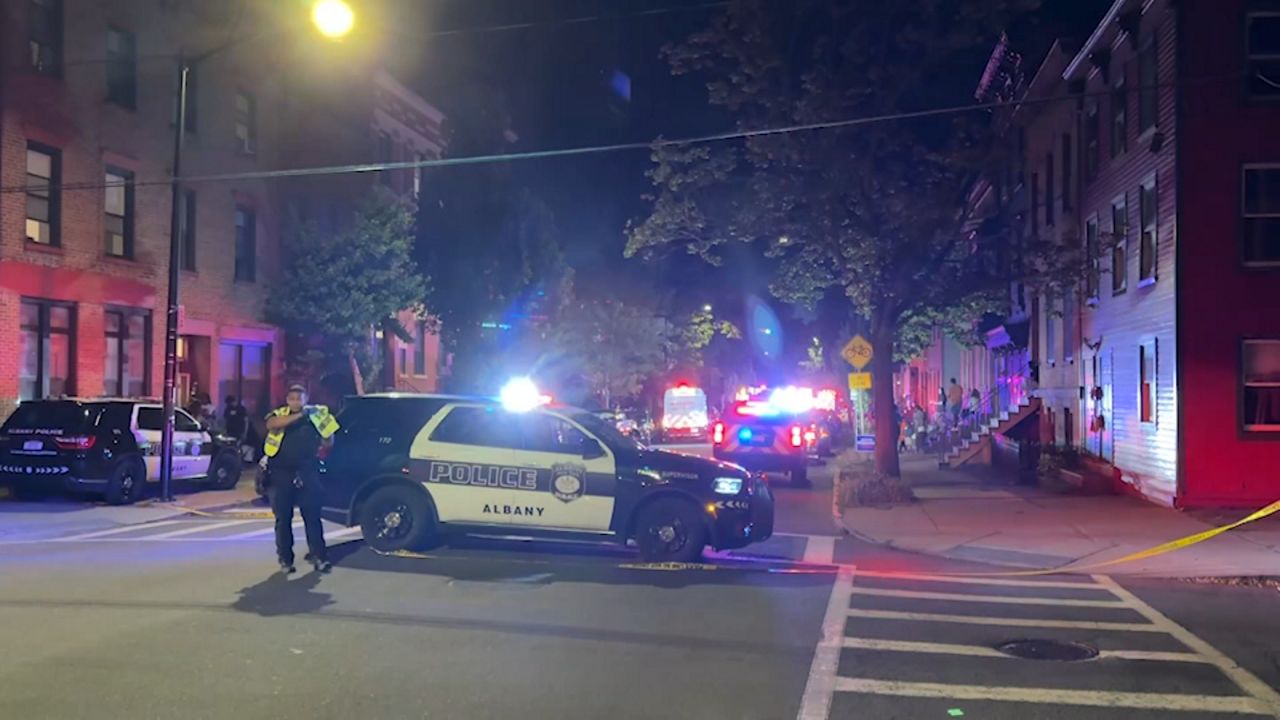
One year after a violent Fourth of July rocked Albany, an effort to address chronic absenteeism which lawmakers have linked to the involvement of youth offenders that day continues in the New York State Legislature.
On that deadly Fourth of July in the capital city, 10 people were shot, one was killed and a fire sparked by a flare gun destroyed two buildings in incidents involving youth offenders. A 15-year-old was charged with murder in the death of 17-year-old Vance Mims III, and several others who allegedly played a role were even younger.
While some pushed for changes to the state’s Raise the Age law, which deals with youthful offenders in the aftermath of the incident, others, including a coalition of Capital Region lawmakers, zeroed in on the ages of those involved. That say chronic absenteeism from school appeared to have played at least some role. Chronic absenteeism is defined by the State Education Department as a student missing 10% or more of the school year.
“As we began to deconstruct, we had heard that two of the shooters were very young, 12 years old. And two of them had been out of school for almost a year,” said state Sen. Pat Fahy.
Fahy told Spectrum News 1 that attendance in schools has not recovered in the aftermath of the COVID-19 pandemic, and the post-pandemic environment has made it more challenging to identify students who may need intervention.
While legislative efforts to address chronic absenteeism specifically stalled this session amid a hectic and late state budget process, lawmakers are working to recalibrate their effort to pass a package of legislation.
The State Education Department says 27% — or about one in four students — are chronically absent with higher levels in larger public city school districts, but Fahy explained that the available data lags by one year. One bill she carries would create a database to track absenteeism in real time, another sponsored by state Sen. James Skoufis would create review teams to address local issues.
A third also sponsored by Fahy would create pilot programs bringing together community resources to address individual cases, with a focus on intervention and, where necessary, involving law enforcement or child protective services.
“To really make sure we have regular dashboards of who is chronically absent and where there is much, much more than meets the eye,” Fahy said. “Often, this type of chronic absenteeism is an indication of something underway.”
Assemblymember John McDonald sponsors the pilot bill and explained that, in the meantime, school districts such as the city of Troy have undertaken similar initiatives on their own.
“They have been able to implement programs using their own resources where they’re not sending police into the streets to pull kids in to go to school,” he said.
Instead, as the bill would do, the program focuses on intervention and prevention.
“Trying to figure out where are we headed here, and what can we do to make sure this child isn’t headed down the wrong path,” he said.
Republican Assemblymember Michael Reilly told Spectrum News 1 that he appreciates the intent of the legislation, but he wants to see the state focus on adjusting Raise the Age to address issues involving 16- and 17-year-olds and for schools to place greater emphasis on discipline for younger students experiencing behavioral problems.
“You may have those restorative practices where you’re having those students involved in conflict resolution, but when they actually commit an infraction that requires a penalty, that’s where I think we’re lacking,” he said.
Fahy said addressing the issue is complicated and involves numerous stakeholders, but the effort will continue next session. With a fiscal impact of $150 million over two years, the proposal would likely have to be included as part of the state budget.
“There are so many pieces to this,” she said. “We were just looking at the data again. We need to peel back many layers.”