
by Michelle Mullen
Two months after announcing plans to demolish the Van Cortlandt Park Stadium, New York City Department of Parks and Recreation officials are continuing to map out what comes next.
In a follow-up meeting with Bronx Community Board 8’s Parks and Recreation Committee, the agency unveiled its first master plan for the stadium, using engineering studies, environmental testing and community feedback to guide the eventual redevelopment of the aging stadium site.
Parks department officials acknowledged that, despite identifying demolition as the only viable option, no funding has yet been secured to replace the nearly century-old structure.
Opened in 1939 as part of New York City’s Depression-era expansion of public parks, Van Cortlandt Park Stadium became one of the Bronx’s premier public athletic venues, serving as a space for the public and an anchor for high school and college athletics — soccer, track and field and baseball among them.
The board’s parks and recreation committee chair Deb Travis said she was relieved to finally hear what the city envisions beyond demolition.
“That last meeting was really the first time that the community found out about the condition of the stadium and kind of the intentions of the parks department,” Travis said, explaining why the committee invited officials back for a second presentation. “We asked the parks department to come back … to explain the rationale for why the stadium would need to be removed, and how they’re approaching the next phases of what will come next.”
The presentation offered the city’s most detailed explanation to date of why the stadium cannot be preserved, what investigators uncovered during months of testing and what could eventually replace it.
Marlisa Wise, an architect with the New York City Department of Parks and Recreation who helped oversee the master planning study, said the agency’s work unfolded in five phases, beginning with health and safety inspections before expanding into engineering investigations examining everything from stormwater management and structural integrity to soil conditions, topography and subsurface conditions. Engineers also collected samples from throughout the site for laboratory testing.
“We brought samples of all the materials into off-site labs, testing them for all kinds of contaminants,” Wise said. “Do we have lead? Do we have asbestos? Do we have chemicals in the soil that we should pull out and do something?”
Inspectors found asbestos, lead-based paint, mold and polychlorinated biphenyls, or PCBs — toxic industrial chemicals once commonly used in construction materials — throughout the building’s interior, along with contaminated soil beneath portions of the site. Officials emphasized that testing found no hazardous contamination on the building’s exterior, where the handball courts remain open and are still considered safe for public use.
The structural investigation proved equally revealing.
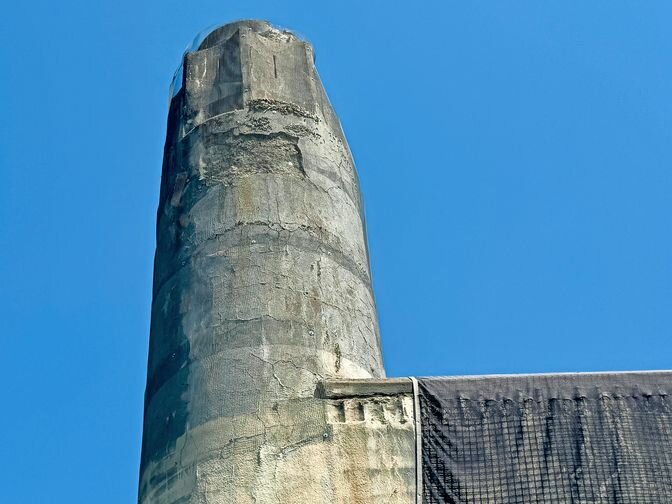
Historical research showed the stadium sits atop former marshland that was filled in as a landfill before construction. Unlike modern buildings that rely on deep foundation systems designed to stabilize structures built on soft ground, the existing stadium rests on a shallow foundation that continues to settle, greatly contributing to widespread cracking throughout the structure, according to the investigation.
“The existing stadium building has deteriorated beyond the point that it can be repaired and saved,” Wise said. “The shallow foundation will continue to subside and cause cracking throughout the structure.”
She added that deteriorating concrete, corroded reinforcing steel and decades-old mechanical, electrical and plumbing systems mean the building would require comprehensive replacement rather than repair. Engineers also found that the building’s original concrete mix allows water to penetrate the structure, accelerating deterioration through repeated freeze-thaw cycles and exposing rusting steel reinforcement beneath the surface.
The study also found that retaining the existing stadium would limit future improvements to the athletic complex. One option, Wise said, is relocating a new building closer to Broadway, which would create space to expand the adjacent playing fields to the National Collegiate Athletic Association’s dimensions while also improving accessibility and allow the site to better serve future recreational needs.
Instead of renovating the structure, the parks department studied two replacement concepts: a roughly 22,000-square-foot community building and a larger, approximately 44,000-square-foot recreation center that would include membership-based amenities such as gymnasiums, fitness facilities and locker rooms. Both concepts would preserve elements of the stadium’s historic character while incorporating modern building standards and improved accessibility.
The proposals were shaped by more than 1,000 responses collected through public meetings, on-site events and an online survey, according to the department. Residents consistently identified improved restrooms, lighting, seating and community gathering spaces among their highest priorities while stressing the importance of preserving the handball courts and the stadium’s identity. Others expressed interest in classrooms, multipurpose rooms and expanded programming that could serve neighborhood residents year-round.
For Travis, the discussion marked a shift from whether the stadium can be saved to what should replace it.
“What people weren’t getting from that first meeting was, ‘What do we get? What happens?’” she said.
While she said the presentation helped answer many lingering questions, Travis believes the planning process should not end there. She hopes the city will hold another round of community engagement before settling on a final design, allowing residents to react to the proposed concepts and offer feedback before funding is pursued.
“The best approach is for there to be a phase two to their public outreach,” Travis said. “The community should be able to see what they’re thinking.”
For now, Parks officials say structural engineers will continue monitoring the stadium while the agency advocates for capital funding to demolish and rebuild the facility. Until funding is secured, the department intends to keep the stadium’s courts and fields open for as long as they can be operated safely.
Keywords
Van Cortlandt Park Stadium,
Van Cortlandt Park,
NYC Parks,
New York City Department of Parks and Recreation,
Bronx Community Board 8,
Deb Travis,
Bronx,
stadium redevelopment