
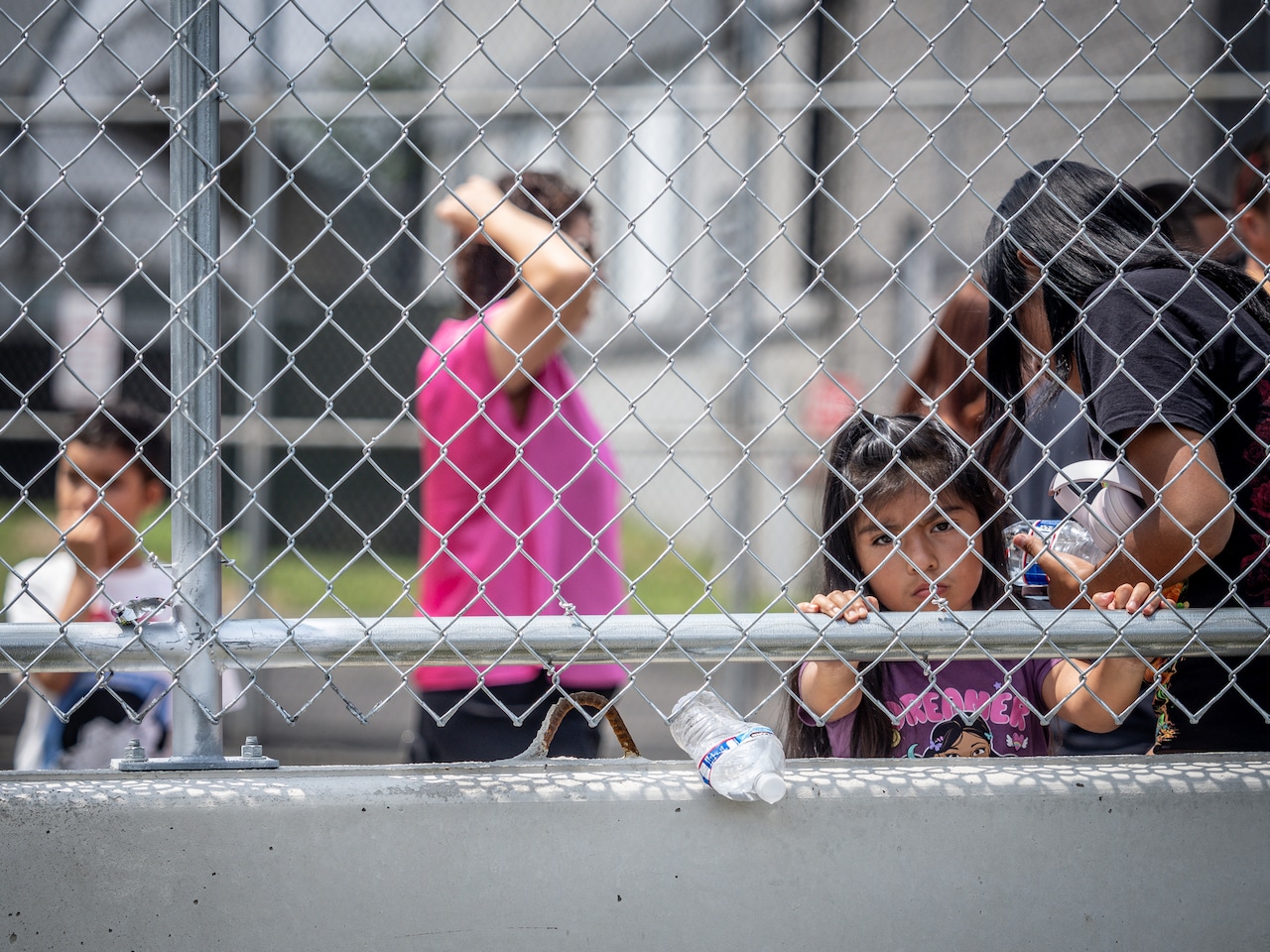
On May 25, Sen. Andy Kim was pepper-sprayed outside Delaney Hall in Newark by ICE agents who fired pepper balls into a crowd that included families and tackled and restrained peaceful protesters.
Delaney Hall is a 15-minute drive from my home. I was there and I witnessed it.
That day, Eyes on ICE New Jersey, a grassroots coalition providing legal resources and mutual aid to families of detainees, was hosting a children’s rally with snacks and music. There were toys, games, and sidewalk chalk. Two people dressed as Batman and Robin were playing guitar. Around 50 people were peacefully gathered in solidarity with the nearly 300 people on labor and hunger strike inside.
Suddenly multiple SUVs and an armed military-grade vehicle raced towards the driveway. I was handing out Capri Suns to children when the ICE agents jumped out, flicking their batons, pepper bullet guns drawn, faces covered in violation of Gov. Mikie Sherrill’s law banning them from wearing masks.
It was terrifying. But what happened to Kim and the other protesters is not the main travesty.
I’m a Latino man, born and raised in New Jersey, and a graduate of Rutgers, the State University of New Jersey. Since January, I have been volunteering at Delaney Hall alongside Eyes on ICE NJ. While I do not have personal experience navigating the immigration process, I show up because the people inside are my neighbors and community members — something that can get lost when the story becomes about what’s happening outside the gates.
Delaney Hall has held up to 1,000 people and currently detains nearly 600. According to government data, the vast majority have no criminal history — a fact that directly contradicts the Trump administration’s justification for mass detention.
Before the strike began on May 22, detainees had already written multiple open letters, signed by nearly 300 people and describing their treatment as “torturous.” Their demands were clear and specific: an in-person meeting with Sherrill at Delaney Hall, the immediate release of medically vulnerable detainees including elderly people, pregnant women, and those with serious medical conditions, meaningful review of immigration cases and habeas filings, and an end to coercive pressure to sign deportation or voluntary departure documents.
Some progress was made. Sherrill attempted to visit but was denied entry. Following sustained pressure, Ariadna Zumba, an 18-year-old high school senior from Orange, who missed her graduation and prom while detained, was released in early June. So was Emanuel Rodrigues, a Brazilian man with a rare life-threatening condition who spent 130 days in solitary confinement and was denied the crutches and wheelchair he needed.
This week the strike ended — not because conditions improved, but because ICE and GEO Group, the private for-profit company operating Delaney Hall under a 15-year, $1 billion contract, used intimidation, segregation and punitive transfers to break it.
The demands remain unmet, and new strikes have begun. Nearly 40 women detained in unit 1 announced on June 11 that they were going on strike, adding new demands including the firing of a guard accused of sexually assaulting at least 10 women inside.
These people are not abstractions. They are parents, siblings and community members with deep roots in New Jersey. In February, I met a father in Delaney Hall who came from Honduras seeking asylum. He was working, contributing to the local economy, and supporting his family. He was walking to the bus after work when masked ICE agents who did not identify themselves grabbed him, pinned him to the ground, and threw him into their car. He had missed a court date because of his job. While detained, he was forced to sign papers that were never translated.
This month, a mother and wife called me after she and her two children were turned away from a visitation appointment. A security officer implied she couldn’t visit her husband because of her family’s involvement with the protests outside.
Eyes on ICE NJ has documented a pattern of escalating enforcement actions since the strikes began: canceled visitation hours, family members prevented from contacting their loved ones inside, punitive transfers between units, and unit wide interventions designed to break the strikes and punish those who participate. ICE and GEO Group have even brought multiple units to meals simultaneously to create the illusion that no hunger strike is occurring.
GEO Group’s contract was signed by President Trump despite the objections of New Jersey state lawmakers, who in 2021 passed a law banning private immigration detention facilities in New Jersey. Federal courts struck it down two years later, paving the way for GEO Group to open Delaney Hall.
The contract is federal, but the consequences belong to all New Jerseyans: the families denied visitation, the fathers being coerced into signing documents they cannot read and the hunger strikers being punished for speaking up. These are our neighbors and community members.
New Jersey residents have already shown that pressure against such actions works. When community organizations, local residents, family members, and elected officials (including Representatives LaMonica McIver, Rob Menendez, and Analilia Mejia, who conducted an unannounced visit to Delaney Hall on May 18), demanded accountability, Sherrill listened.
In June Sherrill announced a $12 million increase in funding for the legal defense of detained immigrants, bringing total funding for the Detention Deportation Defense Initiative, a state program providing free legal representation to low-income New Jersey residents facing deportation, to $20.2 million.
New Jersey’s attorney general has also sued GEO Group for blocking state health inspectors from accessing the facility amid reports of worm-riddled food, inadequate medical care and the spread of communicable diseases.
New Jersey residents must demand that elected officials continue to hold GEO Group accountable and pressure DHS to meet the hunger strikers’ demands. Earlier in the strike, Menendez spent 14 hours at Delaney Hall because he knew his constituents cared. Elected officials show up when they know people are watching.
These detainees are your neighbors. Each one deserves due process and basic human dignity.
Jorge Alvarez is a mental health advocate, social impact strategist, and a Public Voices Fellow with The OpEd Project & Hopelab.