
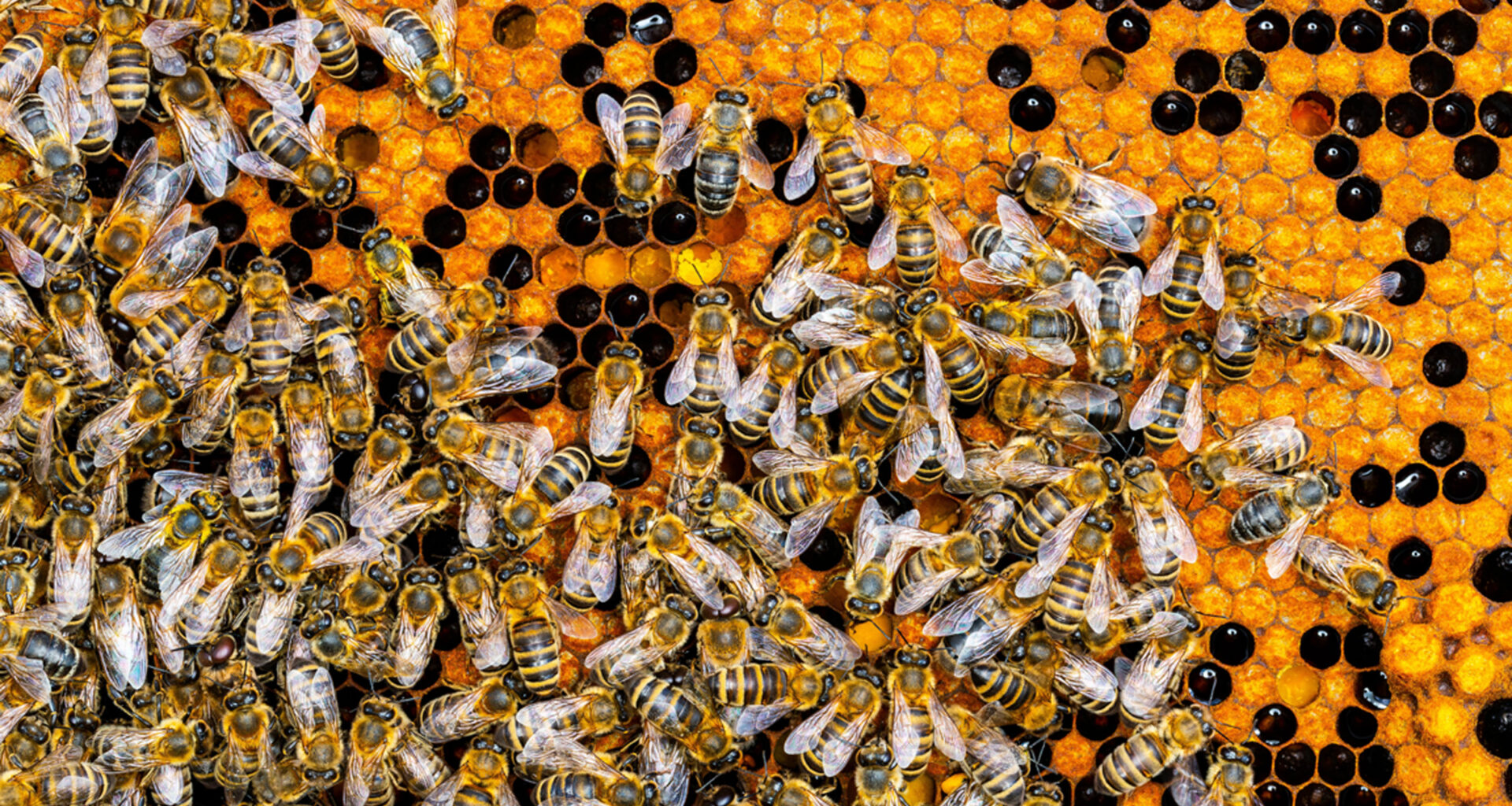
A honeybee hive can look like one of the most orderly places in nature. Thousands of workers move in tight coordination, feeding each other, tending the young, and guarding a single queen at the center of it all.
That order hides a task that most people never notice. As bees bring food home from the fields, they are also carrying back whatever pesticides cling to it, and the colony has to deal with that poison somehow.

New research now shows how far a hive will go to manage that threat, and what happens when its usual defenses run out of room.
Tracking hive pesticides
Researchers at the University of California, Davis (UC Davis) wanted to know exactly where those chemicals go once they enter a hive.
The work was led there and carried out in collaboration with researchers from the Lawrence Livermore National Laboratory (LLNL) and the U.S. Department of Agriculture’s Agricultural Research Service (USDA-ARS).
Most bee toxicology has centered on worker bees alone. This project tracked a single pesticide through the whole bee colony instead, following it into the queen, her ovaries, her eggs, and the wax.
Worker bees filter pesticides
For a long time the assumption was simple. Workers were thought to shield the queen by filtering contamination out of the food they hand her.
To test this, the team built tiny artificial hives they called nanocolonies. Each held one queen and about 60 workers that were fed food laced with the pesticide methyl parathion.
The pesticide carried a faint radioactive tag, which let the researchers trace it in astonishingly small amounts. That tracing relied on a tool named BioAMS.
“With BioAMS, we can trace very low levels of a pesticide,” said Bruce Buchholz, an LLNL scientist and author on the paper.
Early on, the workers did their job well. In the first day they stripped out about 95% of the pesticide from the food before it reached the comb.
The filter starts failing
Young worker bees carry a strong set of enzymes they normally use to process nectar and make royal jelly. Those same tools can break down part of the pesticide before it spreads any further.
But the filter began to slip. By day 10 the workers were removing only 86% of the poison, and it started to build up in the food stored in the cells.
The bees’ bodies told the same story. Over 10 days, workers took on 55 times more pesticide than the queen did.
That decline matters more than it might sound. Chronic, low-level exposure may end up doing more damage than a single, large dose, because it slowly wears down the colony‘s ability to clean itself.
Protecting the queen bee
Through most of this the queen looked remarkably protected. Her body carried far less pesticide than the worker bees around her. This was helped by her diet of royal jelly, which had already been processed and filtered.
The shield was not perfect, though. As the days passed, contamination crept into the queen as well.
“In our study, pesticides began to accumulate in queens over time, suggesting that worker filtration capacity can be overwhelmed,” said Angela Encerrado-Manriquez, the lead author and a recent Ph.D. graduate from UC Davis.
“When this happens, queens have their own defense. Maternal offloading allows them to shunt the toxic burden to their eggs.”
Queen bees offload pesticides
That last move is the heart of the finding. When her own body starts to load up, the queen pushes the chemicals into her eggs.
“In order to protect herself, the queen bee offloads these chemicals into her eggs to get rid of them,” said Sascha Nicklisch, the paper’s senior author and an associate professor in the Department of Environmental Toxicology.
“No one has shown this in honeybees before.”
The numbers back him up. By day 10 the eggs held between 81 and 141 ppb of pesticide, several times more than the queen’s own body.
Queens that laid more eggs spread the burden thinner, so each egg carried less. It looked less like passive leaking and more like a deliberate transfer.
In fact, the eggs were gathering the pesticide faster than the queen’s body was. That points to something concentrating it there on purpose, rather than by accident.
A costly last resort
There is a hard trade-off buried in all of this. The queen survives by handing her poison to the most vulnerable members of the colony.
Young larvae have not yet built the defenses that adults use to break down toxins. Eggs loaded with pesticide may fail to develop, and those losses cut straight into the colony’s future.
In a hive this problem is bigger than it would be for a solitary insect. Only the queen lays eggs, so she cannot be replaced the way a lost worker can.
“The queen is the only member of the hive who can lay eggs that become the next generation of workers,” Nicklisch said.
“She keeps the colony alive, so understanding how pesticides can affect queen bees and also her offspring is important.”
Honeybees pollinate roughly one-third of the world’s food crops, and a healthy queen can lay 1,500 to 2,000 eggs a day. When her brood suffers, farms and food supplies feel it too.
A slow, hidden collapse
Perhaps the most unsettling idea here is about timing. The damage may not appear when the pesticide first arrives, but only months later, after the colony has already spent its defenses.
“When pesticides accumulate to the extent that the queen bee has eggs that are so loaded they may no longer develop properly, there could be a tipping point,” Nicklisch explained.
“There may be a slow, creeping effect of chemical accumulation that will contribute to delayed colony collapse.”
For beekeepers and growers, that points to a practical lesson. Watching pesticide exposure during foraging and colony growth may matter far more than any single day’s dose would suggest.
The study is published in the journal Current Biology.
—–
Like what you read? Subscribe to our newsletter for engaging articles, exclusive content, and the latest updates.
Check us out on EarthSnap, a free app brought to you by Eric Ralls and Earth.com.
—–