
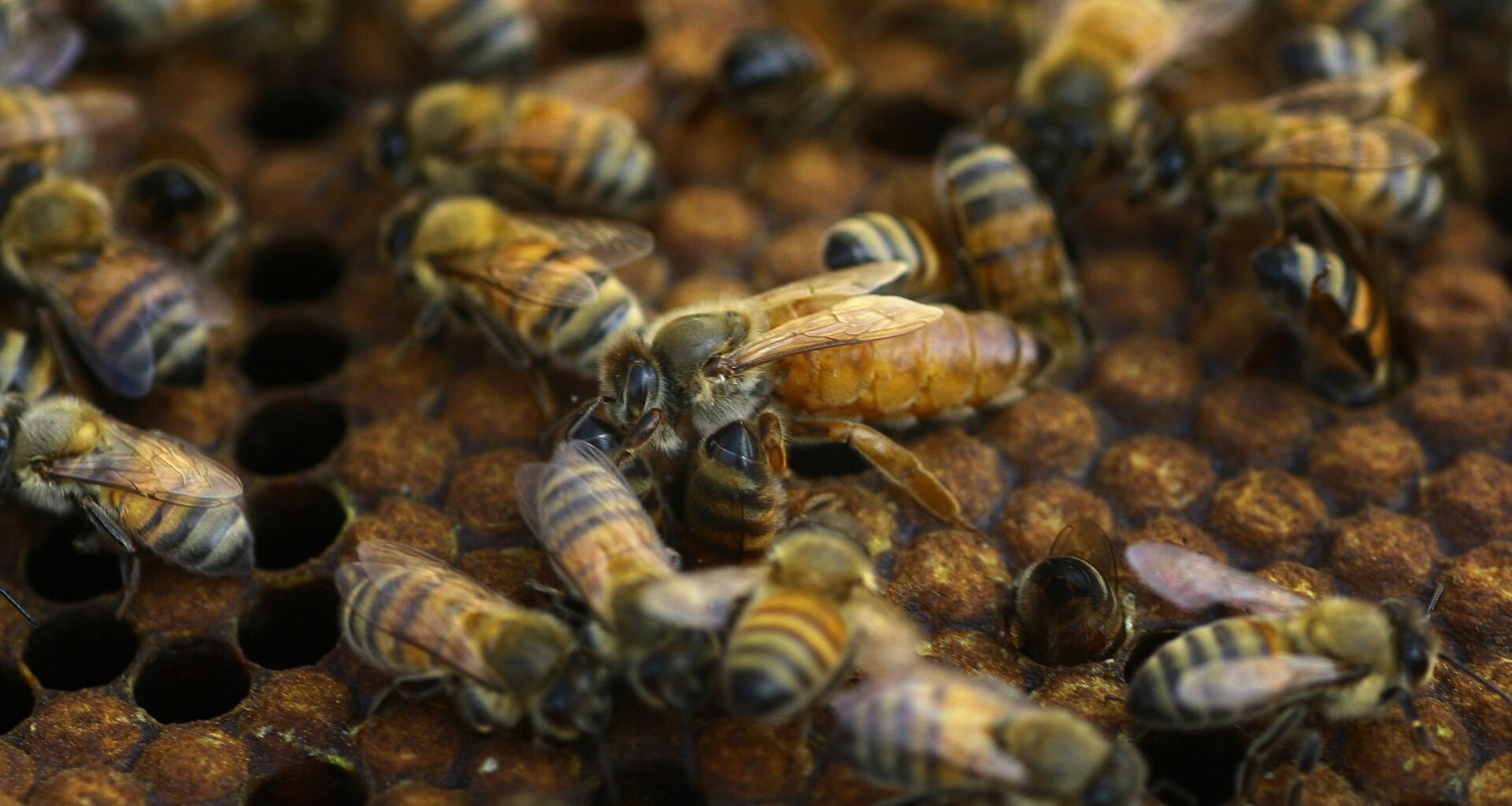
Against the backdrop of the worst recorded US honeybee colony loss in modern history — more than half of all managed colonies destroyed in a single year — a new peer-reviewed study has uncovered a biological mechanism that may help explain why some colonies seem to recover from pesticide exposure before silently falling apart months later. Led by UC Davis researchers and published in Current Biology, the finding adds a critical piece to the puzzle of delayed colony failure. When the workers that normally filter toxins from a hive’s food supply are overwhelmed by chronic, low-level pesticide exposure, a queen bee does not simply absorb the overflow. She actively moves it — concentrating toxic compounds into her own developing eggs at levels several times higher than found in her own body, a process researchers are calling maternal offloading. The finding, published July 2 in Current Biology, is the first direct documentation of this phenomenon in honeybees, and it arrives at a moment when America’s $10 billion beekeeping industry is fighting for its survival.
Worker Bees Run a Toxin Filter That Quietly Fails Over Time
Inside a functioning honeybee colony, a caste of young workers performs a job that has no obvious name: they process incoming food before it reaches the queen, stripping or neutralizing contaminants along the way. The mechanism relies on enzymes these young bees carry at high concentrations — the same biochemical toolkit used to produce royal jelly and process nectar, which can partially neutralize certain pesticide compounds. The result is a queen who appears insulated from her chemical environment even as the workers around her accumulate a substantial toxic burden.
To measure exactly how well this insulation holds, a team from the University of California, Davis, working with colleagues at Lawrence Livermore National Laboratory (LLNL) and the US Department of Agriculture’s Agricultural Research Service, built miniature artificial hives they called nanocolonies. Each consisted of a conical plastic container with a netted bottom, a single queen, and approximately 60 worker bees. The bees were fed food laced with methyl parathion — an organophosphate pesticide tagged with a low-level radioactive carbon-14 marker — at concentrations designed to match what foraging bees encounter in real agricultural environments.
That radioactive tag was the key to the experiment. Tracking pesticide movement through a living colony normally requires concentrations far above real-world exposure levels, because conventional methods cannot detect smaller quantities. The team at LLNL had access to a different instrument: BioAMS, short for biological accelerator mass spectrometry.
How Atomic-Level Detection Unlocked a Previously Invisible Mechanism
BioAMS is the biomedical offshoot of accelerator mass spectrometry, the technology most widely known for radiocarbon dating of archaeological artifacts. Standard mass spectrometry separates atoms by weight but cannot distinguish between isotopes whose masses are nearly identical. AMS solves this by accelerating ions to millions of electron volts — energies high enough to destroy molecular isobars entirely, leaving only the target isotope. The result is a 10^6-fold sensitivity improvement over conventional liquid scintillation counting, enabling detection of labeled molecules at attomole concentrations (10^-18 moles) in biological tissue.
At LLNL’s Center for Accelerator Mass Spectrometry, this technique has been used for decades in pharmaceutical pharmacokinetics. Applying it to honeybee toxicology allowed the team to use doses that were genuinely sublethal and environmentally realistic, rather than the elevated doses that older methods require. “With BioAMS, we can trace very low levels of a pesticide,” said Bruce Buchholz, an LLNL scientist and author on the paper.
On the first day of exposure, the worker bees performed impressively. They removed approximately 95% of the pesticide from the food supply before it could reach the queen or enter the comb — a filtration rate that left the queen with a fraction of the burden borne by the workers surrounding her. Over ten days, workers accumulated roughly 55 times more pesticide than the queen did. That disparity is itself a striking testament to the colony’s self-sacrificial social architecture.
But the filtration rate did not hold. By day 10, it had declined to 86%. The drop sounds modest; its consequences were not.
When Worker Filtration Erodes, Eggs Become the Queen’s Exit Strategy
As the filtration efficiency fell and pesticide began accumulating in the queen’s body, the researchers documented something that had not been observed before in honeybees. Rather than simply absorbing the pesticide into her tissues over time, the queen was concentrating it into her developing eggs.
By day 10, the eggs contained between 81 and 141 parts per billion (ppb) of methyl parathion — several times the concentration measured in the queen’s own body. That disparity rules out passive diffusion as the mechanism. If the transfer were driven only by chemical equilibrium, the egg concentration would be bounded by the queen’s body concentration, not consistently above it. The rate at which pesticide was accumulating in the eggs also exceeded the rate of buildup in the queen — a kinetic signature more consistent with active biological export than with passive equilibration.
“When pesticides accumulate to the extent that the queen bee has eggs that are so loaded they may no longer develop properly, there could be a tipping point,” said Sascha Nicklisch, the paper’s senior author and an associate professor in the UC Davis Department of Environmental Toxicology. “There may be a slow, creeping effect of chemical accumulation that will contribute to delayed colony collapse.”
The probable molecular pathway is the same one the queen normally uses to nourish her eggs. Vitellogenin — a yolk protein — ferries lipid-bound compounds from the queen’s fat body into developing oocytes during oogenesis. Organophosphate pesticides, which are lipid-soluble, can travel this route. Whether the queen’s biology has a mechanism to actively concentrate toxins via this pathway — or whether the elevated egg concentrations result from particularly efficient passive lipid partitioning — is a question the authors flag for future investigation.
Queens that laid more eggs during the exposure period distributed the pesticide burden across a larger number of embryos, reducing the per-egg concentration. The inverse relationship between clutch size and per-egg pesticide load suggests that a queen’s reproductive output itself may function as a variable in toxin management — a finding that adds another layer of complexity to how colony fecundity interacts with environmental contamination.
“No one has shown this in honeybees before,” Nicklisch said.
What the Eggs Cannot Do That Worker Bees Can
The survival logic behind maternal offloading is straightforward: the queen is the colony’s sole source of fertilized eggs. Her death ends the colony. An evolutionary mechanism that keeps her body below the pesticide threshold for reproductive failure — even at the cost of loading some eggs with toxins — may preserve colony survival over a longer time horizon than the alternative.
But the trade-off carries its own cost, and it falls on the embryos. Young larvae and developing embryos do not carry the enzymatic defenses that adult worker bees use to process and excrete toxins. An egg loaded with pesticide at concentrations several times higher than the queen’s own body may fail to develop, may produce a non-viable worker, or may produce a worker with compromised enzymatic capacity — compounding the colony’s filtration problem one generation later.
“The queen is the only member of the hive who can lay eggs that become the next generation of workers,” Nicklisch said. “She keeps the colony alive, so understanding how pesticides can affect queen bees and also her offspring is important.”
“In our study, pesticides began to accumulate in queens over time, suggesting that worker filtration capacity can be overwhelmed,” said Angela Encerrado-Manriquez, the study’s lead author and a recent PhD graduate from UC Davis. “When this happens, queens have their own defense. Maternal offloading allows them to shunt the toxic burden to their eggs.”
Delayed Colony Collapse: Why Post-Mortem Analysis May Be Missing the Real Cause
The most significant implication of the maternal offloading finding is temporal: the mechanism produces damage that does not appear at the moment of pesticide exposure. If a colony’s workers were chronically exposed during a high-pesticide period, the queen’s eggs during that period would absorb the accumulated burden. Those eggs would hatch into worker bees weeks later. If those workers were nonviable or compromised, the colony’s workforce would decline — but by the time that decline became visible, the original pesticide exposure event might be a month or more in the past.
This timing gap creates a systematic problem for conventional toxicological post-mortem analysis. Investigators who sample dead or dying adult workers for pesticide residues are looking at the endpoint of the colony’s failure, not its origin. If the true causal event was a period of filtration erosion followed by brood-stage pesticide loading weeks earlier, that signal would be absent from the adult bees that ultimately expired. Conventional methods would clear pesticides as a proximate cause — accurately, in a narrow technical sense — while missing the mechanism that set the collapse in motion.
The 2024–25 US beekeeping season recorded its worst colony losses since systematic tracking began in 2010: commercial beekeepers lost an average of 62% of their colonies — roughly 1.6 million colonies — representing more than $600 million in direct economic damage and lost pollination income, according to the Honey Bee Health Coalition. USDA Agricultural Research Service is currently conducting a four-tiered investigation into causation, including pesticide residue analysis of stored pollen, wax, and bee samples. The maternal offloading mechanism documented by the UC Davis team is exactly the kind of sublethal, temporally displaced effect that standard residue analysis in adult bees would be unlikely to capture.
Honeybees pollinate approximately one-third of global food crops. A healthy queen lays 1,500 to 2,000 eggs per day; the colony’s agricultural value depends entirely on sustaining that output. When brood viability falls — even weeks after the chemical exposure that caused it — the damage ultimately flows outward into food security, pollination services, and farm economics.
Limitations and What the Study Does Not Yet Prove
Two constraints on the study’s direct applicability deserve explicit attention.
First, the model compound. Methyl parathion is an organophosphate whose US agricultural registrations were cancelled by the EPA in 2003; it is no longer in common field use in this country. It was selected for this experiment not as a representative of current pesticide practice but because its properties make it tractable for radiotracer research — it is well-characterized, it behaves predictably in biological systems, and it can be safely labeled with carbon-14 at sub-lethal doses. The maternal offloading mechanism the study documents is plausibly applicable to other lipid-soluble pesticides, including neonicotinoids and pyrethroids that are still widely used in agriculture. But that applicability has not yet been demonstrated. The study establishes that the mechanism exists and can be detected; it does not establish that it is occurring at scale under current field conditions with currently registered compounds.
Second, the experimental system. Nanocolonies — single queens and 60 workers in a controlled container — replicate the core social dynamics of a hive but not its full complexity. A real colony at peak production season includes thousands of workers in multiple age cohorts, active foraging, Varroa mite pressure, nutritional variation, and temperature regulation. Whether the filtration dynamics and offloading rates documented in nanocolonies scale to full-colony conditions remains to be tested.
What the study definitively contributes is a methodology and a mechanism. BioAMS-based radiotracer research can now be applied to any pesticide of interest at environmentally relevant concentrations, in a multi-compartment colony model that includes the queen, her eggs, the wax, and worker bees across a time series. That is a tool that did not previously exist at this level of sensitivity. The authors identify the next logical steps: testing with neonicotinoids and pyrethroids; running longer exposure periods; and tracking whether brood produced during pesticide exposure periods shows measurable viability deficits.
What This Means for Beekeepers and Growers Now
While the mechanistic research extends forward, the current findings carry immediate practical implications for integrated pest management.
Pesticide application timing matters more than any single acute exposure would suggest. A period of sustained, low-level contamination — the kind that results from systemic pesticide residues in flowering crops over an entire bloom — erodes worker filtration capacity gradually. It is precisely the kind of exposure that beekeepers and farmers rarely track or correlate with colony health outcomes weeks later.
Brood-stage monitoring — examining the viability of eggs and young larvae rather than counting adult bee losses — may detect pesticide-related damage closer to its source than conventional apiary inspection. The study’s authors specifically flag pesticide application timing during peak foraging seasons and periods of rapid colony growth as areas deserving closer scrutiny.
The research represented a convergence of three institutional capabilities: UC Davis provided pollinator biology expertise and experimental design; USDA-ARS contributed specialized knowledge of honeybee colony dynamics and study design; and LLNL supplied the atomic-level detection infrastructure that made sub-lethal radiotracer tracking possible. Testing that infrastructure against the pesticides that beekeepers and farmers actually use today is the work ahead.
Frequently Asked QuestionsHow do pesticides normally reach the queen bee in a hive?
Queens are fed royal jelly — a glandular secretion produced by young workers — and do not forage in agricultural landscapes. Pesticides enter via food that workers bring into the colony. Under normal conditions, those same workers filter the contaminated food before it reaches the queen, using enzymes that can partially detoxify certain compounds. Studies have detected pesticide residues in royal jelly, indicating the filter is imperfect even under baseline conditions; the current research documents what happens when chronic exposure pushes filtration efficiency past its limit.
What is maternal offloading, and why does it happen?
Maternal offloading is the process by which a queen bee under pesticide pressure actively transfers toxic compounds from her own body into her developing eggs at concentrations higher than those found in her own tissues. The most likely pathway is vitellogenin, the yolk protein that normally carries nutrients into developing oocytes — a route that lipid-soluble pesticides can apparently exploit or co-opt. The evolutionary logic is that the queen’s survival takes priority over any individual clutch of eggs, because only the queen can produce the workers the colony needs to survive.
Could this mechanism explain colony collapse disorder in real bee populations?
It may help explain a specific class of collapse: cases where a colony declines weeks or months after a pesticide exposure event, in a pattern that leaves no clear residue signature in adult bees at the time of death. Standard post-mortem analysis looks for pesticides in expired workers; if the actual damage happened at the egg and brood stage weeks earlier, that analysis would produce a false negative. The current study used methyl parathion — a compound banned from US agriculture since 2003 — as a model compound. Whether the same mechanism operates with the neonicotinoids and pyrethroids most commonly implicated in modern colony health problems has not yet been tested and is the research team’s next priority.
What can beekeepers do with this information now?
The study suggests that chronic low-level exposure during high-brood periods may be more damaging than a single acute pesticide event. Beekeepers can consider shifting apiary monitoring to include brood-stage viability assessments — not just counting adult bee losses — and work with growers to track pesticide application schedules around peak colony growth periods. Communication between commercial beekeeping operations and the farmers whose land they service during bloom remains the most actionable near-term protection against the kind of sustained, low-level filtration erosion this study documents.